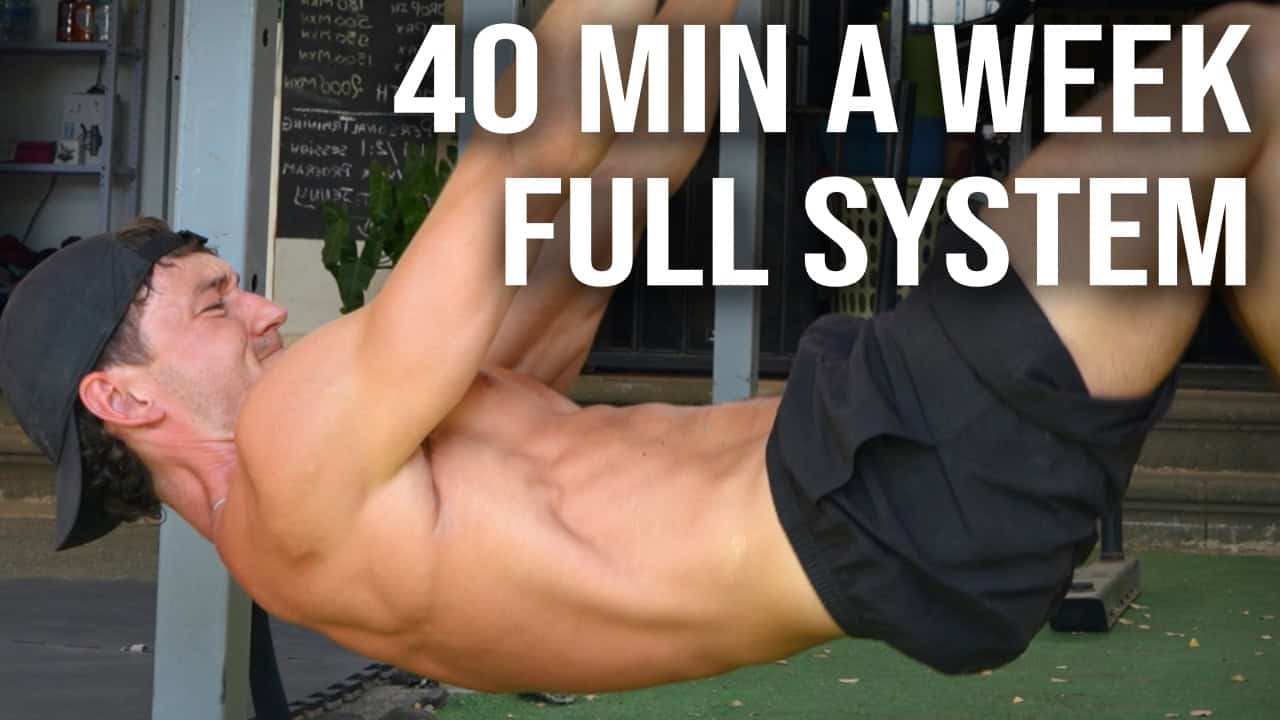
In this video we talk about the routine I used to reach my goal strength, flexibility and physique by training in my backyard for 40 minutes a week. Here’s what we cover:
- The strength training routine I used to efficiently build muscle mass and a wide range bodyweight strength skills using just six basic exercises
- How I integrated mobility into my training to easily unlock and maintain access to large ranges of motion without spending hours on it
- The simple nutrition steps I followed to fuel muscle growth, optimise health, and easily maintain low body fat year-round
- What I focused on with cardio and recovery
Full transcript
40 minutes a week. What if I told you that was all you needed? The internet makes it seem like unless you’re treating fitness like a part-time job, there’s no point in even trying. But unless you want to become a pro bodybuilder, an Olympic gymnast, or an elite triathlete, do you really need to be training like one? When I realised how simple fitness could be, I ended up hitting all my strength, flexibility, and physique goals by training in my backyard for well under an hour a week. And today I want to show you the entire system I used to do that. Just to be clear, if you want to achieve world-class fitness in any specific area, this isn’t for you. But if you want to achieve the large majority of results in a fraction of the time, then my hope is that this system will change your life as it did mine.
The first goal and the central pillar to this system is getting you really strong. Not specific strength, but general full body strength that is going to give you a really solid base of muscle mass and the ability to then go and easily learn the full spectrum of body weight skills. The beauty of that approach is that it does not take much. We just have six basic movement patterns that we need to train and get really strong in. So I have a really high level strength goal for each of these six movement patterns, the north star to build towards over time. So for horizontal pushing, it’s plange pushups. For horizontal pulling, it’s front labour rows. For vertical pushing, it’s handstand pushups. For vertical pulling, it’s one arm chin ups. For squatting, it’s a single leg squat with 75% of my body weight on my back. And for knee flexion, reverse squatting, it’s a nautic curl.
So the point of each of these end goals is that they’re extremely hard and you don’t even have to ever get there. The point is that they’re really hard because it means you have something to keep on progressing towards. You see in my physique, I can’t even nail any of these movements with strict form because to do that, they not only all require a high amount of raw strength, but also really good technique. But we can use them as a tool to build the raw strength and muscle mass that we want in very little time. You reach a high enough level on your progression towards these goals, and then if you want to dial in your form and learn something like a handstand or a muscle up or later on moves like handstand pushups and front lip is like I am, you can do some skill practise for that to your heart’s content and apply the strength that you’ve built.
That can take a lot more time, a lot more frequency, a lot more practise. But building the raw strength and muscle, getting the physique, getting the functional capacity to go and apply to your sports or playing with your kids, whatever it is, that progress can be made in minutes per week as I’ll show you. So with almost zero practise, I unlock things like back levers, human flags, bent arm planches. But as I said, even without learning those skills, just continuing to progress your raw strength towards these end goals forces your body to build lean muscle mass in proportion and progressing to these high levels also demands a lean body composition. We’ll come back to that. Now the point isn’t to use those movements as you’re training because if you’re trying to do that, you’d never be able to train. Each of these movement patterns can be scaled from absolute zero up towards these end goals.
I have students who are in their 60s coming up injury doing this at a level that works for them. I also have students in their 20s and 30s doing stuff more like what you see me doing. The point is training the movement pattern at a level that is challenging for you with the goal of progressing it towards the end level movement over time. So in terms of programming, there are many ways to skin a cap. The single most important key to success with this, like with any strength training programme is progressive overload. So however you approach training, as long as you are continually able to move a heavier load over time, which in this case looks like doing slightly harder variations of the movement pattern, which more and more resembles the end goal movement, then you are making progress. And that is all this comes down to.
If you’re doing that, you’re getting stronger and you are building muscle tissue. How I have approached this over the last six years has been very simple. One set per each of these six movements per week. So I split it into three workouts, each with two movements, training opposing muscles. So my horizontal pushing and pulling together, my knee flexion and extension movement’s another day, vertical pushing and pulling on the third day. Monday, Wednesday, Friday, Monday, Tuesday, Thursday, something like that. And all I try to do when I train is to do a slightly harder version of each of those movements than I did the week before. So I’m always scaling up to my limit, pushing as hard as I can with that simple goal of trying to be stronger than I ever have been in the past. So that ends up being one set of a couple minutes max per week per movement.
You do two movements together three times a week, including setting up the rings and resting in between sets. That whole workout ends up being 10, 15 minutes and you do three of those a week. Now that is really low volume training. If you want to progress faster, yes, you can do more sets. You can increase the frequency, and I’ve been experimenting with those sorts of changes recently. But the more you try to do that, the more you try to optimise and add more work in, the more careful you need to be about managing fatigue. And this is something that takes a lot more nuance, a lot more understanding of your body and good programming to get right. And most people are just so far off ever training intensely enough in the first place that adding more work in is completely missing the point. You are much better off training each movement once a week.
And when you do, absolutely going for it and giving yourself a full week off to just rest and recover and make sure you are ready to go again by the time you come back to that movement. You’re so much better off doing that than trying to do loads of sets, loads of workouts each week, and never actually pushing up your strength. So you can see the results that I have gotten by just doing that one set a week. The basics work. If you are new to this, if you are not making progress, that is all you need. 40 minutes a week, much less than that if you’re just counting actual training time, make every second of it count. Try and be stronger every time you train. Get one step closer to these six strength goals and you’ll be getting everything you could want from your strength training.
If you want a summary of those movements, the end goals, and their progressions, you can download my complete guide on all six for free using the link in the description. So that’s strength. The second goal of the system is to free up your stiffness, eliminate soreness and tightness, and get you moving through full range of motion uninhibited. What so many people don’t realise when they try to achieve better flexibility mobility is that the large majority of their problem is just coming from a lack of strength, specifically a lack of strength in certain end ranges of motion. So all we want to do is make sure that you are training your six basic movement patterns through their entire range of motion. If you have any mobility deficits stopping you doing that in the meantime, for example, a lot of people that I work with come in with limited range of motion in their ankle, which stops them from being able to do a pistol squat.
Even if they have the strength to do it, they try to squat down and fall straight backwards. If there are limits like that, then we want to target them specifically. Work a modified version of the movement in the meantime, like elevating your heel for your single leg squat training. And then as soon as you have the range of motion to do the full movement properly, your strength training then maintains it from then on because you’re working through that full range of motion under load, you’re only going to get better and better at your mobility as you get stronger. And that’s why range of motion standards are such a thing I focus on with my students because the most likely case scenario is you do not need any extra specific mobility work. You just need to train properly and then suddenly your shoulders are going to open up completely and feel loose.
Your hips, your posterior chain, your ankles are all going to feel free and strong and mobile. And the amazing thing about that is it doesn’t take any extra work. You just make sure that every rep you do in your 40 minutes a week is taking you through that entire range of motion. Then if you have specific flexibility goals, for instance, you want to do handstand presses, you need a certain amount of flexibility in your pancake position or your pique position. And so that’s when you can add in some specific loaded stretching work to train strengthen those end ranges of motion and unlock more extreme flexibility. That’s something that’s completely goal dependent. You don’t need to ever be able to put your head on your shins like this to have a strong pain-free posterior chain. But if you want to be able to do a pique press, for instance, spending a couple of months strengthening that end range specifically, we’ll unlock that range for you.
And again, as long as you’re strong enough, mobility doesn’t take very long to open up at all. You just train your nervous system to know that you were strong there and then you’re good. Again, unlock range that you’re going to use and then you don’t have to do any extra work to maintain it because it will be integrated into your strength training, into your skills practise or whatever you’re doing if you’re doing handstand presses. But the principle with that is train under load, use decent amounts of weight, like 20 kilos, 45 pounds, or your body weight. Train it for reps just like you would do normal strength training and do it after your strength sessions when you’re warmed up. I’ve got lots of videos going through examples of that. Again, completely goal dependent, but that is the principle. So you can treat any specific flexibility work like a bolt onto your main strength sessions that you’re only going to keep around as long as it takes you to get to your goal range of motion, and then you can drop it, keep it in your back pocket for when you’re feeling stiff or want to quickly open up that range again in the future.
That’s flexibility, probably the quickest and easiest part of this whole process. Also my least favourite, which is why I’m such a big proponent for, get it done and forget about it or integrate it into your training so you don’t have to worry about it in the first place. Okay, nutrition. There are three goals we have with our diet. The first is to support our training performance and recovery so that we get as much out of those sessions as we can. The second is to nourish our bodies so that we’ve support health, longevity, energy, optimal functioning. And the third is to get us down to a lean body composition that we can sustain because that is also good for our health. It also maximises our relative strength, meaning we have less dead weight that we’re trying to move when we’re learning body weight skills and we look good.
If you’re putting all this work into building a better functioning body, you also want to love what you say in the mirror. So there are three parts to this. The first is just hitting a protein target, 1.8 grammes per kilogramme of gold body weight per day. Figure that out. It’s the only number you’ll ever need again for protein. That just means my body has all the protein it needs for muscle building so we can recover and grow as fast as possible. It’s also going to kill off excess appetite, making it way easy to be lean and we’re just going to be satisfied and feel good. It doesn’t matter when you get this in. So I usually just have one meal a day where I load up a hundred grammes or more and then I don’t have to worry about it for the rest of the day.
You’re going to get basically all your nutrition done for one good meal each day, meaning you don’t have to have this perfect diet or be a saint. You just have to be organised enough to eat a decent lunch and then you’re set. Once you’re hitting protein, the next principle is we just want to get a large dose of nutrients. So again, even if this is just in your one good meal, if you can focus that on whole foods like meat, seafood, eggs, dairy, fruit, vegetables, you’re giving yourself a very good chance of getting the nutrients that your body needs for all its various functions. I don’t think nutrition has to be that complicated. If you can get a large majority of your energy from whole food sources, then you’re probably doing pretty well. And the only other thing to mention is carbohydrates. Ideally for your training, even though with this programme you’re not doing a huge amount of training, carbohydrates is still exceptionally useful for high energy output in your strength training as well as mood and sleep, just feeling good.
So I try and get plenty of carbs in, especially pre-training from fruit, honey, starches. The sauce doesn’t really matter. Now, once all of that is happening, you’re going to be sorting your body out, giving it everything it needs. When you are doing that, along with your strength training, staying very lean becomes exceptionally easy. The more muscle you build, the lower body fat you can naturally just maintain very happily. But if you’ve currently got excess body fat, it makes sense to spend a period of time in a calorie deficit, actively losing that fat until you get to that point of sustainable leanness that you’re happy with. So this is often one of the first things I do with my students when they come in, if they have an extra body fat and a decent base of muscle, is we just do 500 calorie deficit, aiming to lose about a pound a week.
Again, going until it’s difficult, and then by then you’re probably lean enough for now. If this fat loss thing is hard, you’ve almost certainly missed one of the previous points, be that training or protein intake or general nutrition or carbs. Unless you’re a really low body weight or you’re already very lean, a pound a week should be pretty easy. And when you get there, just go back to the things we’ve already talked about. You go back to hypothetical maintenance calories, but you shouldn’t really have to worry about calorie intake anymore. That is the three core pillars of the system, strength, mobility, nutrition. The next question that inevitably arises at this point is what about cardio? And this is also important, but not for the goals we’ve already talked about. My base prescription here is very simply getting eight to 10,000 steps a day. And this is not for fat loss.
This not for calorie deficit. This not for anything like that. This is for mental and physical wellbeing. So for me, I just make sure I get out and walk enough each day. You can listen to a podcast, you can take calls, you can talk with a friend. For me lately, it has been Spanish audiobooks, makes getting an hour of walking an extremely enjoyable best part of the day. In terms of high intensity cardio and VO2 max, heart health, et cetera, just do what you like. I don’t put much though into this at all because I really enjoy activities like surfing, playing tennis, playing basketball. Unless you enjoy it, I just don’t think cardio should be this rigid structured thing that you impose on yourself. Obviously you can do whatever you want, but that’s exactly the point. Do what you want because the specific modality really just doesn’t matter.
Just realise if you never do anything other than your steps, it’s not going to affect your results. The ones we’ve talked about, strength, muscle mass, mobility, body composition. If you do lots of it, it’s also not going to affect your results. Unless you’re competing in something, cardio is a tool for health and wellbeing. Just do what you enjoy. And I’m just going to rapid fire the remaining obvious but important things. In terms of recovery, just try and sleep as much as you can. I know we all have different lives and schedules, but it helps. The more you can wake up without an alarm, the more regularly you can get to bed, the better. But again, do what you can. It’s not going to ruin everything if you don’t get a great night’s sleep. And I think the key thing implicit here that I haven’t said is that you need to manage stress.
For example, trying to double your training load is not going to double your results because so much of the progress that you want to make all comes down to your body’s ability to recover. If we could just train every day and make seven times the gains, I would be doing that, but you need to allow your body the space it needs to heal and adapt. So if you’re struggling to recover, make sure you’re not doing too much intense cardio. Don’t over-train and try and give yourself as much space in the day as you can. Getting those steps in is a great start. That’s it. That’s the entire system. If you like this and you want to learn more, I have an in-depth video training covering how we implement this with people across a wide range of ages and starting abilities and how you can get help to do that yourself.
You can watch that for free using the link in the description below. Otherwise, if you want tutorials on any specific part of this, scroll my channel. There’s lots of free info there to keep you occupied. In any case, thanks so much for watching. I hope this helps. Now go make it happen.