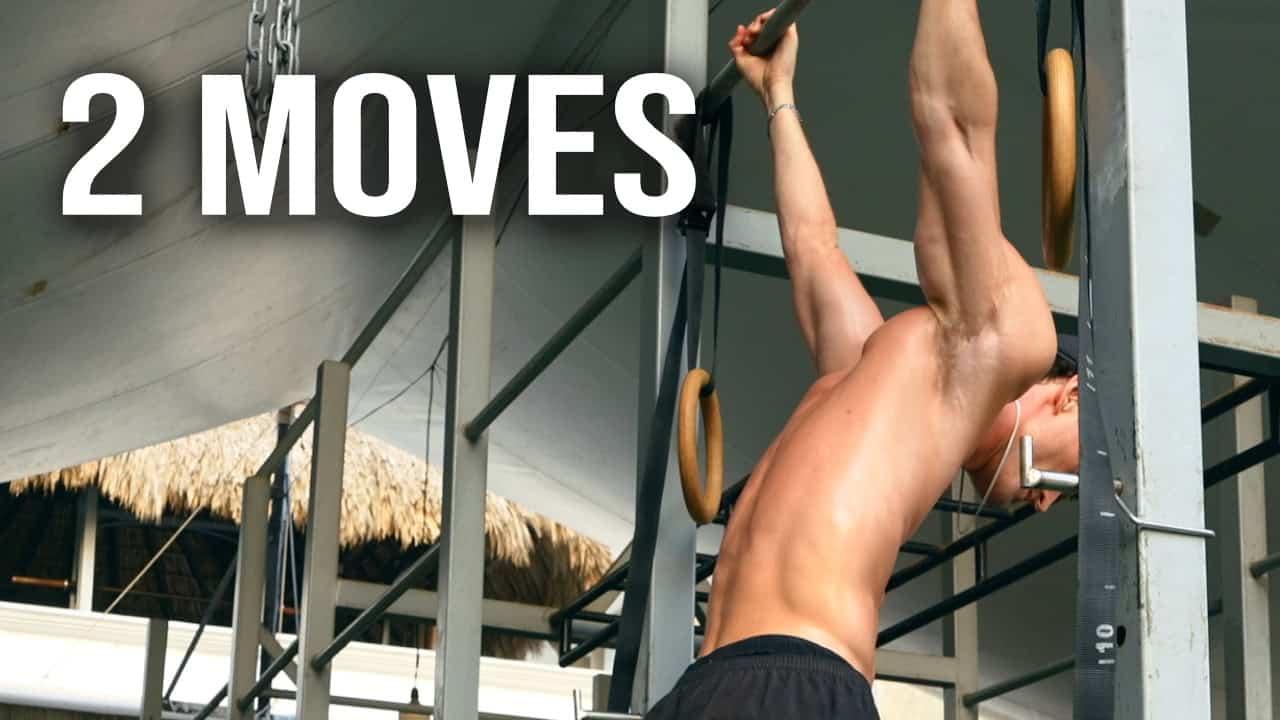
In this video we go through the two-movement upper body routine that unlocks lasting mobility and has kept my shoulders limber and pain-free for over a decade Here’s what we cover:
- Why most shoulder stretching fails to produce any lasting results
- The full two-move routine, with follow-along demonstration and regressions for any starting level
- How to program this into your week to achieve permanent results in the next couple of months
Video summary
This video demonstrates how to achieve lasting shoulder mobility by building strength in end-range positions rather than relying on stretching alone. Two primary movements are presented: the cat stretch for overhead flexion and the German hang for shoulder extension. Both exercises use active muscle contraction near the end range of motion to progressively unlock deeper range of motion. The protocol recommends alternating between these exercises for two to five sets, performed twice weekly after upper body strength training. Unlike traditional stretching routines, this strength-based approach is designed as a finite project lasting weeks to a few months, after which the improved mobility is maintained without ongoing daily practice.
Full transcript
If your shoulders feel tight when you reach overhead or behind your back, or even when you’re sitting at a desk, you’ve probably tried stretching them and it might help for a few minutes, but then they tighten right back up. And that’s because the problem is not that your shoulders are too tight. It’s that they’re not strong enough in those end ranges to move freely in these positions. So instead of stretching them every day forever, you fix it by getting strong there. So in this video, I’m going to show you the two movements that I use to open up my shoulders completely and how you can use them yourself to build full range of motion that lasts essentially forever. If you do what I’m going to show you right, you only need to do it for a few weeks, a few months, max, and then you’re done.
So our first goal with the other body is to be able to take our shoulder through full flexion overhead range of motion. This is going to not only open up our shoulder, but give us stability in this overhead position. Super important if you want to achieve movements like handstands and related skills. And we’re going to train this using the cat stretch. So for this movement, you can use the rings, you can use a bar, you can use a wall like I am here. You basically want to anchor your hands somewhere between hip and shoulder heart. And you just want to think of this as building up this strength to pull out of this overhead position somewhere near your current end range of motion. The stronger we get in this deep flexed overhead position, the safer your body is going to feel there and the more range it’s going to open up for you, allowing you to go deeper.
So what you want to think about is trying to actively pull out of the movement. So the cue you can use is like a ski erg, trying to pull your hands down, pushing the wall or the bar or the rings into the ground. You’ll find as you do this that you’re flexing really hard, your pecs, your lats, the muscles around your shoulder, whatever feels tight and naturally contracts, you just want to contract that even harder, thinking about pulling your hands down as hard as you possibly can. As you do that, you’ll likely notice more range opens up. Feel free to move into it and then flex from there once you feel your muscles contract again. As you do this, remember to breathe and you can just keep going through these cycles of contraction, relaxation, further depth until you get to a point where you’re either bored of it or you feel like you’re not gaining any more range.
Now, if you like this approach and you’re wondering how this fits into a full programme and you want to see how I build not only mobility, but strength and get lean all in under 40 minutes of training a week, I’ve put the whole system into a free video training. You can watch that using the link below. Now we’re going to train the opposite end of the spectrum, which is shoulder extension, which we’re going to train using a German hang. This is a critical one for keeping your chest loose and pain free, especially as you build up your pushing strength with movements like plunge pushups. So to set up for this, you can use the rings or a bar. Either way, you want to make sure when you do the movement you are in a supinated grip. So you can think about drinking soup. Yo palms should be facing you.
This is going to mean we get elbow work as well and prep our joints for future heavy work on the rings. If we can get more bang for our buck from a movement, we might as well. Now you see to get into this position, I either skin the cat where I rotate my body around the rings. If you can’t do that yet, I would just set these lower and jump up into an inverted position and you can move into the German hang from there. Now it is fine if initially you barely move past an inverted position. You just want to move into whatever range of motion you can currently handle with your full body weight. You shouldn’t really need a cue for this movement because you’re trying to hold your body weight up, but you can think about pulling yourself back out of the position as being the cue.
So just like with the cat stretch, you want to just flex the muscles that are naturally tensing up in response to the movement anyway. In this case, you’re going to feel it massively in your chest and the front of your shoulders. Again, you just want to get near the end range that you’re comfortable holding. You don’t have to ever push to get deeper with this. You want to just practise flexing harder near your end range because again, it’s by building more strength in this end range position that more range is going to open up. So we’re not trying to stretch our muscles out. They’re not rubber bands. We’re trying to contract them harder so they get stronger so that you actually open up more range that’s accessible anytime, any day drop of a hat. That is the secret to lasting mobility and this is what most people miss when they try to stretch out their shoulders and don’t get any results.
So again, just get as deep as you are comfortable holding for now. Whatever muscles you feel contracting, flex them as hard as possible, like you’re about to pull yourself out of the movement the whole time. If you find your muscles relaxed and more range opens up, feel free to go into it and then repeat that cycle as many times as you want. If you prefer you can move in and out of the movement, say for 10 reps, or like you see me doing here, you can just hold it for time. Either way works equally well, do whatever is preferable to you. Important thing to note, when you finish your German hang set, make sure you pull back out of it rather than dropping to the ground. It’s going to help you make sure you build that strength, pull out of that position, which is really going to help you with your mobility.
So in terms of protocol, you can repeat this for as many cycles as you want. I would alternate these exercise going back and forth between them until you reach a point you’re happy with. The rule of thumb I use is just to keep going until it starts to become a drag or you’re not really opening up any more range or your muscles start to feel dodgy. The guidelines for this are roughly two to five sets. I think you find definitely more than one beneficial because once you’ve opened up some range, you have a window where you’re more flexible than you were when you started. And so if you keep training for multiple sets, you do get progressively deeper, which is good. Tend to get diminishing returns up to five. So somewhere in that range, doing as much as you can be bothered and feels productive.
Now, if you’re training efficiently, this will take more time than your strength training, but it’s different in that you’re not going to be doing this forever. The best thing you can ever do for your mobility is to stop treating it like a constant chronic chore and start treating it like strength training, but with an end goal. So if you do this right, every single session you should unlock more and more range of motion until you eventually, over the course of weeks or a few months, get to what is effectively your limit. With strength, we want to always keep going, but with mobility, you get steeply to do machine returns and you don’t want to be more mobile past a certain point anyway. Like the contraction mechanism is there for a reason and that’s to keep your joints safe. Most of us are sitting way down here and could be way more mobile and actually beneficial, but there is a point where there’s no point getting any more mobile.
And so I want you to treat this like a fixed finite project that you’re going to work on until you get to a point you’re happy with. You can look at where I’m at for a demonstration of that. My flexion mobility could be better, but honestly, I don’t care about mobility that much and I’m not trying to be a circus clown. I’m very happy with that functional range of motion. When to do this, you can honestly do this every other day if you really wanted to. For simplicity and consistency over this period of time, I would just do it on your upper body days. If you’re training your upper body twice a week, which is what I’d recommend, then it fits perfectly in twice a week on those days, do it after your strength training because all the muscles surrounding your shoulder, your laps, chest, shoulders are going to be warmed up and at their most limber.
You don’t want to do this before your strength training because it negatively affects your strength training and strength training positively affects it if you do it before. So always do it after strength. And that’s basically, if you’re really dedicated and you want to do more, you can add another session in. The key thing is just make sure you’re progressing and actually improving your strength, getting deeper range every session. And once you get the range you’re happy with, you’re done. You do not need to do this forever. I rarely, rarely pull these out when I’m feeling super tight. If you train mobility right, it is a finite process, get it done, get back to the work that matters, which is building up your strength, gaining muscle, and actually achieving some serious ability.