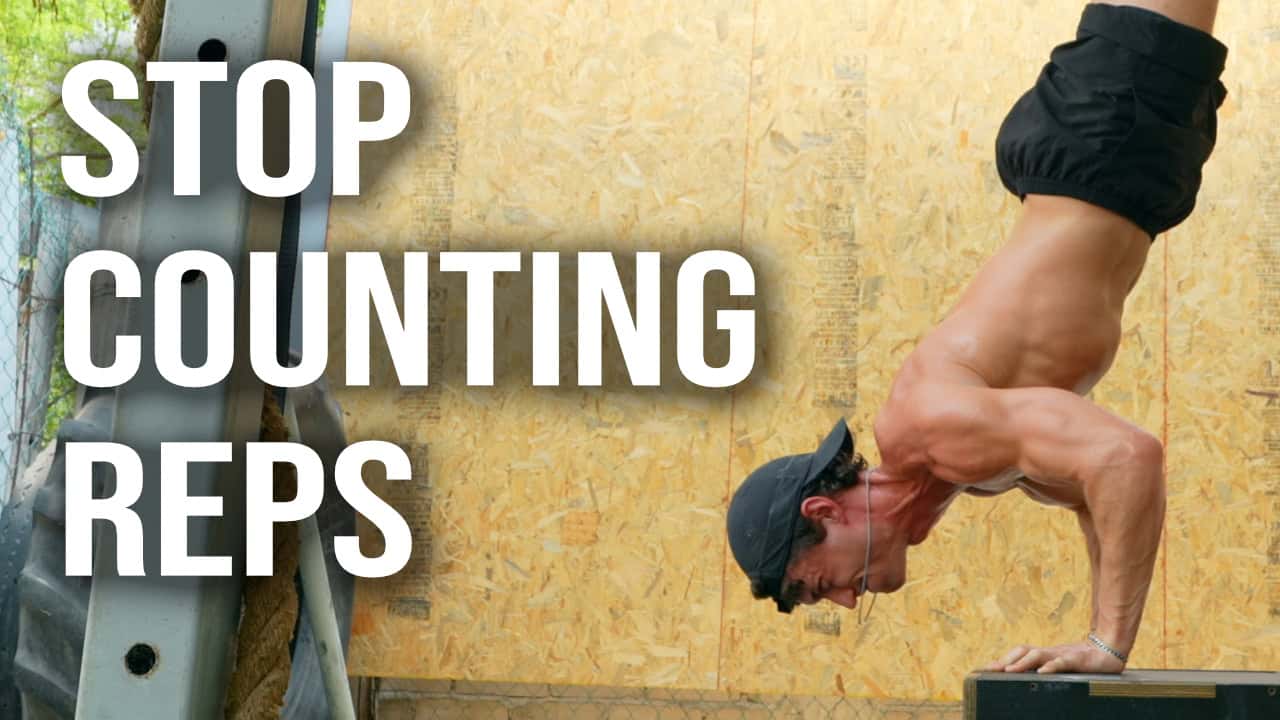
In this video we talk about how to know know if your calisthenics is actually working, or if you’re just spending time and energy staying the same. Here’s what we cover:
- Why counting reps is the worst thing you can do if you want to get stronger and build muscle with calisthenics
- The method I use instead to make sure I’m always progressing towards my strength goals
- What this looks like for the handstand pushup, with a guided demo of how you can track your progress from ground zero beginner all the way to elite
Full transcript
If you’re not tracking your strength, progressing in callisthenics is kind of like driving blind. You could be training consistently for months and actually be getting weaker without knowing it. But without numbers on a barbell, what are you actually supposed to track? A lot of people end up just counting reps, but this is actually one of the worst approaches if you want to get stronger. There’s a simple method that I use instead and it’s what’s allowed me to actually hit all my biggest strength goals while training for less than 40 minutes a week. In this video, I’m going to show you that exact system so that you know objectively whether you’re improving and are never left guessing again. I’m going to show you exactly what this looks like in practise using the example of the handstand pushup, walking you through the frontiers from absolute zero all the way to a leak.
Firstly, why shouldn’t you just count reps? Well, there’s a simple reason. Look at CrossFitters. How do they hit maximum performance if they’re trying to optimise number of pull-ups or muscle-ups or hand sample ups? They cheat. They use as much momentum as possible. They minimise the workload on their muscles so that they can hit the highest number of reps in the shortest amount of time. I don’t know if you’ve ever watched a keeping pull-up, but it looks a whole lot different to what effective strength training looks like. And this is why you don’t want reps to be your indicator of success because it sets up an incentive structure in your training that’s completely opposite what you want if you want to get stronger and build muscle and unlock high level callisthenics goals. For building strength, we need intensity. We need time spent at our strength limit, pushing, pulling, squatting as hard as we can.
And that sort of training very quickly leads to fatigue, meaning we have to rest. The higher the intensity in a given set of training, the less reps we’re going to be able to do. And so if this is our goal, but we’re measuring something that has an inverse relationship with it. You see the problem? It’s like boiling a pot of water and constantly checking to see if it’s boiled by taking the lid off. Every time you do that, you slow it down. Every time you try and hit more reps, you are consciously or not incentivized to reduce the intensity so that you have a chance of increasing your rep count. So what can we measure instead? Well, it’s very easy. We just want to measure how high we can get our absolute level of intensity, i.e. Our maximum strength. Every single movement that you train in callisthenics, even though there’s no weight on a barbell, there is still a spectrum of difficulty.
And at any point in time, your current level sits somewhere on that spectrum. Good training or the parts of good training that get you a result, sit right here at your limit, the current threshold of what you can do, because that’s the work that signals to your body to increase that max and get you closer towards your strength goals, which means closer towards a more muscular, leaner, better looking physique. Our sole goal with training, if we want results, is to push that up with time so that you get closer and closer towards end goal level strength. And this level that you’re currently at, this is what I refer to as your current strength frontier. You can spend all the time you want fluffing around in this zone of stuff that’s too easy for you, but where the battle of progress is for is right up here at your current limits.
And so the easiest way to track your progress with your training in a way that supports the progress that you want to make is just to measure where your current frontier is. Every single time you train when you’re fresh and at your strongest. You have your next goal clear, you get it in the crosshairs and you just work with everything you’ve got to improve that. Every time you train, you get a measure of where you’re at and you can watch it improve session to session. As long as that’s happening, you know your maximum strength is going up, which means you know you’re progressing, you’re building muscle and you’re getting closer to your goals. So what does that look like? Let me walk you through an example. We’ll take the handstand push up. I’m going to walk you through exactly what these various frontiers might look like over your training career from zero to end goal level.
If you want to see this progression system mapped out for all six movements that I train, I put them together in a free guard. You can download that below. So let’s take your vertical pushing training. So your end goal is to build up to a handstand pushup. If you’re watching this, you’re probably not there yet. That’s the whole point. It’s hard. It’s at this end of the spectrum. Chances are you’re somewhere over here. So it’s a series of progressions we use to train this same movement pattern build up towards the hand sampus up. Within each of those progressions, you’re going to have your own frontier that you’re working on and aiming to increase bit by bit until you become strong enough that you can start using the next progression. And so the ground zero for this is doing park pushups where you’re taking most of the weight on your feet but putting as much on your hands as possible.
Your frontier in this beginner stage is just how much of the rep you can do keeping your legs straight. So you keep your feet on the ground and your hips don’t drop and you push through this full range of motion. Once you start to be able to get full range of motion without bending your knees, you’re probably strong enough already that you need to be using the next progression, which is elevating your feet. And you might start just by using this for the negatives when you’re training. Your frontier here is essentially the same thing. It’s how much of the range of motion in a positive, the part of the movement where you’re pushing up can you do whilst keeping your feet on the elevated surface and keeping your hips up. If you break like this and let your hips drop, it doesn’t count. Keeping your hips up the whole time, how much range can you do while keeping your feet elevated?
By the time you’re getting a full range of motion rep in that position, again, you’re already strong enough that you should have moved on already and be using the next progression, which is getting into a shoulder stand. And so this is where you take your full body weight on the rings and just hold it there. Once you’re able to do that, your front ear is how much range of motion you can push up with. And so this will start as tiny little efforts getting nowhere and over time as you get stronger, you’ll get more and more lift off the rings. You can pull on the straps to help yourself do whatever you need. Again, your sole goal here, your front ear is how much range can you get and the hardest part of this movement is right in the middle. That’s the bit that demands the most strength.
So as you get closer and closer to pushing through that, eventually you’re going to reach the tipping point where you can get past it and do a full body weight handstand push up using the straps for help. Once you pass this sticking point, you’ve passed a huge milestone because now you can start doing negatives, but for these you’re going to do it without any assistance. So you’re going to see how far you can get down without using the streps for help before you start to drop. Again, your frontier is just pushing that further and further until you can do a full body weight unassisted negative. Once you can control an unassisted negative, the final frontier is end game level and that’s how much range of motion you can get doing an unassisted positive. The goal, of course, is to get to the point where you can do the full thing.
And for me, now my frontier is basically trying to get cleaner form on this, keep my body straight, do it strict and try and get multiple reps. If I’m strictly measuring raw strength output, then I’d be shifting my weight side to side, emphasising one arm at a time. But for me now the bigger priority is being able to rip these out clean with balance. And so that’s what I’m working on at the start of my set. Again, when I’m precious, how many clean reps can I get? How clean can I get them? And then once I cooked, I go back to using the wall or the straps for assistance. Again, just scaling down to train as long as I want. So that’s it. With your vertical pushing training, you’ll be somewhere on that spectrum right now. You should already know what progression you’re using. Now I want you to think about what your frontier is.
What’s the measure right now of your maximum strength and what does it look like to incrementally improve that week to week? That should be your only focus when you train this movement until you build enough strength to get to the next one. Forget about reps, track your max, push it up, that’s the whole game. Link to that guards below if you want it.