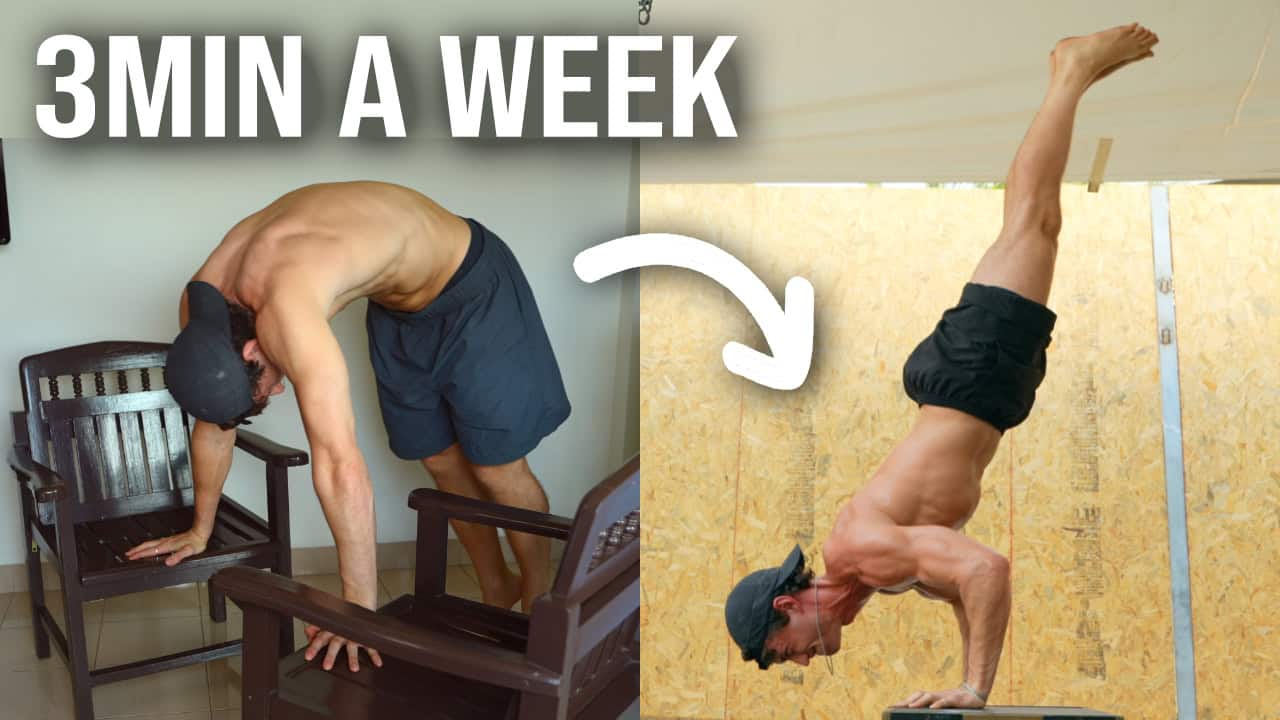
In this video we talk about how to build shoulder strength insanely fast, at home in under three minutes a week, starting from an absolute beginner level. Here’s what we cover:
- The reason most shoulder strengthening programs take way too long, if they even work at all
- The underused method for triggering rapid muscle, strength and mobility gain in just minutes per week
- How to do it yourself at home today, with nothing but a couple of chairs
- Guided demonstration and weekly training protocol to progress all the way from beginner to freestanding handstand pushups
Full transcript
I built this level of shoulder strength by training it for less than three minutes a week at home with no fancy equipment. And the reason I was able to do so is because I leveraged a powerful, massively underutilised technique that most programmes completely miss, which is why they take hours a week if they work at all. In this video, I’m going to show you exactly what that technique is and how to apply it so that you can start developing your shoulder strength today, starting from absolute ground zero. I’ve got clients in their 70s using this exact method and getting stronger every single week. So lack of strength is not an excuse. In fact, it’s the very reason that you need to start. If you’re not currently training your overhead pushing strength, then you are leaving your shoulders vulnerable to losing muscle mass, mobility, and basic function, which only puts them at increasing risk of injury with time.
But I get it, most people aren’t doing this because most programmes either take hours a week or they just don’t work because they don’t push you anywhere near your current strength limit or they get you doing so much volume that you couldn’t recover from proper intense work anyway. What we’re going to do here is the exact opposite. A couple of minutes, once a week, done brutally hard. Very simply, the core to this technique, if you understand nothing else, you want to build a huge amount of strength, muscle, and mobility in a very short amount of time, is that rather than move our muscles against a resistance like a weight, we are going to vary the resistance until it moves our muscles despite us pushing against it as hard as we can. Most people have never worked this intensely ever in their lives, and once you experience it, you’ll understand very quickly why these couple of minutes a week are more than enough to start progressing.
So rather than try and convince you any further, I’m just going to show you and let you try it, experience it for yourself. And just quickly, before you worry about injuring yourself, when you start out with this, you’re not going to be strong enough to hurt yourself. The limit that we’re going to find is your strength, not mine, not someone else’s. We’re going to scale up to what your body’s capable of handling and we can scale right back down when we need to. So take your time and remember that the only way your strength is going to improve is if you challenge it. The way we’re going to get set up for this is by elevating our hands on something so that our head can go past them. So you can do this on rings or parallettes. If you don’t have either of those handy, then any elevated platform you can find will work.
If you can find two chairs of the same height and something to prop your feet up on, that will work perfectly. So we’re going to start at the top. All you want to do is get into this overhead position, kind of like you’re doing your handstand. So you’re going to push the chairs or whatever you’re using overhead as much as you can. The cue to easily get in the right position is to touch your shoulders to your ears. If you can shrug your shoulders like that until you feel that contact, then you know you’re in an overhead position. Try and get your hips up as high as you can. They’re not going to be directly vertical, but just get them as high as they’ll go. Now the way we’re going to load this movement up is by shifting our weight forward onto our hands. So the way that you vary the difficulty between zero and maxing out is just by how much you shift your centre of gravity forward from your feet onto your hands.
So to find your limit, what you’re going to do is bend your elbows slightly and then shift weight forward until you start to feel that weight loading onto your shoulders. And when you feel that tension, great, keep on increasing it. So keep shifting your weight forward, keep getting more of your body weight onto your hands until it literally starts forcing you down. And at this point, all I want you to think about doing is pushing back up. So imagine those chairs are dumbbells that you’re trying to press overhead. From now on the whole time, all you want to think about trying to do is push up, push back into that initial starting handstand like position that we started in. And if you’re able to win or you’re stuck and you’re not moving, then add more weight onto your hands until you start to lose. Now this is obviously going to be incredibly difficult, that’s the point.
We’re aiming to get the difficulty above our maximum strength level so that we actually actively fail all the way down to the bottom. If you’re finding it hard to get enough weight onto your hands, then you can elevate your feet up onto something higher, that’s going to make it easier to shift your weight forward, get more of your body weight on your hands. And all you want to do is keep adjusting how much weight is on your hands so that inch by inch, you actually force yourself down to the bottom of the movement. Keep trying to push up the whole time. You’ll know when you’ve got this right because it will be extremely intense. And in one rep, you’ll very likely feel your shoulders absolutely cooked. Once you get this right, you have now unlocked the secret to very, very effective, efficient strength training. This is as complex as it gets.
So fight as hard as you can all the way to the bottom until you get to this position where your wrists touch your chest or your shoulders touch the chairs or the rings or whatever you’re using. To go back up, you don’t change anything in your upper body. You keep on pushing overhead. All you do is adjust the difficulty back ever so slightly so that it’s easy enough for you to win. So you can shift your weight back onto your feet. If you’re still stuck, you can bring a foot forward, you can go down to a knee, whatever you need to do to take weight off your hands just enough so that you can start to win. So we’re going from 5% over the maximum load we can hold to 5% under so that we can slowly win, grind our way up to the top of the rep.
And again, finish in that overhead position, touch your shoulders to your ears, and that is a complete rep done. And a single rep of this might take you 15, 30 seconds. That’s fine. Take your time with it. The point is at every inch you’re trying to work as hard as possible against the maximum resistance you can push against. You will notice that working this hard, forcing yourself down cooks your shoulders pretty quickly. That’s exactly the point. We are only going to do this for a minute or two once a week. That is plenty of work to stimulate your muscles to grow and start building strength in this overhead pushing pattern. And your single goal is not to feel like you worked out, it’s not to get a pump, it’s not to get sore, even though those things may well happen. Your goal is to come back to this each week and get stronger.
So every single time you do this, you want to be aiming to do a harder version than you did last week. Initially, that’s just going to be very simply adding slightly more weight to your hands. If you’re dropping down to a knee, it’s going to be over time needing to do that less and less until you can do the whole thing on your feet. When you’re finding it difficult to make it hard enough, it’s very easy to scale up. You can just elevate your feet and that should allow you to get basically all your body weight on your hands. If you need an extra challenge from there, then the next step is you can put your feet up on a wall so that you’re just leaning against it. And then eventually with enough weight on your hands, then you won’t need the wall at all and you’ll be doing this free standing in the air, full body weight.
By that point, your chest, shoulders, triceps are going to be absolutely jacked and your strength and mobility far beyond what any mortal human actually needs to get to. But it’s fun. So if you’re doing this for three minutes a week, you may as well keep progressing to as high level as you can get to. Now the temptation is going to be to do more than this couple minutes set a week. Can you do more? Absolutely, it’s possible. But should you do more? No. The reason is you’re going to make way more progress from optimising your intensity and actually pushing as hard as possible and then recovering from that work than trying to do more of it. Because what inevitably happens is when we try and do more volume, we dilute the quality of the training that we’re doing, everything becomes slightly weaker. We start to spread our effort out over the work we’re doing.
So it becomes less potent signalling. In that work, we accumulate more fatigue, which makes it harder for us to train at high level. We have to recover from it, puts us at a higher risk of injury. And obviously that just eats up more time. We’re just going to reduce the chances of you being super consistent with this, which is by far the most important part of all of it. So for all these reasons, less is more, make what you’re doing count. If you want something else to work on during the week while you are recovering for your next round, I’d suggest adding in some other basic movement patterns to cover the rest of your body. If you want to see the six that I use to build my entire body in under 40 minutes a week of training, there’s a downloadable guide on all of them and their progressions links in the description below.
You can grab a copy of that for free. Anyway, I hope this helps. This movement can be an intimidating one, especially when you’re looking at someone doing handstand pushups, but you do not need to worry about that. Just building some basic strength on this foundational progression is going to give you so much in terms of shoulder health and quality of life benefits. And if you find yourself smashing through that and building up to doing handstands, then that’s a nice bonus too. You got questions, drop me in the comments below. Go build those shoulders.