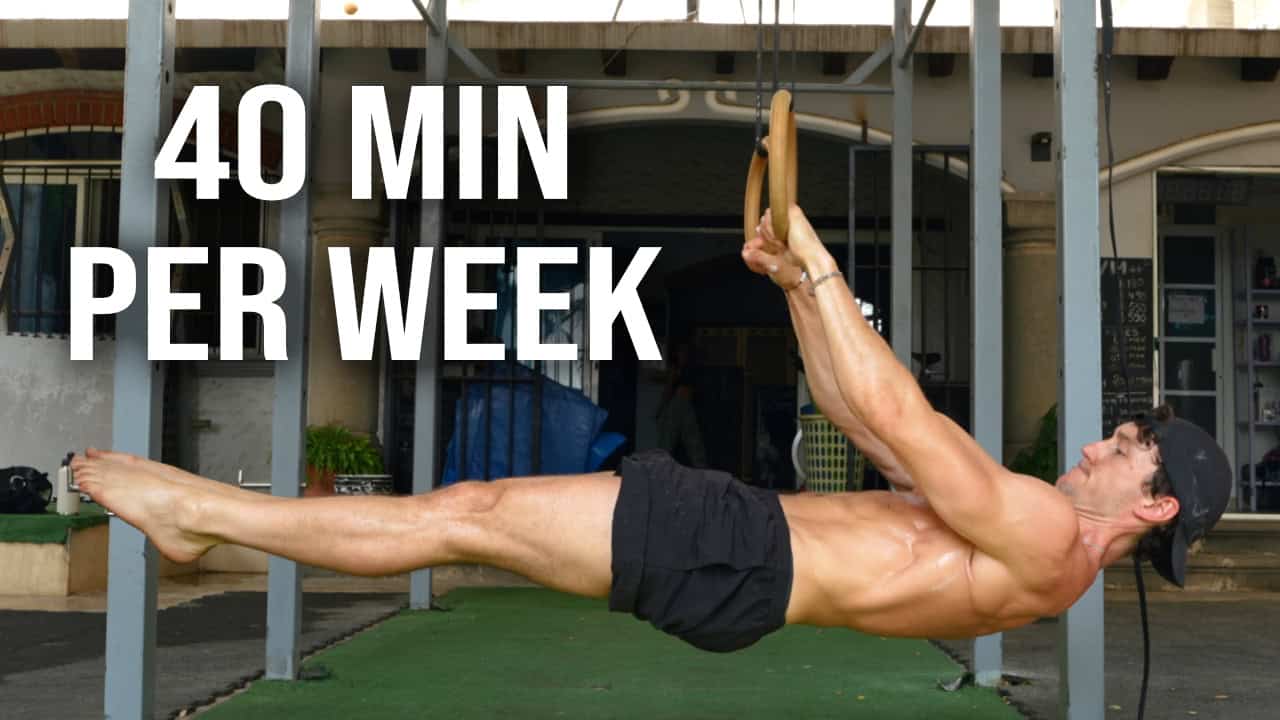
In this video we talk about why you should stop chasing calisthenics skills if you want a stronger, healthier, better-looking body. Here’s what we cover:
- The two recent training experiments I’ll never go back from
- What dedicated planche and front lever training actually cost me
- Why the best calisthenics skills come as a byproduct of building a better body
- Where I’ve landed with my own training goals and what I recommend
Full transcript
For the last few months, I’ve been running a series of experiments, including dedicated plant and front lever training on top of my normal workouts. And I’m getting somewhere with them, but it’s cost me way more than I expected, including eating into my muscle building work. And it’s made me ask a question that I haven’t considered in quite a long time. What am I actually training for? So today I’m going to go through everything I’ve tested, what I think is actually worth adding to your routine, and where I’ve landed with my own goals. I love the skill side of callisthenics, but I just don’t think that chasing skills is the best way to get them. For me, it never has been. All my strength, all my callisthenics party tricks came from working hard in the basic planes of motion, building muscle, and getting lean. The moves all came as a byproduct of building a better body.
And ironically, since I’ve started chasing specific skills in an attempt to show that the basics work, I’ve ended up drifting further from the basics that I have been in years. So let me talk you through what I’ve actually tested and what it did. The first two experiments I will never go back from. The third is where things got a lot more interesting. So the first experiment, which I talked about in a recent video, was doing shorter sets, more of them, and at a high frequency each week. I won’t rehash that all here, but the bottom line is that if you are doing the basics well already, then this is a no-brainer way of milking more out of them. So I will undoubtedly be keeping this approach from here on, aiming to progress faster and more aggressively in these basic movement patterns that have given me so much today.
The second experiment has been more of a byproduct of my skill research, but that was integrating more ranges of motion into those basic six planes of motion that I’m already training. For instance, training the proper planche positioning every rep of horizontal pushing, training the front lever touch position at the top of horizontal pulling, essentially modifying those basic movement patterns that we’re already training to get more out of every rep. And I think that is also a no-brainer. I already feel like my horizontal pushing and pulling movements are more comprehensive, more interesting, more challenging now. And so I want to continue this tinkering to see how the same thing can be applied to my vertical pushing and pulling, especially for me working on strengthening the bottom range of the one arm chin up and progressing on from handstand pushups to things like 90 degree pushups. Obviously I’ll keep you posted as I tinker, but I think if you’re doing the basics consistently and putting in the effort to get stronger at them, then they may as well be giving you as high a return on your effort as possible.
And this attention to working every inch at maximum effort across a full range of motion is why I think just six movements have been able to give me so much in terms of strength, in terms of free gains, mobility. And it’s why it’s something I work really hard on with all my coaching students to make sure we get that right from the start. And no hate on traditional strength training, whatever works for you, do it. But this is probably why I haven’t done an isolation movement in over a decade. For me, it’s just not enough return on my time and energy. Weighing up a bicep curl versus max effort, full range, one arm, chin up training, rep for rep, I know which is going to give me more. And then we come to this dedicated straight arm work. The whole theme you’re probably saying here is what can you get for your effort?
What I didn’t account for when running this experiment of dedicated planch and front lever training was how much that was going to take away from the rest of my training in that by the time I’ve really gone hard doing that component of things, a lot of my muscles and my central nervous system have taken quite a beating. And so it’s not just free extra work that I get to do as well as the main large range of motion muscle building stuff that we’ve been talking about so far. Something always has to give. I think with all of these experiments, the key thing that I have learned is that the limiting factor to your progress is always fatigue. If fatigue wasn’t a thing, we could just train like an absolute beast every other day and get super strong. Everything would be so simple. We put on loads of muscle, it’d be easy.
But it’s not just about the signal you send to your muscles to grow. Every rep you do that achieves that and the reps that don’t come at a cost of fatigue. And if we allow that to keep piling up, we end up with low performance training that does even less to signal to our bodies to grow and we start to put ourselves in the danger zone of getting injured. And so effective training is always this balance of getting high quality work in whilst allowing fatigue to dissipate so that we can do this again and just repeating this cycle of stimulus, recovery, allowing fatigue to clear and then going again. And every single thing that you add into your routine to try and get more done comes at this cost of fatigue. And that’s why I think it is so important to be really clear on what you want.
And since putting in this dedicated time to training planter and front lever, it’s made me really ask this question. It is fun progressing on these specific moves. There’s some reward of getting better at them. I’m slowly progressing. I’ve started to unlock advanced tough planters. My front lever is improving, but it’s made me realise that if those goals themselves were what I really cared about, I would’ve been training specifically for them a long time ago. It’s not really my main jam. And now I find myself sort of chasing multiple rabbits. I think if you want to just build up a fantastic physique, get a good amount of muscle mass and get lean, then that’s really easy or at least it’s very simple. If you want to just learn skills like planter and front lever, that’s a whole lot easier to do as well. I’m currently sort of treading this middle ground between the two.
Before I started the planter and front lever work, I was starting to see awesome progress again in my size and body composition. Just doing my three sets of three movements three times a week. I was getting again in the best shape of my life and starting to beat it, which is really exciting. Again, for 15 minutes of work three times a week, what more could you want? And so now that I start to see my performance on that work and my recovery for it being impacted by the skill work, like now I’m only getting one or two sets done of that because that’s all I can manage at a proper high level of output without completely toasting myself and being wrecked for the next session. That’s really making me face this question of do I want to sacrifice gains to get better at these skills?
And would I even be training these skills if it wasn’t for YouTube and trying to prove a point of what was possible? I’m not sure I would. All power to the people who want to be callisthenics athletes, I think it’s really cool. And the strength skills you see these people do is super impressive. And I’m starting to understand just how much it takes in terms of consistency, daily training, fatigue management to be able to get there. Ironically, the reason that I was even interested in doing these skills was to show that that wasn’t necessary. Because to be clear, training for less than 40 minutes a week, building a base of raw strength and muscle by training these positions and getting lean, that unlocked a huge amount for me for free with no practise, handstand presses, handstand pushups, one arm chin ups, front leaders, back leaders, side levers.
All these things you see me do honestly are byproduct skills. And the point that I started YouTube and coaching to make was that it doesn’t take much to get all that. If you just build a really strong body by building that base of muscle, you get lean to maximise your relative strength. All these basic skills are yours just from doing that and nothing else. And that is really cool. The thing is to build elite skills like a planche, the sort of training that’s going to get you there looks very different to that basic training, that muscle building training, the training that’s going to give you an incredible physique and all the other benefits at the same time as the raw strength. It takes a lot better management of fatigue. It takes a lot better programming. Frequency is king. Training a lot more, dedicating a lot more time to it every week with much greater consistency.
That’s how you get to that level of calisthenic strength, which again, if that’s you, power to you. But I think I’ve realised what I want is to just keep getting jacked, do it with three short sessions a week, less than an hour. If I’m travelling, if my routine’s interrupted, I can just keep going. It’s not going to throw off my perfectly aligned fatigue, adaptation, timing, management. I can just keep building muscle, looking great, getting stronger over time. And again, I can only share with my values and goals and what I’ve learned. But what’s made the real difference to my life has not been my ability to do a front lever. It’s been the general transformation in my physique and athleticism that’s emerged from just locking into building strength in these six basic movement patterns. When I look in the mirror and I’m absolutely stoked, when I can go and pick up any sort of sport or physical activity and be physically capable doing it, be strong, be athletic, be able to jump, sprint, have no mobility issues and have plenty of time and energy in the week to actually do those sorts of things because my strength training is so simple and efficient and dialled, that is life changing.
And I think it’s so much easier to achieve that than most people realise. So where I’m landing, I think I’m going to continue these skill experiments for a while just that I give myself the chance to make some more progress and get some perspective on this stuff so I can speak with authority on it, share it with you guys. But what I think my actual goal is, is to build an outrageous physique from an incredibly small focused amount of work. Strong, muscular, lean, mobile, two or three short sessions a week with plenty of time and energy left to go surf, play basketball, play tennis, everything else I want to do in my life. And ultimately I want to be a demonstration to you to show you all of what’s possible with under an hour a week of training, just a handful of well-selected movements. Whatever byproduct strength skills I continue to get from that, awesome.
But I’m not really interested in becoming a slave to tricks just because they look cool. Ido Portal once made that comment about the one I’m handstand and now I see what he’s getting at. The unrelenting frequency that you need to make progress in these really high level calisthenic skills is just a very different game to building a great body and certainly not the game that I know any of my students or the people I know want to play. But being realistic about what you can expect from either journey I think is important and I want to be a very transparent example of all of that. The reason I started teaching fitness in the first place was not because I wanted to be the best at it. It’s because I got so much for my own life from such little input that I wanted everyone to be able to access that sort of framework because the barrier that I see when I look around me is not people having access to the information that will allow them to become elite callisthenics athletes.
It’s time I wanted and still want everyone to at least know how to get in insanely good shape in 40 minutes a week from home if they want to. So the baseline standard for fitness and for quality of life, for self-confidence, for wellbeing is just so much harder. So I’ll continue to be transparent sharing all of this, but these are just my thoughts. To sum this up, I think the less goals you have to work towards, the more resources that you have at your disposal to attack them with and the simpler achieving them becomes. Gaining muscle mass, a great physique, and a very high level of functional ability is much, much easier than learning elite strength skills. Two or three short sessions a week, basic nutrition right, and you’re good. I will keep you posted on how my goals continue to evolve. If you’re not already very jacked, lean, strong and mobile, then jump aboard.
Let’s make it happen. Learn about our system using the links in the description. I’ll continue to try and make this process as simple, clear, and easy as possible for everyone, whether you’re a coaching client or you continue just watching along here. I’ll keep you posted on how my goals continue to evolve and refine the process to achieving them. Questions, thoughts, please drop in the comments below. Look forward to hearing from you. We’ll speak soon.