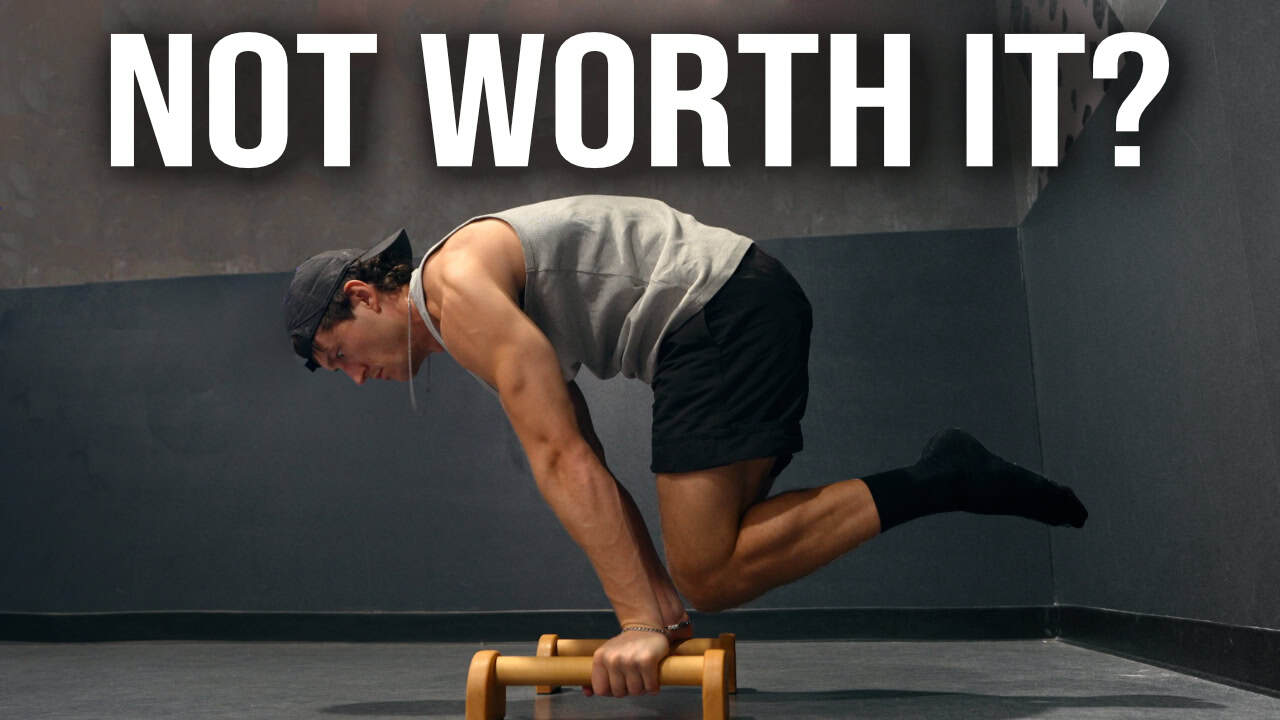
In this video we talk about the true cost of achieving the planche. Here’s what we cover:
- The difference in input required for basic “free gains” strength vs elite calisthenics skills like the planche
- The experiment I’m running to try to improve my specific strength in the planche (and front lever) position
- My real-world experience and learnings so far
- Key considerations so far in terms of specificity, time, fatigue, and return on effort
Full transcript
40 minutes a week of training has given me an enormous amount in terms of muscle mass, physique, and my general strength. But if you ask me to do any really high level calisthenic skill like a planche, I’m cooked. In this video, I want to break down the difference between the strength and muscle mass built by such a simple system as the one I’ve used versus the specificity required by elite movements like the planche and share the experiment that I’ve been running over the past month to find out just what it takes to progress on some of these extremely challenging callisthenics movements. Recently, I’ve talked about the difference between the really high leverage work that gets you a huge amount of benefits for a very small time input versus the large amount of remaining work that you can do to make progress, for example, in specific movement patterns that gives you a lot more specific return on your time and effort.
And the more I learn about the world of high level callisthenics and some of these much more advanced strength skills, the more I’m realising that the pursuit of elite body weight strength very much falls into that category of a lot more work for a lot less functional benefit. I’ve been able to build a really good base of muscle mass with my method of training the six basic movement patterns, large range of motion, and working that range as hard as possible. A few shortages about a week focusing on recovery, allowing my body to grow stronger. My physique is what I always wanted to be. Very happy with that. And as I’ve talked about, I think the biggest win is just how easy and time efficient it has been to achieve. I’ve also got some amazing byproduct strength, which is cool and fun to play around with, but I’m far from a callisthenics beast.
I can barely hold a solid tuck blanche. So a big part of the recent research I’ve been doing to find out how I can get more from the training that I’m doing has been revolved around calisthenic skills and what it takes to be able to build the specific strength needed to do them. Now, just from training my six basics, I have got a short cruddy front lever, partial range, one arm chin ups, a dodgy range of handstand presses. I do have a full range handstand pushup and then things like muscle ups, back levers, lower level skills like that are quite easy. And testing recently, I’ve even found I can do short human flags. Again, all of this with no specific practise, just the 40 minutes a week, six basic movements that I talk about. What I’ve been interested in learning is what it takes in addition to this to learn things like planches, full range one up chin ups, longer front lever holds, front lever pull-ups, 90 degree pushups, this sort of range of next level skills.
So what I’m starting with and the main thing I’ve been focused on the last month has been mainly on the planche and front lever, these straight arm positions. So I’ll walk you through what I’ve been playing around with to improve my strength in these positions. But first I want to share the general things I’ve learned from this experience already. I have a lot of respect for callisthenics athletes and gymnasts who do these crazy strength moves. I’m going to reserve judgement on how worth it I think pursuing these things are for a later video once I’ve had some more time to make some progress and gather more experience. But the way I see this working is that you’ve kind of got two components to think about. You have the machinery of your body, your muscle mass, basically the structures, your raw tissue. And then you have your operating system, you have your neuromuscular coordination, a lot of the learning that happens up here, which allows you to use that hardware to perform certain movements.
Some moves like handstands are massively biassed towards the skill component. You don’t need a lot of strength to do them. I’ve talked about how I think the best way to build a solid handstand is by building a lot of raw strength so you can handle the movement. And that is just the general way that I lean because I see that strength giving you so much more than just learning the skill. But with some of these other movements like planches, these are much more demanding strength wise and so you actually can’t get around technique or skill with raw strength. You need both. And for a planche, you need both to be at a really high level. Both your raw ability to exert force and your coordination between all your muscles to exert force together in the right way to hold the position need to be on point.
Now upgrading the hardware, building muscle mass is pretty straightforward. And as I’ve talked about at length, it does not take much time. Three intense 10 to 15 minute sessions a week, ample to trigger massive amounts of growth and consistently build muscle get stronger all the way up to where you see me and beyond because the bottleneck is just muscle growth. Your body has to go and do that while you’re resting and sleeping. And so as long as your recovery and nutrition are reasonably dialled and you stimulate the growth effectively, you can get done in very little time, which is awesome. However, learning difficult skills, upgrading the software to use all of your physical machinery in a highly efficient manner for a very specific skill takes a lot more training. The other hard thing about that is that every bit of training that you do to upgrade the software taxes the hardware.
And so again, I wouldn’t consider myself very advanced in calisthenic skills, but it’s already bleedingly clear to me that you need to be much more dialled in on managing fatigue and recovery whilst you do this training because essentially you want to maximise exposure to the learning stimulus. The other thing that’s very clear is that the training stimulus needs to be hyper specific. If you want to learn tennis, there is no secret that you need to play a lot of tennis. Doesn’t it matter how many air swing four hand drills you do or footwork practise. If you don’t play tennis, you are never going to reach any decent level of tennis. Similarly, if you want to learn a planche, then you need to train the planch. Does not matter if you’ve got a massive bench press and your shoulder flexion is really strong, which is the prime movement in a planche.
Even if you have crazy strength in that position, it does not automatically translate to being able to hold your body in a plank with straight arms because it just requires enormously different muscle activation and coordination. The other thing to bear in mind that I’ll come back to down the road when we talk about trade-offs and what’s worth your time and energy investment, the specific work required to train some of these skills, it’s quite universally accepted that that work is quite isolated in what it gives you. And so to learn a planch, you need to spend a lot of time training the planch, but training the planch doesn’t necessarily give you a huge amount else other than the planch. So working a really limited range of motion limits the amount of strength you gain largely to that range of motion, and it also is much less effective for building muscle mass.
And so I think it’s worth keeping in the back of your mind that if you are trying to get maximum output from your training input and you want to build muscle and a good physique, targeting these sorts of specific skills is probably not the most efficient way to do it, which is why I haven’t put any emphasis on it today. And I’m still not convinced how dedicated I am to pushing them back. I’m interested again to see what that trade off actually looks like. So we’ll do it all for science. So the current experiments, what I’ve been playing around with lately has just been a very focused bit of additional strength skill work on top of my normal gains focused six movements training, which I last did an update on in this video. I’ve been doing this additional work purely focused on building two skills, complimentary antagonists, the planch and the front lever position.
My starting point is a very uninspiring tuck planch and a temperamental front lever. If I’m feeling strong, I’m going to bang out one of these for a couple seconds, but I’ve never got really long holds. So it’s solid, but I would like to be able to hold it for longer. So the goals ideally as you get to an advanced tuck and ideally then a straddle planch I can hold for three seconds and to extend my front lever to be a consistent five second hold with clean form. Arbitrary goals, but just things that would mean tangible, measurable progress on these basic but difficult skills. That’s it. As I said today, all I have done to train these is pulling from the front lever position and doing rows through range of motion that gets my elbows just past my body and working through a pushup, planch, pushup movement with not a lot of emphasis at all on good planch positioning at the top, either at the start or the end of reps, which may have something to do with my lack of planchability.
I’ll talk more to that sort of integration in an upcoming video. So now I want to talk about the specific straight arm work. So the concept here is getting exposure to these specific positions, trying as hard as possible to hold the best position that I can and doing that across enough weekly volume to stimulate strength gain in the position, making that hard enough that it is challenging and stimulates adaptation, but also making it easy enough that I can accumulate volume and overall training stimulus in the position with enough frequency over the week to get the adaptations that I want. So split this into two days, which just line up with my current AB workout split. So I’m training each of them three times a week. So every workout I’ve started with a couple of holds for each. Both days are really high effort, but one is high intensity or absolute difficulty and the other is a bit easier and allows me to accumulate more time in these positions.
So in the intense day, I’m just attempting the hardest version that I can for a couple second hold. So this has been scaled back to straddle front levers, tuck blanches, trying to get good form. And then I’m just scaling both of those back and doing sets that I can hold for close to the range of eight to 12 seconds, fully focused on maximum effort the whole time, trying to get the best possible form at all times, but pushing that pretty much to form breakdown failure. And I’m treating this exactly like normal strength training, doing three sets of those alternating push versus pull before I move on to do the same exact thing with my full range max effort bend arm work. So that’s the heavy day and then the volume lighter a day. I’m just scanning that back a bit more to allow longer holds.
I’ve had to play around with bands for the first time or I’m just scaling it down by progression, making it easier. And then instead of doing raw holds, I’m doing some dynamic work just to mix things up and get some more range of motion. So doing front lever pulls and these sort of dynamic planche lanes. The idea is just three times a week, accumulate as much time as possible, practising these positions, working as hard as I can, but making it easy enough that I can actually work it for a reasonable amount of training time. That’s it. There’s only been about a month, so I don’t have a huge amount of strength gains to show you or any data, but that’s what I’m doing. It’s been quite fun. The early things I will say, getting back to trade-offs, this has blown out my training time more than double.
And so for some very specific skill work, my sessions have gone from 15 to 20 minutes to over 40 now. So going back to this video where we talk about the asymmetrical return on time investment, this is not what I would recommend to people who want a high return on their training time, but I’m interested to see how my body responds and how those specific skills develop. So stay tuned, but I hope this is interesting. If you want help with the high leverage stuff, you want to build an incredible physique that can do basically everything that matters strength and mobility wise, then you can learn all about our system and how I help people by watching the free training links below in the description. Thanks so much for watching. Speak to you soon.