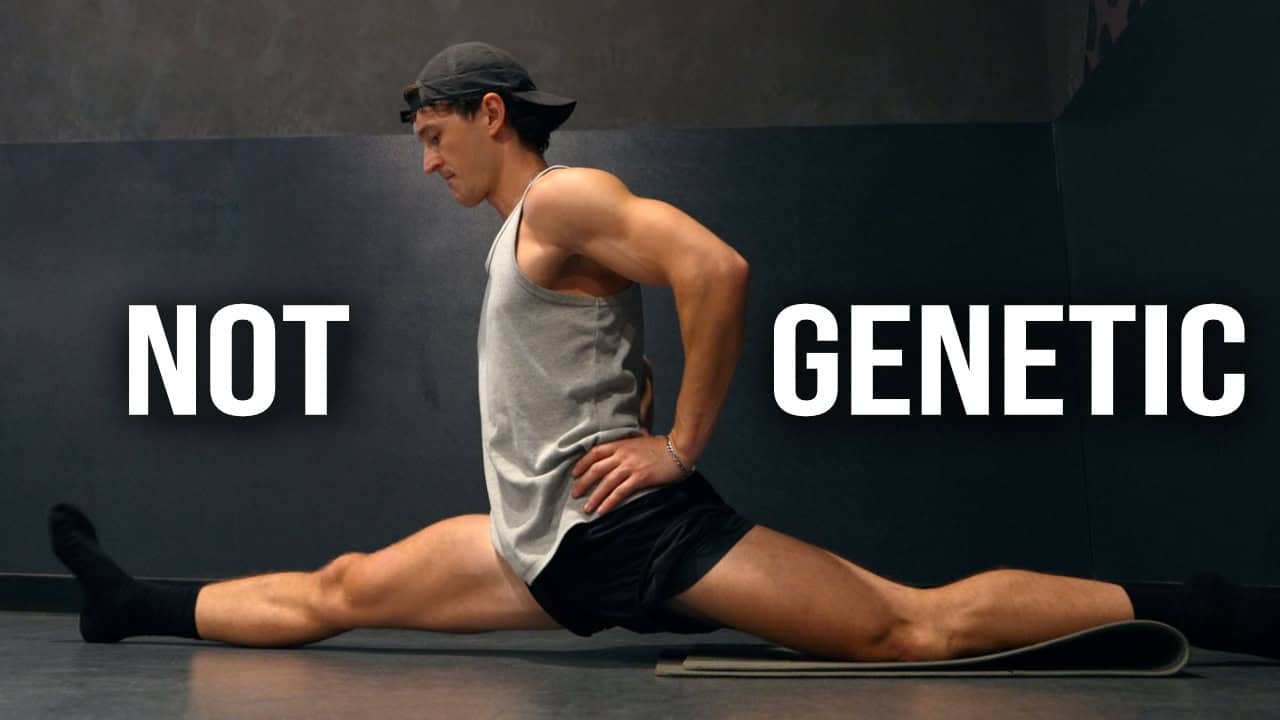
In this video we talk about how to unlock the front splits permanently. Here’s what we cover:
- Why proper flexibility only needs to be achieved once
- The mechanism for unlocking full front splits
- Guided walkthrough of how to train front splits flexibility from beginner level to full range
- Weekly training protocol to maximise progress
Full transcript
About a decade ago, I learned the front splits over a couple of months, and now I go years without touching it. In a set or two, I can open it up back to this. It’s just range that I now have access to. So if you have tight hip flexes and you want a permanent solution, or you just want to learn a move to prove to yourself that flexibility is not genetic, but something that you can train for, then in this video, I’m going to show you how you can achieve exactly the same in just a few short minutes a week. If trying to get into this movement is currently extremely tight, then there’s nothing wrong with you. Your nervous system is simply doing its job, which in this case is to keep you safe by not letting you go into ranges of motion that are dangerous and put you at risk of injuring your joints.
You rip both your femurs out of place, dislocate both hips, you’re in a world of pain, looking at a very long road to recovery that will probably never have you back functioning like you did. Now, that’s obviously not going to happen when you move into the splits under control, but we first need to train your nervous system to know that. Just realise from the outset here, you unlock a position like this once. It’s much like strength training. Once you have built muscle mass, even if you take years off strength training and let it disappear, it is so much quicker and easier to get back than it was to build in the first place. Flexibility is exactly the same. There is muscle memory. Your body learns that it can do this, you only have to teach it once. And the way that we teach it is also much like strength training.
In fact, if you can just treat this exactly the same, you’re going to have no problem quickly opening up large ranges of motion. The way you want to think about this, there are certain muscles that are the limiting factors for getting into this position, the ones that tense up naturally when you try and move into it. For this movement, it’ll be your hip flexors on your rear leg and your hamstrings on your front leg. You want to think about this like strength training those muscles in this stretch position. You’re not trying to stretch, you’re not trying to force them to relax or lengthen, you’re actually trying to contract them hard, underload, knee your end range, and do that for reps until you get really good at it. And the weird thing that happens is that the better you get at flexing in this stretched position, the more comfortable your body gets there and you don’t have to do anything.
You just notice that it starts relaxing and you start having access to more range, not in an uncomfortable, awkward way, in a way that you actually feel safe, relaxed, and strong, which is a pretty cool feeling. So for the front splits, we’re just going to think about doing reps of slides in and out of the deepest range we can comfortably hold and flex in. So word of warning from the start, initially, this is going to feel pathetic. You’re going to feel like you can’t get any range of motion whatsoever. It’s going to feel awkward. That’s good. Remember, you don’t have to try and get into a split. You just have to do reps, moving as deep as you currently can. So as you do this, I would try and keep your hips facing forward as much as you can, put your foot on something that can slide.
This works best on floorboards or tiles, or you can get a slider, put something under your heel that can glide across the ground. Make sure your back knee is patterned so you can get a towel or something, because it is going to be driving hard into the ground. And you can just assist yourself to do this with your hands on either side of you. It helps to have an elevated platform so that you can give yourself as much assistance as you need. If you’re finding it too heavy, it can be really useful to take some of the load off using your hands. You’ll actually find that there’s a perfect balance here of body weight pushing down in you that allows you to get the deepest range comfortably. It’s not nothing, but it also might not be your whole body weight. So use whatever allows you to get deepest, most comfortably.
And every time you move out, you want to be thinking about flexing the stretch muscles. So you can think about scissoring your legs together. Your back leg drives down and forward. Your knee is trying to drive into the ground and your front leg you’re trying to pull down and back. You can think about driving your front heel into the ground with a straight leg. The main form things to think about are keeping your front leg straight, so lock your knee out and as I said, keep your hip straight. So if you think about driving your back hip forward, like you’re trying to place the front of your thigh flat onto the ground, then that will help keep the alignment and make sure you’re loading up the rear hip flexor properly so that it gets stronger and unlocks the range we’re trying to achieve. And that’s it.
You can just work this for sets. I would aim for 10 reps each side. Get one set done. If you’re feeling like it’s productive and you want to have a go at some more, you can do multiple sets. Unlike your actual strength training, you don’t need much rest for this at all. You can keep doing as many sets as you like until you feel like you’re not really gaining any more range of motion. Do one. If you want to do a couple more, feel free. And I’ll just do this after your strength training for as long as it takes for you to get the range of motion that you want. So if you’re doing it two or three times a week, that’s plenty. You’re going to make really fast progress in this. And once you’ve got range of motion they’re happy with, or if you get bored of it, honestly, I wouldn’t put too much emphasis on this movement as a goal.
It can be really useful to open up these muscles if they’re tight, if they’re limiting factors for you in life or in training or in your sports. But as a goal in itself, I can count on my hands the times that I’ve shown off my front spots. Next to building muscle mass and raw strength, these sorts of flexibility goals pale in comparison. So if you haven’t already dialled in your main strength training and nutrition, that is by far where I would suggest starting. 40 minutes a week of good strength training is going to give you so much more general mobility and functional capacity than doing any specific flexibility move. If you want to get an idea of where to start with that, I’d watch this video. That’s it. I know a few of you have struggled with the exact cues and training methodology for the front split, so hopefully this helps.
If there’s something I missed or still unclear, please let me know in the comments. If you want to complete programme for implementing this sort of systemized strength and mobility training all in one in 40 minutes a week, you can watch an in-depth training on how we work completely free using the link in the description. Thanks for watching. Chat soon.