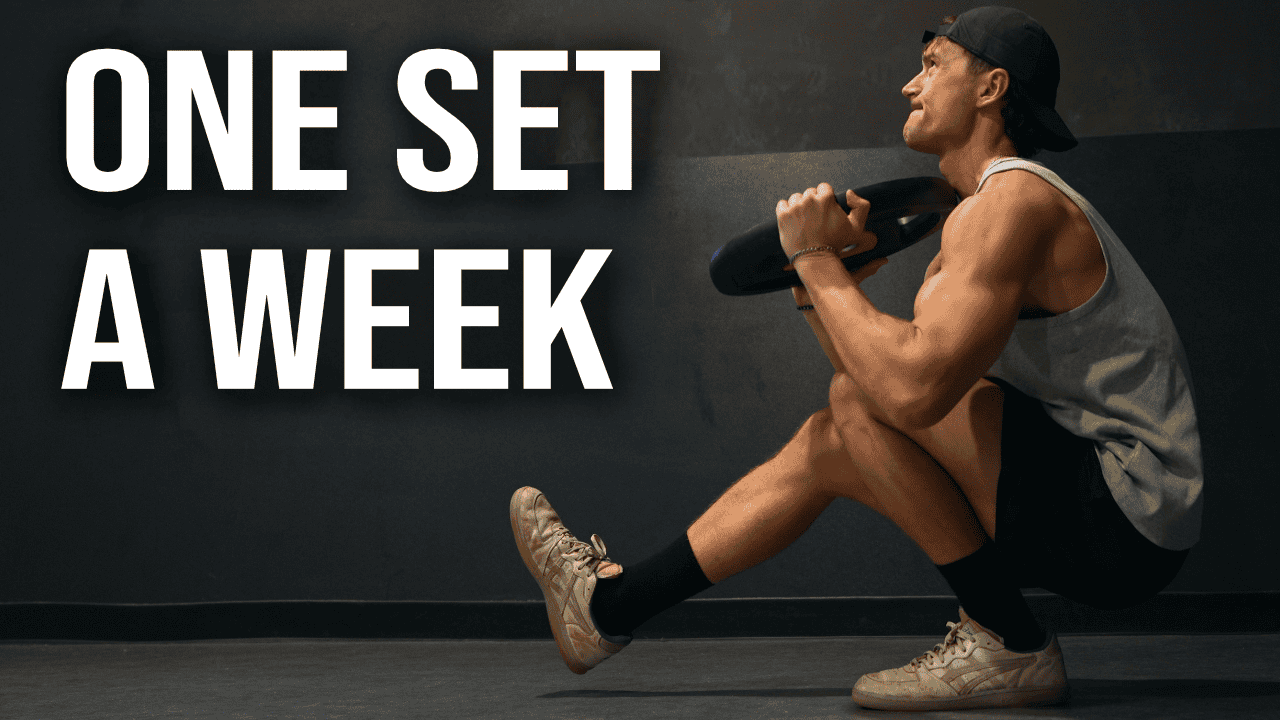
In this video we talk about why if you only do one exercise, it should be the squat. Here’s what we cover:
- Why you’re making squat training way harder than necessary
- Three different variations to train this movement for any setup and training preference
- Essential form for maximising results in under 5 minutes a week
- My secret mobility weapon for unlocking a freestanding single leg squat ASAP
Full transcript
There is one movement that will easily have the biggest impact on your physique, mobility, and quality of life. And yet I see people hating this movement, struggling to perform it properly, or avoiding it entirely far more than any other, my younger self included. And that’s the squat. In this video, I want to show you how to make your squat training simple, fun, and easy so that in less than five minutes a week, you can get the insane list of benefits from this movement and watch your entire body transform as a result. I’m also going to show you an exercise you can use to quickly fix your mobility and stop you falling back when you try and do a single leg squat. So stay tuned for that. The average person does not take their hips, knees, and ankles through any decent range of motion with any load regularly.
And it’s one of the biggest reasons you see people losing mobility as they age. But even in your younger years, the massive benefits that building quad and glute and hamstring strength have is crazy. It wasn’t until I started training squats consistently that I built the muscle needed to get really lean. My physique completely transformed forever. It’s such a dark horse movement, you don’t realise how much it does for you. However, if you have a spirit that’s 40% alcohol, you just don’t need to drink as much as if you’re having a beer, hopefully. And so if you give someone who hasn’t drank much alcohol whiskey, they’ll usually think it’s gross. Point of that analogy is that squats are like the 40-proof whiskey. You just don’t need much of them to get a huge stimulus for your body. I avoid it for years because I found it so taxing.
So do less. It is a powerful movement. We want to make it as easy as possible to take weekly squat medicine. So what I want to prescribe for you is a very short, very potent amount of work that will literally take you a couple minutes, but it will transform your physique and you get this right now. And when you’re 80, you have a chance of actually being able to squat down and play with your grandkids. And so I’ll show you a bunch of ways that you can train this. I’ve been on the road nearly all year and so haven’t had access to my weighted vest. So I’ve been experimenting a lot with different types of leg training and it’s never been easier or more fun to do. So as I take you through some of those ideas, the main thing I want you to bear in mind here is specificity.
If your goal is to unlock your first single leg squat or a weighted single leg squat or something similar, then the best sort of leg training is a loaded single leg squat because you’re training the movement pattern that you’re specifically trying to build. Yes, you get the massive benefits of mobility through full range of motion, general strength, muscle mass across your entire body, but you also get the coordination to use that strength to do a single leg squat. If you could give a rat about single leg squats and you just want to get all these general benefits that I’ve been talking about, then the specific movement that you use really doesn’t matter. As long as you are taking your hip, knee, and ankle through as large a range of motion as you can, ideally compressing them all at the bottom and getting a nice stretch and then actively pushing out of that stretch position, then you’re going to be getting all the benefits that you can.
The reason that compression of the bottom is so great is because it builds mobility training into the squat itself. And nearly everyone that I work with has a limited range of motion usually in their ankle. And so if you can train to that nice squished position, knee to chest, hips fully flexed, knee fully flexed and ankle as flexed as it can go, then we get all those joints nice and strong and bendy without needing to do any direct mobility work. So there’s lots of ways you can do this. My ideal one that I use is the loaded single leg squat. The reason being that this is a freestanding movement, you build the movement pattern of doing a single leg squat. It can be technically challenging if you don’t have the ankle flexion mobility to do it properly. So for a lot of people, I suggest starting with an elevated heel.
The key thing being you want to maintain as much hip flexion as you possibly can getting your knee to your chest because you don’t train that hip flexion through full range motion, you miss a lot of great benefits we’ve talked about with your glute strength and hamstring strength, which work to extend that hip. That’s the strength we want for function, for our booty, but also for athletic performance because hip extension is the motion we use when we’re sprinting, when we’re jumping, all of those explosive movements. With this, I just shove as much weight on as you can handle and spot yourself through it because the idea with all these squats is you just do a very short amount of work, one rep, a couple reps, depending on how you feel, but you just push as hard as you possibly can. And ideally we want to load this movement up so that the whole range of motion, we have to fight for it.
If you use less weight, you almost certainly feel you don’t need much weight at the bottom of this movement when the movement’s naturally hard, but then you’ll quickly reach a point where it’s way too easy for you. And if we’re not having to try really hard to push against resistance, then we’re not stimulating growth. And if we miss out on stimulating growth through half the movement, then we’re missing half the movement’s benefits. Really common problem with how people train squats. You don’t need a bunch of different lower body movements if you just get the entire squat range trained at maximum effort. So that’s the classic version. It’s also really low barrier because all you need is some weighted vests and you can do it at home. If you’ve got access to a gym, then my next favourite one that I’ve used a lot is the Smith Machine version.
So I’ve been training these just by loading up similar amount of weight, 60 kilos onto the Smith Machine barbell and just spotting purely with my other foot. Downsides are that you’re locked into a set movement pattern, but I find this a whole lot easier than trying to do it with a freestanding barbell for the reason that you can adjust the difficulty so much more easily. Because if you’re spotting with the other leg, then you need to shift your weight first to that leg to be able to take some of the load. So it’s really hard to keep it at maximum effort. You’re playing a whole extra game of balance. When you use weight best, you can just use your hands. It’s much simpler. And so with the Smith machine, you can literally just push more with the assisting leg to make it easier, push less to make it harder and work that whole range really nicely through full range motion.
If you’re struggling with the mobility or you just want something even easier, a lower barrier to get you doing this, then you can also use leg press or a hack squat machine. These make it extremely easy and it’s the same thing. You just load up as much weight as you can handle to get as much range of motion as possible max effort and then you just spot with your other foot as little as possible. The disadvantage with these, again, you’re even more locked into a set movement pattern with the machine and you miss out on a bit of range of motion, at least on the leg press with your hip extension. But again, I’ve still been using this sometimes because I’m lazy and if I’m not training my proper single leg squat, I’m like, whatever. But it works. You’re going to get all the same mobility benefits at the bottom.
Again, if you get knee to chest and you get that stretcher in your ankle and your knees fully bent, then you’re good. And yeah, maybe you miss out on a bit of hip extension at the top, but minor differences here. If it’s fun for you and it means you do it, don’t overthink it, do it. Also, you’re going to get large majority of benefits just doing once a week. You can do one hard set alternating legs. If you want a couple more, go for it. I’ve been doing this recently once every second workout, so three times a fortnght. Keep it simple. Once a week, one set. All I did for five years to build these legs and they have served me very well today. Now I say to give you a specific mobility weapon to accelerate your progress to being able to do full unassisted single leg squats.
Just the single leg squat training is going to build the strength to be clear. But the biggest thing that I see stopping my students from being able to do a freestanding single leg squat is often not strength, but this lack of ankle flexion mobility. So if that is your limiting factor, and you know that because if you’re trying to do a single leg squat and you fall backwards about halfway through, then that’s the reason. It’s because you can’t get your knee far enough over your toe to keep your weight centred on your foot. So if you want to fix that and get to doing freestanding pistol squats as soon as possible, a really good exercise to target that mobility directly is the ATG split squat. This is one of Ben Patrick’s movements. I think it’s fantastic because what it does is directly target the limiting factor for this movement, which is getting that knee over that toe in that bent knee position.
So it’s directly mimicking the mobility that we want to unlock. It’s doing that under load and you can scale this so easily to your current level of mobility. The key thing is to just keep your heel flat on the ground and drive your knee over your big toe. And you can do this after your squat training, you can do it on rest days, really doesn’t matter. You can do it a couple times a week. With mobility stuff, I would say go hard at it for a few months until you get the mobility that you want and then you can chuckle away. This will maintain itself by doing your squat training. We’re specifically targeting something here to allow you to then train better through a larger range of motion that I don’t have to do any work on my ankle mobility because I smash it every time I do squats.
So you can do this. I would use a decent amount of weight because the more you can load up that end range position and get stronger, the faster you’re going to unlock that mobility. Do it for 10 reps, do it for one set or a couple and do it two or three times a week. You’ll make very fast progress with your ankle mobility. So that’s an extra add-on. The main thing is choose a squat variation that you like that makes sense to you and do it once a week. You’ll just see so many frigging benefits from it and your body will transform. If you want help getting your entire body strength and mobility sorted in under 40 minutes a week, free training below, running you through our entire system and how you can get help with it, links in the description. Otherwise, I hope this makes these squat sound doable if not exciting.
Honestly, my favourite movement right now, get after it.