In this video we talk about why you’re not rowing hard enough to get results, and what to do about it. Here’s what we cover:
- Why a weak upper back is the cause of most common postural issues
- The problems with standard approaches to upper back training that result in little to no progress in strength and muscle gain
- How to flip these issues and achieve a high-level upper back strength in as little as three hard reps per week
Full transcript
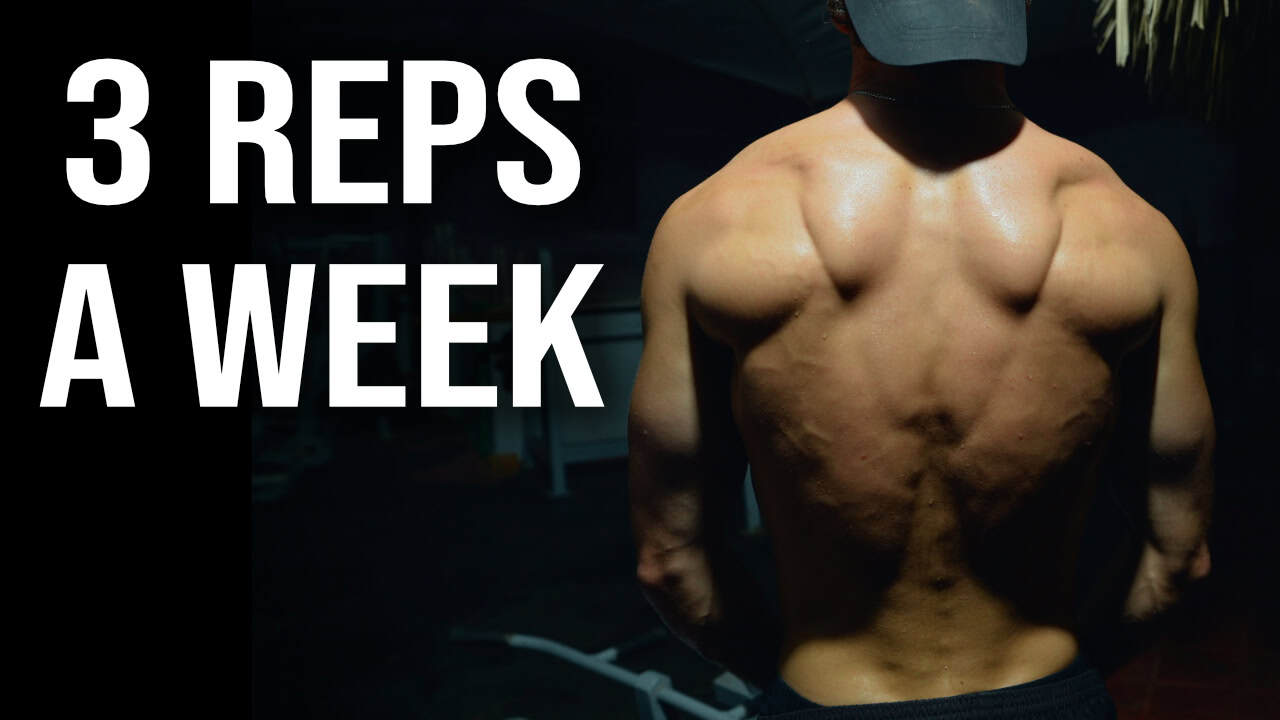
Most people’s upper backs are weak, leaving them slouch forward with that classic hunchback posture. Then they try and fix it with postural alignment or stretching when what they actually need is strength. This was built by one movement and I’ve done it in about three reps a week, but fixing posture is just the beginning. That same training got me to the point where I can do things like this. In this video, I’m going to show you how to get the same results yourself starting from zero. The movement pattern that builds your upper back is the row, but the problem with most people’s rows is that they are way too light. If you’ve ever stuck to a gym programme for ages, but just felt like you were going through the motions and never actually got any results from it, then you know exactly what I’m talking about.
Just going through the motions with rows with weight that doesn’t make you red in the face is kind of like brushing your teeth. You don’t get a jacked arm from doing this every night. In the same way, if you’re just doing some measly single arm dumbbell row or body weight row for rep after rep, set after set, you’re not actually telling your body to change. Now you don’t need weight to do this. I did this all with body weight training, but regardless of the tool you use, the same principle applies. If this is the bottom of the row and this is the top and this line is your maximum strength at each point in that rep. Most rows where people are just going through the motion with a weight that’s too light or God forbid just their body weight on a normal body weight row, then the intensity, the force required is down here.
It’s nowhere near your limit and so it doesn’t signal any change. It never gets anywhere near our maximum strength and so there’s no signal sent to our body to do anything. You’re not going to build muscle just by moving a weight around. Doesn’t matter how many sets or reps or gym sessions you do or how many years you spend doing that. You’re going to send a clear signal to change by challenging your maximum mobility, your body doesn’t respond. And then what people do is exactly that. To try and compensate for a lack of effective training, they try and do lots of it, layering on more and more and more of this submaximal work expecting a different result. You’ve all probably seen that person who’s been going to the gym for a decade is super consistent showing up and training and has a physique that you would not write home about.
No one who has been training properly for three to five years needs to look like they don’t lift. If you’re actually challenging the limit of what you can doing, it does not take that long to see results. A couple of years you can transform your physique, but a lot of people get stuck at set one, which is the lack of intensity. But the insidious thing about this here is that the more of this lower level stuff that you try and do, the harder you make it to perform with higher intensity and actually reach the limits of your strength in your training. Think of it like sprinting. How fast do you think you could go if I said to sprint as fast as possible for five seconds versus five minutes? Which of these do you think is going to result in the average higher speed? It’s going to be the five second sprint, right?
And now imagine you have to do this sprint every morning versus once a week. Again, which do you think is going to have the highest average speed? Probably the one you don’t have to do as often. And now imagine that top speed is the force output in our rows. That is the sole driver of growth. How much load you can move throughout that move pattern. Increase that over time, you build more muscle. The last mistake that people then make is realising this, realising that they’re not doing enough in terms of absolute load and then going actually too heavy and getting stuck. Because what happens in, if we go back to the strength curve, what happens if I try to lift a weight at this level, as soon as I reach the part of the road where I actually hit my limit, which is exactly what we want to aim for, then I have to stop because I’m not strong enough for the rest of the rep to actually keep going at this level.
And so that’s why rows can be really frustrating because as soon as you get a load that’s heavy enough to actually challenge your maximum strength, you only get a tiny part of the rep that actually maximally challenges you. The rest is still easily within what you can do and then you have to stop once you hit max. It’s a rock and a hard place here. Too light, you don’t get any results, too heavy, you can’t really train. More work doesn’t help you. And so the way to solve all of this is to set up your roast that they challenge you from maximum intensity from the start of the rep and then they scale with your strength as you move so that every single point in the rep, you have to pull as hard as possible to move the load. If you do that, then you get an entire range of motion that’s maximally challenged to your maximum force output and in seconds you stimulate growth.
This is the Goldilocks zone. This is that zone of perfect stimulus that’s perfectly targeted at our body to make it grow. And that’s how you get training so effective that in one hard set but week and build up some movements like front levers. So how do we load it? Well, we basically just need a difficulty knob that we can turn as we train to scale it up to our strength and then down just enough as we train to keep it at max effort. When we want to turn around and do the negative, we can then scale it back up so that it gets too hard for us and forces us back down the rep. We do that and I’ve done two or three reps of that sort of training a week to get all the results you’ve seen here. It doesn’t take much. Okay. So what does that look like for rows?
Well, track away your barbell and dumbbells. The one and only way I’ve found to do this is by using body weight training. Gymnastics rings make this super simple. If we take the front lever as an end goal level of strength and I know you might not be anywhere near doing this now, that is fine. Why is this movement so hard? It’s not a lack of core strength. I can tell you that right now. You don’t actually need that much core strength to do this movement. The difficulty all comes from the torque at your shoulder joint because your feet are out here, it’s a really long lever, which means the force required from your upper back to keep your shoulder in position and not flop down to the ground is just massive. And so you need physically big, strong back muscles to be able to maintain this position.
If you want to scale this back down and make it really easier, all we’ve got to understand is that the difficulty actually comes from the horizontal distance between our shoulders and our hands. And so if we reduce that distance, i.e. By tucking back in or by dropping to our feet and actually just doing a body weight row like this and we can control the difficulty by just how far away we push the rings towards our feet. And so the best way to understand this is you can forget about the physics, just try it yourself and this will make a whole lot more sense. So I’m going to walk you through that exact experiment. You can do this at home using rings, TRX, a table, a bed sheet, anything you’ve got lying around. Before we dive into that, if you want to see all six movements that I’ve used to build my body, including this one with the progressions and strength targets for each, I’ve put that all into a free guide, you can download it using the link of the description.
So the easiest way to understand how to do this movement is just to get to the top of a body weight row and we’re going to just scale the difficulty knob up to the point where you are forced down. If you fail throughout the negative, in other words, if you try to keep pulling up the whole time and just make it so hard that you will literally force down to the bottom of the movement, then you know you have found your maximum strength limit. You’re actually above it and this is how you get crazy results from very little training. So get anything you can do a row and you can use a table, you can put bedsheets behind a door like this and use them, you can use gymnastics rings if you’ve got them, or you can use some sort of parallel bar. Pull yourself up toward the top of a body weight row.
All you are going to do is try as hard as possible to stay there, keep rolling your elbows down towards the ground, keep your body where it is. But what you’re going to do is crank the difficulty nobody by pushing your hands away towards your feet. Keep pushing further and further, your shoulder will come back the opposite direction. That horizontal distance between your shoulders and hands will increase and you just want to keep pushing it until you start to lose control and you actually force down to the bottom of the movement. Keep trying to rug your elbows down towards the ground until you end up in the position where your elbows are fully locked out, you’re at the bottom of the row. You have now just experienced what proper effective strength training looks like. On the way up, you do the same thing. You just make it ever so slightly easier so that at every point in the rep, you have to pull as hard as possible and the whole thing’s really slow and difficult.
You can see the effort on my face as I try. If you need to make this easier, are you physically stuck, then you can just walk your feet back like this, take load off your hands and it’s the same process here. If you need to make it harder, then just keep pushing your hands away until you can take your feet off the ground. And that is your first goal as you train this movement and get better and better at it. Your goal is to be able to get your feet up off the ground, get your knees to your chest and do these tuck front lever rows. But just this simple progression of pushing your hands away is going to allow you to build all that strength. And once you get the point of doing tux is a very simple progression onwards towards full front levers.
The protocol for this, this is going to be way more intense than any other sort of strength training you’ve ever done. If you’ve done traditional rows in the past, do it once a week. Keep it simple. If you want to do more training, do another pull movement on another day, I’d suggest your vertical pulling. Do one set of this, keep it really short and sweet. As soon as you can’t pull as hard as possible, stop. If you want to do more sets you can, you need to be even more aware of keeping them short so that you actually recover enough to do them. I wouldn’t worry about that until you’re making some pretty solid, consistent progress with this. Keep it simple, focus on the technique and intensity and just work them as hard as possible until you can start to jump up and get your feet off the ground.
And by the way, that’s all I ever did to get the results that you see now. One movement, three reps a week, that’s all it took. If you’re on the full system, links below. Speak soon.