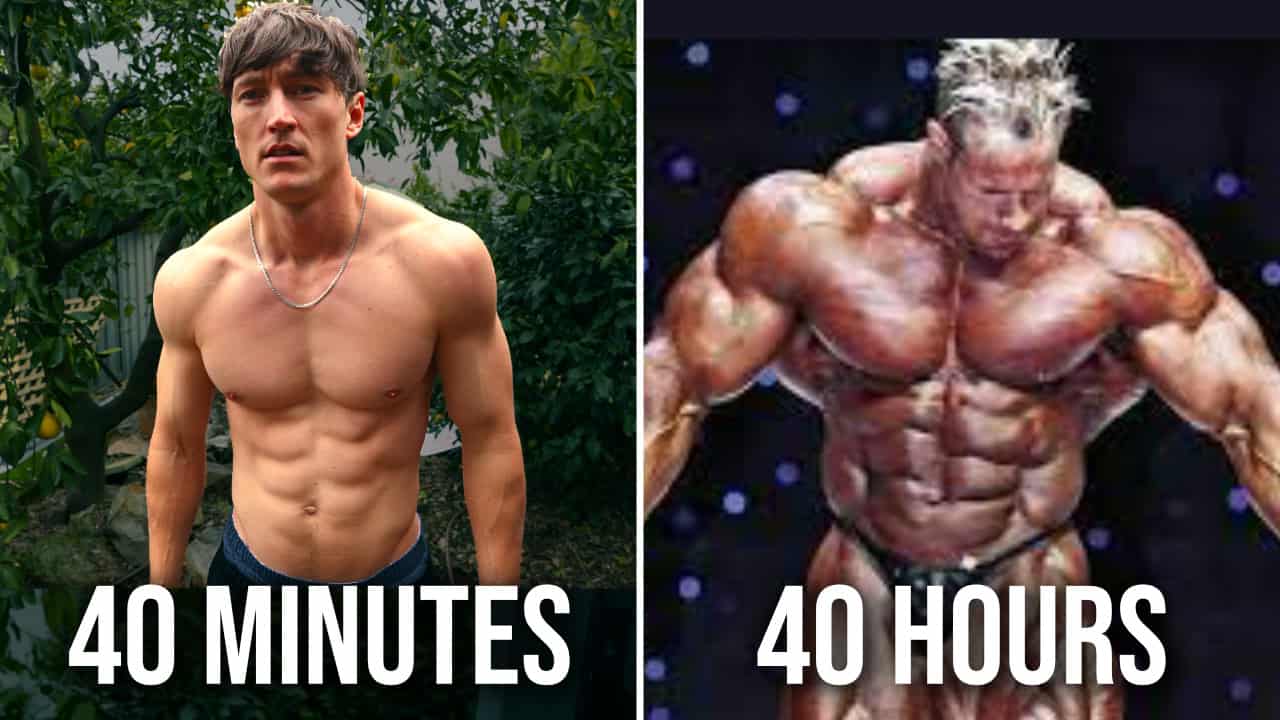
In this video we talk about the extreme differences involved in becoming the fittest person in the world vs the fittest of the people around you, and why for most people the latter is the undeniably better choice. Here’s what we cover:
- Why many people are attempting to model their fitness routines off completely the wrong examples
- The #1 factor that accounts for the vast majority of difference between elite athletes vs average people, that most severely underestimate
- How that can be leveraged to achieve 90% of the same results in a tiny fraction (well under 10%) of the time
- The often overlooked risks and downsides associated with pushing for the remaining 10% of performance
- How I fit fitness into the bigger picture of my life goals
Video summary
We discuss the distinction between becoming a world-class athlete versus simply becoming more physically capable than those around you. The time and effort required to reach the top of athletic performance is vastly greater than what is needed to achieve a high level of personal fitness.
I emphasise that 90% of the difference between elite athletes and average people is simply the amount of time they have dedicated to training, rather than any innate genetic advantages. For most people, the goal should be to achieve a high level of fitness in a reasonable amount of time (under 40 minutes per week) rather than pursuing the extreme sacrifices and risks required to become a world-class athlete. This approach allows more time and energy to be devoted to other important aspects of life like relationships and work.
Full transcript
Do you want to be a world-class athlete or just more capable than anyone else around you? Do you want to have the best physique in the world or the best out of everyone? The reason that this might be one of the most important questions you ever ask yourself is that the difference in input required to achieve these two goals is I’m willing to bet astronomically more than you think. This is a full-time job, this is under an hour of work a week, and it’s not just about time either. There are heavy costs to choosing the former and far too many people who really just want a great body that they actually have the time and freedom to enjoy are trying to emulate professional athletes and achieve it in a way that makes that very goal impossible. In this video, I want to show you how to choose a routine that actually improves your entire life, rather than leaving you too time poor and restricted and broken to even notice you’ve reached your goal.
Some of the biggest kickbacks I get from people considering our approach to fitness is saying things like, oh, I think I’m need more volume to gain more size, and they’re skinny, which annoys me a lot, but I’ll explain where this era comes from. Or the other infuriating response is saying, why don’t professional bodybuilders or elite Olympic gymnasts train like this? Then why do they do so much more work? Understand this principle and it will literally change your life forever. The only difference between elite level performers and normal people is number one, the amount of time they have been training for, and this accounts for most of the difference, maybe 90% of the gap between average Joe and best in the world. And number two, the remaining 10% comes from maxing out every percentage of progress possible, which as I’ll explain is risky, very time consuming, difficult as opposed to just doing enough to stimulate progress, which still gets you 90% of the way there, but in 10% of the time and is simpler and far safer and easier.
And then on top of that, you can add in whatever genetic differences and predispositions. The best of the best, best have to be able to take all of that and beat everyone else. So let’s talk about time. This is what I think just so many people fail to understand at all, and if you take nothing else away from this video, I just want you to walk away realising that 90% of the game is this, and unless you actually truly care about that final 10% of the performance, your priority just needs to be on nailing this, doing the thing long-term because almost everyone I see failing to be where they want to be have just hugely underestimated how much of a part this plays. You can get really, really good at anything way better than anyone else. You probably know without putting a huge amount of time into it, but regardless of how much time you do put in, it’s still going to take a long time to get there because the time required to transform yourself, to build muscle tissue, to get really strong or to rewire your brain and learn any skill to get good at business or piano or a language, the time required is sleep cycles.
It’s your body actually making those changes, building muscle rewiring synaptic pathways, that takes time, but it’s not about the time you spend doing the thing. Your job is just to show up and stimulate adaptations to occur and allow them to happen. And that really doesn’t need to take long. It’s a fraction of what most people think. Easy analogy for this. Imagine you’re trying to learn Spanish. What approach do you think would get you further? You do five hours once every 12 weeks, or you do five minutes every weekday, which do you think will get you better? Because over 12 weeks, it’s the exact same amount of time, it’s five hours, but I can tell you it’s absolutely not the same result because I’ve done the latter and with the right stimulus, it works. So once you are consistently showing up and sending the signals necessary for your body to adapt, whether that be training or practising a language, whatever, it’s very little variability actually comes down to how much time you’re putting in, let’s say every day or every week.
And this will hopefully help you understand why that’s the case. When we’re stimulating adaptation, like when we’re training, trying to tell our bodies to get stronger, we’re operating on a steep diminishing returns function. The more stimulus we put in, the more adaptations we signal, but it’s not linear, it doesn’t work like this. Instead, the first tiny amount of effort we put in will stimulate the vast majority of the adaptation that we want, and every bit more we put in, every bit more training we try and do every bit, we try and push ourselves to do more work, we get less and less and less extra benefit. So back to our dichotomy of awesome versus world-class. If you want the extra 10% results, you can put in the extra 90% work to get there, but it’s going to take you 10 times the amount of time and you also have other downsides as well.
Ignoring the neglect that requires to other aspects of your life, you also have to accept experiencing things like a lot more stress on your body that it has to somehow recover from. And a reminder that’s more of the same negative stress, stressful less and less and less positive result, meaning the more you do, you’re getting an objectively worse return on investment of that effort and ultimately reducing the longevity of your practise and your body itself. So another thing to keep in mind here, so when you look on the internet, the best in the world, the insanely strong and ripped massive people, they have just been first and foremost doing this properly for way longer than you pushing their strength, fueling progress properly, staying uninjured, and that accounts for most of the differences between you. On top of that, they have then also made this progress faster and gone to an even higher level by taking it on like a full-time job, pushing the limits of their physiology, fighting at this frontier of fatigue and injury, and then let’s not kill ourselves.
That many have gone even more extreme than naturally possible by using drugs. Another thing that in the context of overall health and wellbeing, I’m utterly uninterested in doing, but they’re completely unrealistic for the X. Almost all dicks, the physique you see me with that still took 10 years to build, but it only took 40 minutes a week of some smart stimulus to do so, and I had a great physique well before 10 in diminishing returns applies long-term as well. So early days it’s much quicker progress than later. And yeah, maybe this all would’ve happened a little quicker. Had I trained diligently six hours a week and smashed myself, had I been a nutcase with my diet and super rigid and absolutely nailed all the details, but that would’ve come at a cost to my body and to my life because I got a lot of other shit done in the meantime that would not have been possible had I been spending those hours in the gym.
Why are we worrying about physical fitness in the first place? It’s really easy to forget about context when we’re looking at fitness specifically, but nothing happens in a vacuum when we’re thinking about overall wellbeing as a human being, there’s three basic components that you could say, make it up physical health, quality, relationships, and meaningful work. Achieving these three things and experiencing positive emotion on a daily basis for me is the overall goal. I want to be happy. I want to be flourishing, thriving, I want to enjoy my life without any of these three things. That’s impossible. And so on a fundamental level, when I think about goals, this is what I’m aiming for. Now, the issue when it comes to fitness and figuring out what we want to be striving for, the problem with trying to be the best in the world is that in the process of doing what is necessary to be world class at anything, be it bodybuilding or gymnastics or power lifting or any other sort of physical sport, we inevitably take time and energy away from these other elements of our life, reducing our ability to work on our relationships, our work, and any other personal pursuits that bring us joy as well.
Ironically, it also detracts from our physical health because the work that’s necessary to become the best in the world involves huge amounts of fatigue and constantly battling injuries and even adverse performance enhancing drug use. So with all of this, is it even worth achieving the goal at all? If you like me, are trying to just get your life as good and enjoyable as possible because realise that the highest performers, the best of the best, the people going for gold medals and bodybuilding titles, they are happy to make the sacrifice. They decide that it is worth it, that the higher purpose of achieving that goal is worth coming at the expense of their own physical and emotional wellbeing. It’s what makes these elite performers so respectable because they decide that they’re willing to make that sacrifice for something bigger than themselves. But if you are not them aiming for that goal, why the fuck would you ever approach fitness like they do?
If we take the ultimate approach and think about going for the best in the room, trying to be really good but not best in the world, we can massively boost the quality of our physical health. We increase our strength, we improve our body composition, and we get lean. We increase our general daily energy level, our physical capacity. We gain and maintain muscle mass and mobility as we age, meaning our longevity and overall quality of life is extended. And the whole point is that that can be achieved in under 40 minutes of work a week, which I would say is a pretty fair sacrifice for one of these three key pillars of your overall life because then we can put all that remaining time and energy back into the other things that matter with leftover to go and apply to whatever other skills or hobbies we want to pursue.
The takeaway here is decide on your goal. Do you want to compete to be the best in the world? Are you willing to go and sacrifice your wellbeing for that higher aim or do you want to improve your physical health? How you feel and how you look as just one key component of an awesome life? Because either one is going to take you five to 10 years, but the form requires dedication, pain, sacrifice of other things, and a whole host of commitments to things that I’m not interested in ever committing to. The latter is relatively easy and can be done in less than 40 minutes a week with a pretty effortless diet if you just realise one thing, it’s that when you make time your ally, none of this is hard. Most people just can’t plan for those long timelines and so many people I see trying to compensate by going hard, not realising the rapidly reducing outcomes they’re getting on all this extra effort, which will never make up for the passage of time. If you like this philosophy and want to see how it applies to fitness specifically, I’d say we’ve just about nailed it at this stage. You can check out our full free training on our method below. Otherwise, if you want to watch more videos, check out this one. Chuck your questions in the comments below for me, and I’ll chat to you soon.