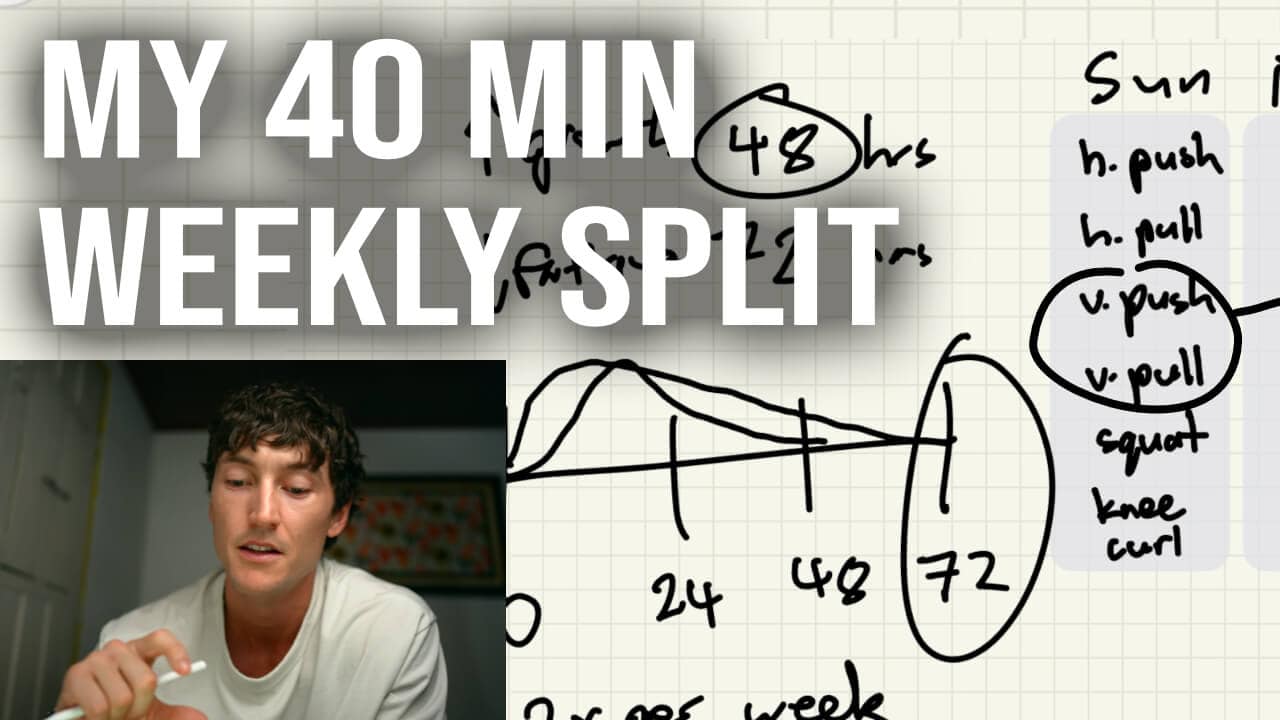
In this video we talk about the most effective way to split your training over the week for maximum progress and minimum time. Here’s what we cover:
- How to optimise growth signalling so that we are always building as much muscle as possible
- The two types of fatigue and how to minimise their impact
- My ideal training routine (copy me)
- The best training split options to suit any preference and schedule
Video summary
This video explains how to optimally structure strength training routines across the week. It presents a framework based on six fundamental movement patterns—horizontal pushing and pulling, vertical pushing and pulling, squatting, and knee curls—trained once weekly to maximise muscle growth while minimising fatigue. Jack recommends a three-session-per-week split: horizontal push/pull on Monday, vertical push/pull on Thursday or Friday, and legs separately, allowing adequate recovery (48-72 hours) between muscle group sessions while maintaining training intensity. Alternative routines for two sessions per week or full-body single sessions are also viable, though with trade-offs in volume and difficulty. The key principle emphasised is consistency and adherence—selecting a routine that fits your schedule ensures you train all movement patterns regularly, which matters more than perfect scientific optimisation.
Full transcript
One session a week, 40 minutes of intense proper strength training. This is more than enough to transform your body and get incredible results. And for many people who are struggling to train at any other time in the week, it’s a fantastic solution. It works. But if there was a way to make that training easier, make significantly faster progress and spend even less time doing it each week, then I would want to know about it. And it turns out that there is. And so in this video, I want to show you what the most optimal way of splitting up your training over the week is, exactly how I do it, and then how you can adapt things when optimal isn’t possible so that regardless of what life throws at you, you never miss a beat and still make the best games possible. So I’m going to show you how I split up a workout routine based on these six basic movement patterns, horizontal pushing, horizontal pulling, vertical pushing, vertical pulling, squatting, and then some sort of reverse squat knee curl movement.
The way I structure my training and teach all my students to do to great success is to use one movement for each of these movement patterns, train it once a week with the sole intent of getting as strong as possible at it. Whether or not you’re taking exactly the same approach as us, understanding these principles is going to help massively with how you structure your training. And if you are using the same movements, then I would highly recommend you understand this so that you have the option at least to structure your training for maximum gains with minimal downside and time as well. So the sort of two key things to consider when we’re deciding how to split up our training. The first is muscle protein synthesis and gains, how we spread our signal over the week so that we’re always building muscle and getting stronger.
And then the other is managing the fatigue that comes with training so that when we do come and train, we can push as hard as possible. And so this isn’t super complicated. In terms of muscle protein synthesis, every time that we train hard a group of muscles, there’s about 48 hours of elevated higher muscle protein synthesis where your body is going and building muscle. So that one’s pretty clear cut. There’s lots of research on a link of paper in the description if you’re interested. The other thing to consider is fatigue. And so this will depend a lot more on how much work you’re doing and then how good your recovery is, sleep, nutrition, lifestyle factors, stress, et cetera. But we can say generally that maybe about 72 hours after training, most of the fatigue from that specific session will be dissipated. And so basically what this means is we want a good three days after training a set of muscles before we train them again so that we have enough time to recover, but then so that we get muscle protein synthesis happening again.
So if we thought about a three day timeline like this, muscle protein synthesis is looking something like this, very rough drawing, but you get the idea, and then fatigue might look something like this. And so let’s say that our goal for most muscles is to hit them about three days after we train them again. Well, with seven days in the week, the easiest way to do this is to just hit our muscles twice a week, which means that every three to four days we are stimulating growth and meaning that we’re always sort of anabolic, we’re always progressing, making gains. So that’s considering our body’s response to training stimulus and its growth. The other really important thing that we have to consider is our ability to actually send that signal to do the training at a high enough quality and intensity that we actually do tell our body to grow.
Because over time, if we’re not actually getting stronger, then we’re unable to send an effective signal to our bodies to keep getting stronger and therefore build muscle. And so in terms of fatigue management, there’s two things you can think about. One is localised fatigue, meaning the actual muscles we use in a session are going to tyre out. And so let’s take two of our pushing movements, horizontal and vocal pushing. These are going to use a lot of the same muscles, triceps, shoulders, chest being three obvious ones. If we try and do, let’s say on the same day, horizontal pushing, and then we go after that at some point in the same session into vertical pushing. It should be reasonably intuitive that by the time we have absolutely gassed our shoulders and our chest and our triceps doing horizontal pushing, that by the time we then go to do vertical pushing, we’re not going to be able to be hitting PRs.
We’re not going to be able to push anywhere near the level of maximum intensity that we might have been on the first movement. And so ideally, for the sake of pure ability to signal to our body to grow by pushing hard, we would want to separate these movements ideally by three days coming back to this fatigue management thing here. So we want to do that for our two pushing movements and we want to do the same for our pulling movements, horizontal pulling and vertical pulling, because again, much the same muscles used, biceps, upper back, rear delts, lats are going to be used massively in both these movement patterns. Okay. So we want to split these movements up across the week, ideally about three or four days so that we can push equally hard on all of our movements, avoiding the downsides of this localised fatigue we get in these muscles when we train the movements in a single session.
The final things you consider before I actually show you what all this looks like as routine options is general fatigue. And so this is referring to the fact that even if we’re training completely different muscles in every movement, we’re going to accumulate systemic fatigue across our body. Our central nervous system is going to get cooked. Basically our body’s just going to have a very tough time doing anything, regardless of what movement it actually is. And so ideally we split up our movements so that we have two, maybe three in a single session. This is less scientific, more from personal experience, from experimenting, but I find that two allows you to go very hard as long as they’re not the same muscle group. And three is still possible. And we’ll talk about that more in just a second. But basically what happens if you keep trying to add movements on and do four, five, six in a single session, they just get much harder to do.
Each successive movement is way harder to push hard on. You end up with lower intensity overall, even right from the start, because you know those movements are coming, you have to stretch yourself out to last the whole session. And then motivation starts to become a factor because think about the difference. If you have to work yourself up to do an entire 40 minute routine training your entire body for the week, how much harder is that to bud off than just doing a single movement or two movements, three minute or 10 minute session, and then you’re done for the day. Okay, so let’s put all this together and solve for maximum gains. By the way, if you’re enjoying this and want to know specifically what movements I’m actually using for the his movement patterns, I have put them all together into a simple document along with the benefits of each, what movements they unlock and the basic levels of progression.
If you want to have a look at that, you can download it for free using the first link in the description. Okay. So I’ll show you first how I do this. So this is the routine that I’ve used for a long, long time, 90% of the time, and it’s very simple. So basically I will start with horizontal push and pull on Monday, and that’s the kind of anchor of my week. It means that we get different muscles worked. These are antagonist movements, meaning they’re literally the opposite, pushing one direction, pulling the other, which means that there’s really no negative impacts of the first movement on the second. As long as you have a good rest, I’m talking at least five minutes in between. So if I do horizontal push and that takes me two or three minutes, five minutes rest, two or three minutes to do horizontal pulling, then my total training time for the day ends up being around 10 minutes, including rest times, which is fantastic.
So super easy to buy it off. I can channel nearly 100% energy into both of these movements. Then from there, I have vertical push and vertical pull to do. All we said before is that we want to put these three to four days later. And so three to four days means either Thursday or Friday. If I train them on Thursday, I have three days in between here and then I’ll have four days till I train them again. And then if I put them on Friday, then I’ll have four days between Monday and Friday sessions and then three days before I train those muscles again on Monday. So it doesn’t really matter. That varies week to week, depending on who’s around to train with, what I feel like doing. And then the final session of the week is legs and this can literally go anywhere. Usually I do it on a Tuesday just to get it done.
Sometimes I will be busy and do it on Wednesday, but it really doesn’t matter because as long as you’re doing it on its own day, then the main effects of that general fatigue, systemic fatigue are dissipated. So whenever it is convenient, I’ll do that. And that is basically the default routine I’d recommend. If you have all the options possible and just want a routine to run with, then you can pretty much sort the video there and go with that. That works. And it’s what I recommend to all my students if they’ve got the option to set up their routine however they want. Obviously the specific days of the week don’t matter. I just like starting on Monday. The next best routine, if you want to squeeze everything into two days a week, it’s very doable. As I said, you start to have more of this issue of general fatigue in that three movements in a single session training your entire body is just a bit tougher, but it’s something that I’ve been using while I’ve been travelling to mean that it’s just much easier to get two workouts in a week than three, because that means that you have five days of the week, you don’t even need to worry about training.
So when I’m doing this, it’s as simple as putting squats on that first upper body session in the week and then doing naughty curls on the day that I train vertical pushing and pulling. And so each of these days becomes a full body workout, essentially. Downside to that, obviously it will take longer and just be a bit harder. But if you do what it works, just expect to be completely wrecked for the good half hour to hour after your session. And if you’re somewhere hot and humid, you have to be very sweaty as well. As I said, if you are someone who is just really struggling to get training done, you have a crazy week, maybe you are travelling and want to get everything done for the week before you leave. There’s all sorts of reasons why you might just want to get your training done in one day.
It’s good to know that you can. And this doesn’t have to be all the time, but if those sort of weeks come up, you know you’re not going to be able to train for a while. You just want to smash everything out at once. Then it absolutely works and you can, as I said, the main downsides of what we’ve talked about here, you for all of that week won’t be making as much progress in the second half of the week and it’s just going to be a lot harder to do and it’s going to be a lot harder to push as hard as possible and do as much hard work on the later movements, whatever you choose to do on the backup each session is going to suffer. But the biggest thing with all of this is adherence like the most important thing you possibly can do for yourself is to get all these promotion patterns trained once a week as consistently as possible.
And so whatever set up, whatever routine allows you to do that is the one I would just highly suggest doing because this is all optimization, but optimization means bugger all if you’re not actually showing up and doing what you plan to do. Before we wrap up, there’s a couple other things I want to discuss. One option you may have thought of obviously is to put one movement each day over the week, six days. This is completely valid. The reason I don’t suggest it is I just think the marginal benefits gained from doing this don’t really add up to the downside of having to train basically every single day. Like you’re going to train at horizontal pull pretty much just as well if you do it after your horizontal push provides you have that rest as you would if it had its own day. And so I just think like, doesn’t really matter.
And if this sort of routine appeals to you and you want to just get up in the morning and smash out a movement or you want to get home from work and just do one movement, then yeah, it completely can work. I just think for most people, fewer workouts during the week for the same outcome is generally easier. Final thing to cover, you may have noticed with all this discussion at the start that legs are only getting trained once a week and you would be absolutely right about that. For me, doing legs once a week is enough. My biggest priority is my upper body development strength and while I really value having athletic strong legs and building leg muscle is one of the best things you can do for your overall physique, body composition, once a week is just enough. As I said, you don’t start regressing in strength and muscle within a week of not training and movement.
It’s just that for optimal, maximum, all week gains, hitting them every two or three days is better. However, there is also the fatigue things to consider and squats are extremely taxing on your body. So the fatigue you accumulate from doing even one rep, if it’s heavy and grinding enough of squatting is crazy and having a full week to recover for them is usually better for me. It means my training is much higher quality and remember at the end of the day, it’s how hard you can push, how much stronger you can get that determines how much muscle you grow, not how scientifically optimal your setup is. And so I find that I can just push harder. Squat training is more fun once a week, which is extremely important for adherence. From my sake, I used to try and do a lot more and then just never was consistent.
And what was the point? Now from doing one, two reps a week for the last several years, I’ve made incredible gains with my strength and my lower body muscle mass. So that’s my thoughts on squats. If you wanted to do legs twice a week, you could absolutely do so and just have this alternating up a lower type setup. However, I would not recommend this until you are very consistently hitting the basics suggested before, using one of those routines I suggested and making consistent, significant strength gain with them because I don’t do this. So I certainly wouldn’t start there if that’s something to consider if you more advance or want more leg gains. And so in terms of training splits, that’s it. I think they’re the only things that you really need to consider and that’s how I set up my training for great success. Again, this isn’t rocket science.
There’s a few principles to consider, but at the end of the day, whatever makes sense to you and is going to be the most fun for you to execute is absolutely the best choice. Hopefully this helps guide your decision making with it. If you’ve got more questions on any of this stuff, please let me know. We’d love to hear from you. Hope yourselves as always. Thanks watching.