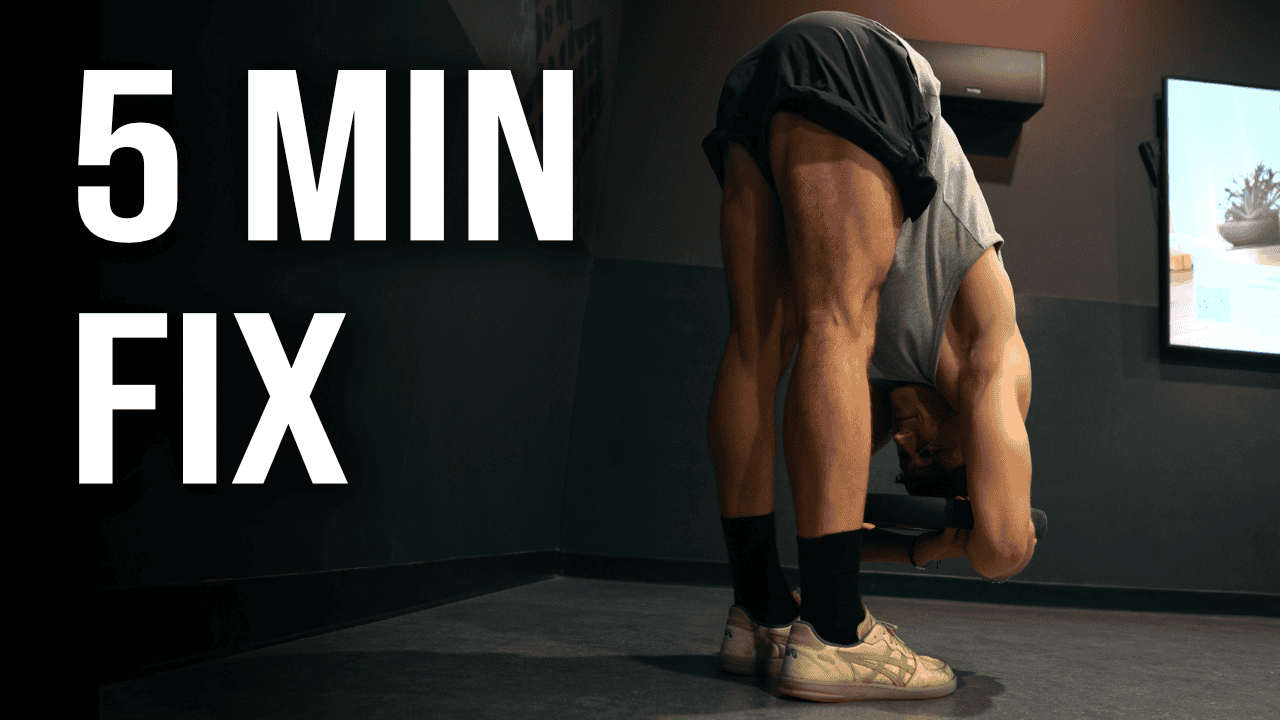
In this video we talk about how to fix tight hamstrings permanently. Here’s what we cover:
- The little-known reason your hamstrings actually get tight and sore in the first place
- Why stretching doesn’t give you any lasting results
- The 5-minute routine I used to eliminate hamstring tightness completely
Full transcript
If you’ve ever experienced an aching discomfort in the back of your legs, your hamstrings are probably tight and you’ve probably tried stretching them, felt uncomfortable in the moment, gotten some temporary relief, but then it quickly comes straight back. I’ve been there. Thankfully, I have a routine that takes a couple of minutes that got me more or less permanent relief from this and now allows me to very quickly eliminate it on the rare occasion that it does show off again. In this video, I’m going to walk you through it so that you can get instant relief now, fix the actual source of the problem, and then have a solution whenever it does re-irritate again in future. So that we know what’s going on here, your hamstrings cross two joints, your hip and your knee. And so when your knee is flexed and your hip is extended, like in this position, your hamstrings are at the shortest.
They’re stretched over the least distance possible. When you’re standing, we’ve extended the knee, so now they’re a little more stretched. Or when you’re sitting, we flex the hip so they’re a little more stretched as well. And then if we extend the knee and flex the hip at the same time, then they’re in their longest possible position stretched around both joints. So you can think of this as basically the maximal possible range of motion that your hamstrings can go through. At any point in time, there is a limit to the range of motion that our body is comfortable allowing that muscle to get to. And so the problem with having sore, tight, achy hamstrings is when this threshold gets too close to your normal resting positions, like when you’re lying in bed or sitting at your office chair, for instance. Because if you think about it, if you try and get to a position more like this, at some point, the limiting factor is not your joint, it’s that your hamstrings start seizing up, your nervous system starts sending a signal to that muscle to contract and it’s uncomfortable.
You want to move out of that position. Yo can’t just hang out there. But that’s what ends up happening to so many of us in daily life because this threshold ends up so close to the positions we want to inhabit on a daily basis. And so when you try and stretch, what happens is you temporarily go beyond this range. And so it’s like pulling your muscle like a rubber band. For a minute you get relief because everything’s nicer than the warning signals that you get once you stretch it past your comfortable threshold. But then like a rubber band, it just snaps back down and you never actually change this baseline range of motion that your nervous system is regulating. So if we want to feel comfortable and have hamstrings that are loose and limber and not sending us this constant nagging signal that they’re tight, then we need to move the threshold closer to this end of the range of motion because then that way everything on this side of it is going to feel super comfortable for us.
It’s within our functional range. So just stretching the muscle out doesn’t work. How do we actually do this? How do we move our baseline range of motion? If you followed me for a while, the answer to this will not surprise you. We do it through strength training. By actually strengthening our muscles, our hamstrings in this case, in this end range of motion, we train our nervous system to know that we are actually strong enough to hang out in this range. There’s no need for it to seize up and keep us out of it because doing that for good reason, this is all a safety mechanism. If we’re too weak to move into deep ranges of motion, then it’s much safer that we don’t do that so that we don’t end up hurting ourselves injuring our joints. And so rather than just having a thin rubber band that we always try and stretch out beyond what it’s capable of, if instead we actually build a thicker, stronger, more durable band that has greater length, then not only does daily living become comfortable and pain-free, but then we have access to all the range of motion we want.
And we’re actually safe doing it because we’ve got there not by playing games and tricking our nervous system, but by actually building the strength required. The good news about this is that once your regular strength training is dialled in, you’re training your movements across a full range of motion. This sort of thing isn’t a recurring problem. You don’t need to be doing specific work all the time to get more limber. It’s just built into the training that you’re doing. The routine I’m about to show you is a tool that I rarely use. Because my normal training’s so dark, I only have these sorts of problems when I miss training sessions and I’m very sedentary. The time that this popped up recently, I had skipped my leg session, hadn’t trained these muscles in over a week, and then I spent eight hours on a bus sitting down.
All of that training, the strength work that not only gets you this, but the muscle, the body weight skills, everything only needs to take 40 minutes a week. It doesn’t need to be extensive. You just have to do it properly. If you want the exact system that I use to do all of that, I’ve got a full free training breaking it down linked to that’s in the description below. All that said, having this five-minute routine in my back pocket is one of the best tools for reversing this sort of problem instantly. So here it is. I’m going to show you two movements here. The first one is directly working on the hamstring flexibility that we’ve talked about here, flexing the hip with extended knees, legs together. Then I’ll show you the other one where we work a similar movement pattern, but with legs spread. This is going to have much more focus on the adductors and muscles of the inner thigh.
I pair them both because in the end I feel like I can fold myself in half in any way and I cease to have any sorts of issues related to tightness in the back of my legs, lower back, posterior chain. So working both of these movements is really simple. You want to make sure you lock your knees and for this one, you’re going to put your feet together. The key thing is that we want to have weight because our goal here is to strengthen, not just stretch our muscles. We need some sort of solid resistance to work against. Even if you’re a beginner, I would recommend a minimum of 20 to 25 kilos or 45 pounds. Here I’m using a 20 kilo weight plate. So even if you’re not at a gym, you should have something of an equivalent weight that you can use. You can also use your weight vest if you’re training loaded single leg squats like I do.
But it’s really important to have that weight because all we’re doing here as we train is just treating this like strength training, doing reps, going in and then pulling back out against the resistance. And the most important thing to understand here is that the goal is not to stretch. The goal is not to go as deep as you possibly can. All you’re trying to do is move into your end range, find the point where your muscles naturally start to tense up, which is where you know you’re approaching that threshold of your current accessible range of motion. And all you have to do at that point is pull back out because the muscles that are going to allow you to pull out of the movement are by definition the ones that are under load getting stretched. So as you feel in this case, your hamstrings, your calves naturally tighten up, they are the muscles that you just flex it even harder to pull back out of the movement and get to the top.
So that’s the park. For both of these movements, I would suggest aiming just for a baseline of 10 reps, but you can honestly do as many reps as you like. If I am feeling like I’m continuing to unlock more and more range of motion and it’s feeling good and I’m enjoying it, I’ve sometimes done 30 reps on a pancake set. It’s completely up to you. Listen to your body and what you want to do. If you aim for 10 reps, see how your body responds. You’re already going to have received so many benefits just from doing that baseline of work. So that’s the pike, the feet together version. Now we get onto the pancake, which is essentially the same movement just with our legs spread. For this one, we’re going to sit down. Again, you want your legs locked, spread them as far as you comfortably can, and we’re going to use the same weight again that we used for the first exercise.
If you are finding it too awkward to get into this starting position, what you can do is simply elevate your hips, which is going to tilt your whole body forward and reduce the angle of hip flexion necessary to get that weight in front of your hips and actually start training. So use whatever height platform you need here just so that you can get that weight forward enough with locked knees so that it starts pulling you into the movement and you feel that tension in the muscles of your inner thigh. And again, very simply, all we’re trying to do is do reps of strength training using those tensed muscles to pull ourselves back out for reps. Now as you do this like you see with me, you will probably notice more and more range open up. That threshold temporarily moves deeper and deeper as you strength train in that range.
That’s great, but again, it’s not necessarily the goal. All you want to do is get your reps in, work those muscles hard and build strength in them so that over time we actually build more strength in those end ranges and that threshold permanently moves deeper, allowing us a greater baseline range of motion because we’ve earned it by building the strength we need in that position. So that’s basically the process. In terms of when to use this, if this is mobility first aid like me, you might have got off an eight hour bus and just need to feel human again. You can use this whenever you want. If you want to incorporate this into your training for a while to actually progressively build up your strength in these end ranges of motion and unlock the sort of flexibility that you see me with here, then I would highly suggest you incorporate it at the end of your strength training sessions when your body is already maximally warmed up and flexible and when it won’t negatively impact your actual strength training itself.
If you like, you can do it after every strength session two, three, four times a week should be fine. This sort of end range strength training is a potent tool. You should not need more than a couple of months to unlock some serious mobility with it if your baseline strength is already good. That’s it. Two movements, one set each. Shouldn’t take you much more than five minutes. You probably should never have a problem with tie ham strings again in your life. Full training systems below if you’re interested in learning more. Hope this helps.