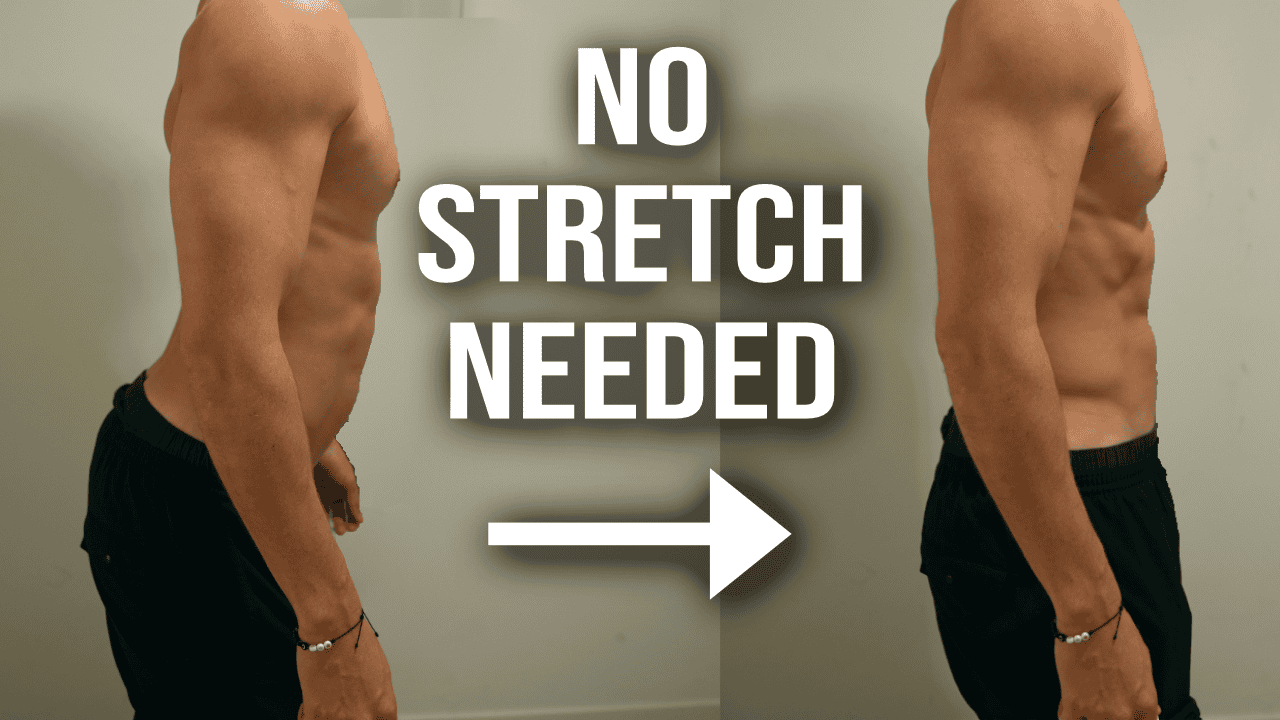
In this video we talk about how to fix anterior pelvic tilt forever. Here’s what we cover:
- The real causes of anterior pelvic tilt that most people overlook
- Why bandaid mobility fixes never solve the problem long-term
- The simple strength routine that fixes this automatically, with zero specific work required
- How to accelerate the relevant mobility changes if you want to fix your pelvic tilt ASAP
Full transcript
If your hips tilt forward like this, you have a curved lower back and your arse and gut stick out, and you’re probably experiencing a very common postural issue, anterior pelvic tilt. Now, even if you ignore the weakness and tightness that are the root causes of this, which are no doubt problems in themselves, living in this position puts strain on your lower back that just isn’t necessary. So if you want to fix it, the good news is that you can eliminate this problem for good without needing to even do any specific work on it. And in this video, I’m going to show you how. I’m going to explain what the specific causes of this are, what you need to do to fix it, and then if you want to take the most efficient method, I’ll show you how to get that done as part of a comprehensive strength routine at home in under 40 minutes a week and make sure that no other issues like this even get a chance to develop.
Disclaimer before we start, if you just want a quick bandaid solution to temporarily relieve the problem, look elsewhere. This is not a quick fix. What I’m going to offer you is a permanent effective solution that leaves you stronger, leaner, and more mobile all at the same time. It takes time to achieve those things, but it doesn’t need to take much time out of your weak. Here’s what you’re going to do. Noticing a postural issue like anterior pelvic tilt is very much a canary in the coal mine of your body. It’s less of an acute issue in itself and more of a surface level symptom indicating deeper, more systemic issues. In this case, what’s specifically going on is two or three things. Firstly, your hip flexors are tight, and this is really common when you spend all day sitting at a desk with your hip flex at 90 degrees.
If you’re always sedentary and never taking your hip flexors through a lengthened range of motion, then naturally their default setting becomes shorter. So hip flexors are pulling your hip shut, which when you’re standing looks like your pelvis rolling forward. The other factor is weak glutes. Your glute to these big muscles in your bum which work to extend the hip. So when you’re running or jumping or sprinting or squatting, these along with your hamstrings are the prime movers that allow your hip to open up under load. But again, when you’re sitting in a chair all day and never training them, they’re weaker and they’re less active. And so they don’t do anything to fight the tightened hip flexors. And again, they let your hip roll over. So you see here, we’ve basically just got a problem in a lack of natural hip extension. And then the other thing contributing to this to a lesser degree is a weak core, which allows your torso to arch as your hips roll forward.
So you see, none of these problems are permanent or structural issues. They’re all just due to a lack of regular training of the relevant muscles. And the great news about this is that firstly, it’s easy to fix. And secondly, it takes nothing special to keep it fixed once you do. And we just need to strengthen your core and your glutes, which will happen with any proper strength training programme, even one with just six movements and 40 minutes a week and lengthen your hip flexes, which we can do once and that will pretty much be sorted forever. The first place I would always start here is strength training. Trying to fix specific mobility deficits without first sorting out your base strength. It’s kind of like trying to fill a leaky bucket. You can open up new range, but if you’re not regularly taking your body through its full ranges of motion and strengthening them over time, then you have no system to keep the changes that you make with flexibility work.
And this is why I hate bandaid mobility solutions. Sure, you can make yourself feel better in the short term, but then you’re stuck either continuing to do these mobility drills all the time every day in order to keep the changes or you stop because randomly you have other things to spend your time on and then the problems just come back. So the first place I would start before anything else is get some sort of strength movement in your week that strengthens your glutes. If you do not have a squatting pattern that you’re doing once a week, honestly, one rep a week is enough, then get one sorted. I talked about how quick and simple and easy you can make that in this video. If you want an easy solution, start with that. Training your squat pattern once a week is going to start to build massive amounts of strength and mass in your glutes, which is going to do so much more for you than just fix the tilt of your pelvis.
You’re going to be stronger, you’re going to be faster, you’re going to be more easily able to get up off the ground, run, jump, move, however you want. Building that muscle mass is also naturally going to raise your metabolism, get you leaner by default. So many good things come out of working such big muscles as your glutes. So just pick a goal with your squatting training, a heavy strength target to work towards and just try and get a little bit closer each week. For your core, I honestly wouldn’t prescribe any specific core work because again, it’s kind of like a bandaid solution. If you’re training your entire body properly, focus on big upper body movements, your core is going to be as strong as it needs to be. There’s no way you continue progressing towards movements like front lever robes and one on chin ups without your core getting very strong, much more than you ever need to actually fix anterior pelvic tilt.
So again, rather than adding in core work to your routine to try and specifically target this issue, much more time effective to just make sure you’ve got a handful of movements that cover all your main planes of motion. You get strong enough at those, core isn’t going to be a problem. I’ve never had to train it directly ever, and I’m yet to have an issue with my core strength. If you want to see the six movements that I used to do that, I have them all in a simple guide walking you through strength goals and progressions. You can download that for free in the description. That strength training will be the highest leverage 40 minutes of your week. And it means that once this issue is resolved, you just don’t have to ever worry about it again. So once you’ve got that sorted, the final thing we can think about is the specific tightness.
That’s the final contributing factor to your anterior pelvic tilt. Much like with this strength work we’ve just talked about where I would prescribe choosing a high level goal to work towards with your squatting and your other movement patterns. For unlocking range of motion, I would just choose the relevant flexibility goal. It’s going to mean you have more than enough accessible range in your hip flexors to more than counteract the tightness that cause your anterior pelvic tilt in the first place. So for this easy solution, work on your front splits. You don’t even need to get close to a full front split to completely fix the problem that we’re working on here, but wherever you are currently on the spectrum of being able to do this or not, that’s the process that’s going to fix your hip flexor tightness. So link a video here that you can watch to learn how to train that, but that is the cherry on top.
Once you have your basic strength training in place, you may find that you don’t even need to work on hip flexor strength. Your body just gets so used to working under load through these basic ranges of motion that your hip flexors loosen up anyway. But if you’re progressing your strength, your glutes are stronger, your core is stronger and your hip flexor tightness is bothering you, this is a quick, direct way to open up that range, train your nervous system to stop tensing up so much, counteract all that time you spend at the desk each day. And by that stage, you should no longer have any issue with anterior pelvic tilt. Now, how long is this going to take to solve? The answer is as long as it takes. It purely depends on how weak those relevant muscles are and how tight your hip flexes are.
But what I can say is that this sort of global approach to fixing this problem is going to give you so much more than just fixing up your posture. If this is the gateway drug that gets you into developing strength, muscle mass, getting leaner, then the changes that serious progress and all of that is going to make to your life, that is going to be a life changing win. If you want to skip the headache of figuring all this stuff out and just get a simple system implemented 40 minutes a week to cover your entire strength training, mobility, nutrition, get you lean, then I would suggest watching the free training on how our system works using the link in the description. Many of you requested this one, so I hope it helps. If I’ve missed anything, please let me know in the comments. Thanks watching.
We’ll speak soon.