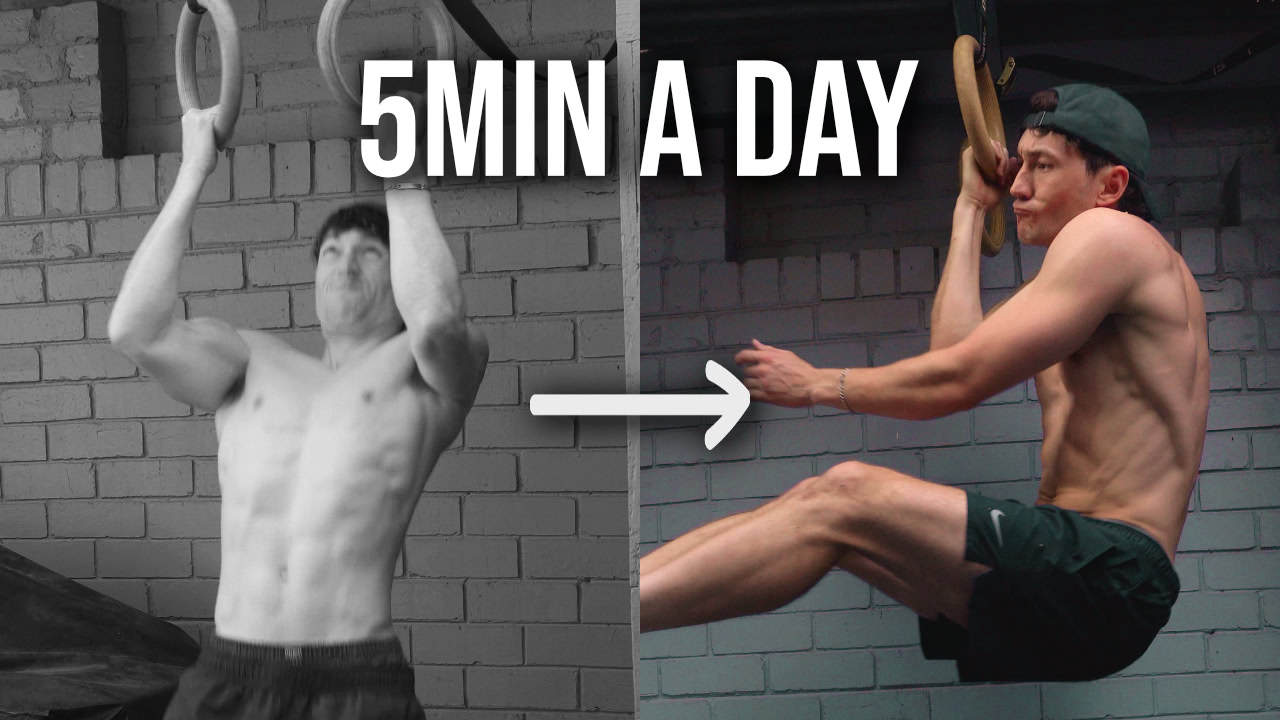
In this video we talk about how to achieve any goal (from your first chinup to a foreign language) way faster for a fraction of the time investment. Here’s what we cover:
- The little-understood constraint on how fast you can achieve something
- My 3-step formula for achieving any goal fast in 5 minutes a day
- The secret sauce to achieving elite-level results beyond your goal
Video summary
I present a 3-step framework for achieving goals fast and efficiently:
- Find your threshold of ability – Identify the most challenging and enjoyable level of difficulty for the task, which will provide the optimal stimulus for growth and adaptation.
- Do as little as possible – Minimise the amount of time spent on the task each day, as the body has diminishing returns on adaptation beyond a certain point. Consistency is more important than duration.
- Plan for a 5+ year timeline – Recognise that significant, lasting change takes time, so approach the goal with a long-term mindset rather than expecting rapid results. Stick to the process consistently over an extended period.
The key principles are making the work fun and challenging, optimising for consistency over workload, and having patience for the long-term transformation required to achieve ambitious goals.
Full transcript
Five minutes a day. That is all. It’s taken me to learn several foreign languages, read hundreds of books, and build my dream body all in pretty short timelines. And if any of that sounds ludicrous to you, then I want to challenge your entire perspective of what effective goal achievement looks like. In this video, I want to show you a simple repeatable framework that anyone can use to achieve any goal that you set yourself in a genuine fraction of the time that it takes most people to achieve it while dedicating less than five minutes a day to it. So what’s the limiting factor on how fast we can achieve a goal, whether that be learning Italian, achieving your first chin up, reading your list of a hundred books, this is probably the least understood and least spoken about. Part of goal achievement I think is why so many people fail to ever get to where they want to get to despite the amount of work put in.
Because if you ask someone, what’s the limiting factor on your rate of progress towards a goal, most people will say it’s work how much effort you’re putting in. And these things are certainly correlated, and yes, work is required, but it’s not the limiting factor on how fast you can get to your goal because you don’t achieve the ability to do a chin up or to speak Italian whilst you’re practising those things. You achieve them by changing the structure of who you are physically to achieve a chin. Your body needs to build muscle tissue and turn your body into one that is stronger and is physically capable of doing a chin up or a one arm chin. It takes time and sleep cycles for your body to go and actually make those changes to your muscle mass. If you’re learning a language, your body needs to literally rewire synaptic pathways.
It needs to change the structure of your brain to one that has all the vocabulary grammatical structures, verb conjugations built into it so that they’re there for you to access. That again, takes time. Just it’s maybe more obvious with strength training that that body needs to go and do the building of the muscle. But it’s the same thing with learning a complex skill like a language. It takes time for your body to actually rewire all those pathways. And even with reading books, you could try and sit down and read nonstop and accumulate more and more knowledge. But again, it’s not in the reading itself that you learn like with practising your language and practising chin-ups, you’re exposing yourself to new ideas. And then when you’re going about your day interacting with the world, you’re integrating those ideas into your worldview. And again, that takes time because you’re restructuring your understanding of reality, your brain’s changing, reshaping.
It’s a physiological process that takes time. So the constraint on how fast we can achieve our goal, whatever it be, is not the amount of work we put in, but the adaptations that our brain and body make in response to that work. We do the work to challenge ourselves so that in the aftermath, our body goes and adapts reshapes itself to be a body, a brain that is better adapted to that challenge next time we face it. So if we want to achieve something, our goal is not to just do as much work as possible if we want to actually get there as fast as we can. The way we should be thinking is how can we design a routine, a process that is optimised for that transformation to get us to the version of ourselves that can do the thing as fast as possible?
That is a fundamentally different task. So what would that look like? If you’re with me so far, you’re now asking the right question. So here’s the three step system you can use to do exactly that. Step one is to find your threshold of ability. If we want to send an effective signal to our bodies to change, then it needs to be challenging and ideally it needs to be at the absolute limit of our current ability because if we’re going to already do something, then there’s no incentive for our bodies to adapt. Now here’s another thing that I see so many people getting wrong in the gym, in their language practise. In any pursuit where you see people trying to get a result and not getting one, you’ll see a common theme and that is boredom. If what you are doing when you practise or you train is not fun is a very strong indicator that what you are doing is not signalling growth, it’s not challenging enough.
You’ll see people in the gym training well below failure, spending most of their time not reaching it, which sends no signal to your body that it needs to build muscle and grow, which is why you see so many people in the gym spending hours every single day and getting no tangible results, never getting a body that they’re happy with. The stimulus is not created equal. The reason I only train for five minutes a day, 40 minutes a week is because every second is spent at failure. I hit the limit of my strength from the start of my first rep, and then I’m always training there, just adjusting my training to keep me at failure the whole time. That is potent stimulus. That’s how you build muscle and strength in five minutes a day. Language learning is another great example. You see this so much to people on joy lingo, spending unbelievable amounts of time doing practise that is tedious and not overly challenging, well below their threshold.
The inherent limit in any app like that that’s trying to set the difficulty for you is that you’re not scaling to find your maximum challenge threshold. And so just doing this passive sort of repetition, again, weak stimulus, I’ve seen plenty of people spend months and months getting nowhere. The solution again is to do what is fun, go for the goal and then scale back just to make things doable. Just like with strength training. So with a language, your goal is to be able to speak it. You just start trying to use it. When I started learning Spanish two years ago, I just started looking at example sentences and just testing myself to try and learn those example by example, and then I just break those sentences down to try and understand how they were put together, which started to teach me grammar and vocabulary starting from the end goal.
And very quickly within a few months, I’d kind of managed to get my head around all the basic grammar because I’d seen it all in examples. And this is reverse to how most people go about it. You start reading from a textbook or doing your app practise, if you want to find your maximum challenge, it’s much more effective to go to the end goal, start trying to use it and then scale back to the point where if there’s something you don’t understand, you can go and look it up. You can read articles, you can figure things out, and very quickly get to the point where suddenly that’s too easy. And within six months, I’d started just being bored of that. And so I moved on to the next most challenging thing, which is reading and watching TV shows, consuming media because I found that more stimulating.
So the principle here with any of these things is make it fun and challenging. And if or when you’re bored, it’s a sign that you’ve overtaken the stimulus you’re currently giving yourself and you need to scale up reading’s. Another great example here, people try and force themselves to read and they’re bored, which means that they’re not learning a single thing and there is no point to it. Again, if you’re bored, you’re not taking anything in and you’re not solving any problems. The value in reading nonfiction at least comes from filling curiosity gaps, answering questions, finding models to plug the gap in your understanding of the world that you can then go and use to operate better within it and achieve things have a better life. And so again, boredom’s this beautiful cue that the stimulus isn’t challenging or useful for you, the best thing to do is move on.
And so with reading, I’m ruthless flick through things until you find something that you’re interested in, read it as long as it’s interesting, read the parts that you’re interested in and move on. And this will allow you to extract the key ideas from books so much more quickly while skipping huge waves of text that are never going to benefit you. If I’m bored, I move on, I’ll jump around things as much as I want. Because again, anytime you’re spending reading something that’s not interesting is time that you could be spending reading something that would be giving you mad epiphanies, blowing your mind, and ultimately changing your life. So that’s step one. Find your threshold of ability, which means your threshold of enjoyment. Make it fun, make it intense, make it challenging. Step two is then key to making all of this work. And this is what most people get utterly wrong, which is why I started this video with the breakdown of water constraints.
Most people will get excited, they’ll have this goal, they’ll want to be able to speak German as soon as possible, and they still start smashing practise trying to learn as many words as they possibly can in a sitting, or they’ll really want to get this chin up. So they’ll start doing chin up practise sets and sets and reps of it going hard doing it every day. And very quickly they burn out. Suddenly they have a job that they’ve got to sustain. They’ve got a dog, they’ve got to look after, they’ve got life jobs to do and can’t be spending two hours on this goal that they kind of want to achieve. And were super motivated for last weekend. And when you don’t see the results coming proportional to the amount of time and effort you’re putting in as well, it’s very demotivating. Why is that?
Because there’s only so much adapting that your body can do each day. So step two in this process is once you are doing challenging work, that’s fun and stimulating. Step two is to then do as little as possible. Now that we’ve optimised the efficacy of the signal that we’re sending, we now want to optimise for the consistency of sending that signal. And the huge thing to understand here is the law of diminishing returns. Even if we’re sending the most potent signal possible to our bodies to adapt, we’re getting steeply diminishing returns on the adaptation that’s going to come in over the next 24 or 48 hours as a result of that work. So in a way, the less you do, the better return on investment of time and energy that you’re going to get. So to show you how extreme you want to be with this, for chin-ups, I do one set once a week for these.
In terms of the five minutes a day thing, if you’re training your entire body to build strength and muscle, there’s basically six movement patterns you want to train chin up pattern being one of them. So if you did a movement a day, six days a week, you’ve got basically less than five minutes, one single set before that exercise as a set in step one. You’re just training your chin up as heavy as you can possibly make it, guiding yourself through with your feet. So it’s always a failure. It’s always trying to do something can’t do. That’s obviously extremely intense, extremely challenging. You’re working at your limit the whole time. As soon as that stops being fun, it’s over. So usually this is a lot less than five minutes for me, it’s usually two or three, but the idea is that you’re following fun and excitement enjoyment.
As soon as that starts to diminish and it becomes a grind, we’ve flipped from the opposite of boredom to now it’s too extreme and it’s overwhelming us. That’s when we pull the plug and say, cool, you’re getting a very good sign from your body that you’ve gotten the benefit from the activity for the day, and you can push on and do more. But remember every bit more that you do, you’re getting less and less and less benefit from it. And you can’t just think about today’s session, think about the system that you’re implementing every couple more minutes that you’re trying to do each day. That’s a couple minutes every single day for a long time to come. So it’s not just about can I get it done today? It’s about will I want to, will I be actively excited to come back and do this in seven months from now?
That’s the question we need to be asking here with step two, sustainability. So step one, make it fun. Step two, do as little as possible. Step three is really simple, but the most important out of all of this, and that is to plan for at least a five year timeline with your goal. Because now that we’re doing effective work and we’re doing consistently, the only thing that can stop us from reaching the outcome is not continuing this process for long enough. And having done this in several areas, I can tell you that the really crazy insane results come from that sort of timeline. You’re going to make awesome progress in the next six months, the next year, and that should motivate you because it shows you that you’re on the path. But to really get to the point where you’re speaking fluent Japanese or you are jacked and you’re really proud of your body and you’re well beyond chin-ups doing closer to one, those things take five to 10 years to really nail.
And so if you want the thing, it shouldn’t be a problem to be aiming for that sort of timeline if you’re doing step one and two, right? Because A, it’s always fun. Strength training for me is the best half hour of my week. Same with language practise. It’s so rewarding and fun and stimulating and so quick. You’re making it fun intentionally, and you’re doing so little. The whole point of step two is that even on days when you cannot be bothered, it’s only five minutes or less so you can get it done. So thinking in terms of five year timelines can be difficult when you haven’t started something, but it shouldn’t be a problem because this process should be such an effortless, seamless, fun part of your daily routine that if you can’t imagine doing it for five years, then you should probably revise either whether you really want the goal and it’s worth spending time on in the first place, or whether your process is actually properly set up for that long-term efficacy and sustainability.
So that’s one. Two, your body can’t build the muscle that it’s going to take to do all chin up, one arm, chin up overnight. It’s going to take time. Same thing, your learning language, your brain just, there’s so many pathways that need to be rewired and structures built on top of each other to get there. If you’re reading lots of books, you’re fundamentally shifting and restructuring the entire way you see the world. You’ve got already decades of time spent every day embedding down your current frameworks of reality and how you see things. And so if you want to change those, which is what good nonfiction books will help you do, that’s going to just take time. So in the secret method that I’ve used to achieve a couple things in seemingly very little time is basically just doing way less, way more consistently, and then doing it for way longer than anyone else, and just making sure every second of it counts. That’s the three step framework. Find threshold, do as little as possible, and plan for five years plus, you get that right. There’s really no limits on what you can achieve pretty much as quickly as humanly possible. Hope this helps. If you want some help applying it to Fitness link below. Otherwise, chat soon.