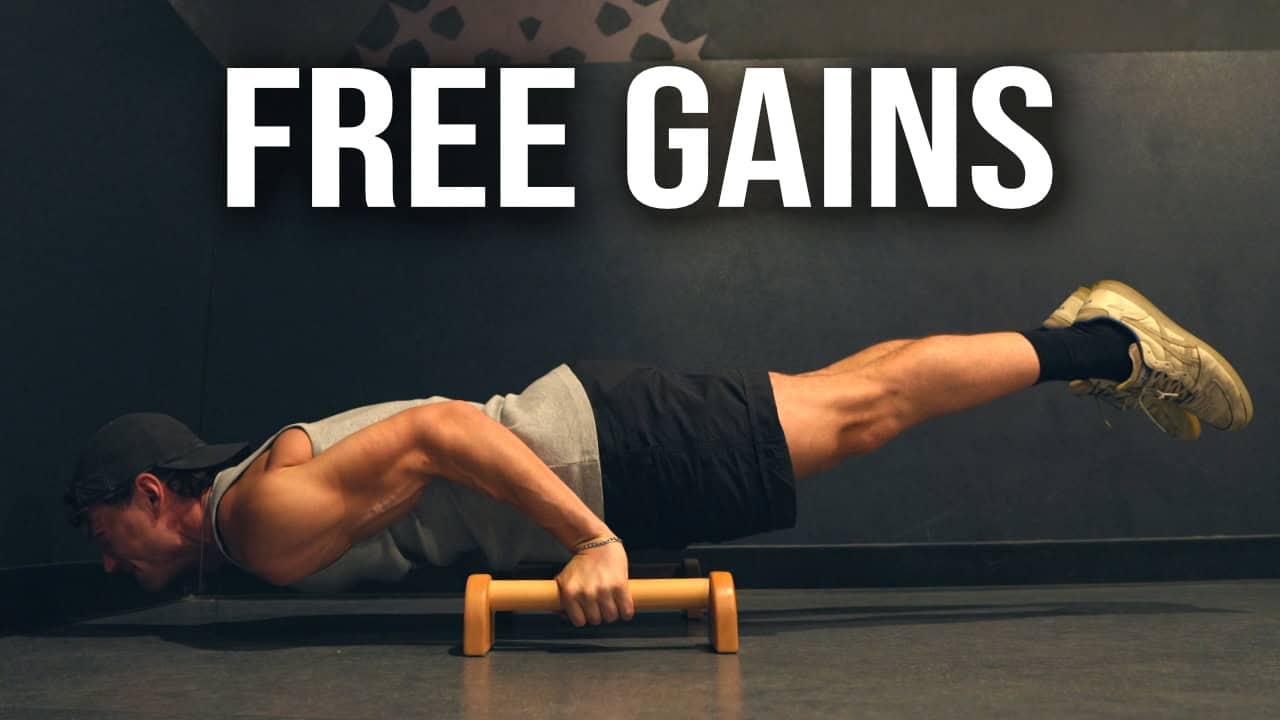
In this video we talk about the two mistakes that have been killing the “free gains” in my calisthenics training. Here’s what we cover:
- The key technique difference between free gains and wasted reps
- The form mistake almost everyone makes in planche pushup training that’s handicapped my planche progress to date
- The overlooked part of the front lever row that’s limited my pulling strength
- How I’m fixing both, without adding any extra time to training
Full transcript
One of the coolest parts about strength training for me is that I’ve been able to unlock such a range of free gains from simply training six movement patterns and just getting strong enough at them. But my recent research and experiments have pointed out some clear gaps in how I’ve been training some of these movements, which has actually limited the amount of free gains I’ve been able to make in certain skills. So in this video, I wanted to share what they are, what I’m doing to fix them, and how you can make sure if you are taking a super minimal approach like this, that you get the most out of every movement that you’re training, unlock the full range of strength skills possible and maximise the mobility and injury prevention protective benefits that they offer. I talked recently about the work I’ve been playing around with to build more straight arm strength in the planch and front lever positions.
Very specific work that takes a lot more time to get marginally specific benefits from. Not a lot of potential in terms of muscle growth or general strength, but specific strength for some specific skills which you may or may not care about, and I have it to this point. But it’s all about the cost, right? If I offered you a tonic right now that was free, had zero side effects, and meant that you could instantly just get down on the ground and do a planch, well, why wouldn’t you take it? And that’s how I see form in strength training. If you’re doing the reps already, you may as well be doing them in such a way that you maximise the gains that you make from those reps. And so when I’m coaching, one of the biggest things that I focus on with my students is range of motion.
The muscles involved and the activations and coordination required by movement change as you do the movement. Something that pulls you through as much range of motion as a one arm chin up, going from a dead hang to holding the ring to your chest uses a massive amount of muscle mass and training hard across that full range gives you a huge stimulus for muscle growth and to get stronger in not just one position, but a huge range of them. And so if we only train half of that range like a lot of people do by default due to lack of awareness or not knowing how to change the loading of the movement to actually allow full range training, then we just miss out on enormous amount of benefits and it doesn’t take any extra time. And that’s why I think there are no excuses. If you’re only training six movements and it’s taking you 40 minutes a week, there is no reason to not be training across full range motion and getting the maximum benefits from those movements.
I tell all my students that you’re much better at doing one rep across a full range of motion than doing 10 that hit partial because you’ll get qualitatively different benefits from the one full range rep rather than maybe some marginal extra stimulus of a limited variety by doing more reps of a partial range of motion. You can get away with a lot and still build muscle. You don’t need to train the entire range of motion of your movements to build plenty of mass and look great. But when we’re talking specifically about strength skills, to a large degree, if you don’t train it, you don’t gain it, meaning your body doesn’t learn to fire muscles and coordinate them accordingly in a certain position if you don’t spend any time working hard to do so in that position. And so static positions like planters and front levers can kind of be thought of as a single frame in the range of motion of a dynamic movement.
If I do a front lever row, the first frame, the starting instant that I pull from is a front lever or a progression of the front lever. And so in my case, I think just starting in my best version of that position every time I do my horizontal pulling training has given me enough byproduct strength to hold a short front lever. Now, a lot of the free gain movements that you might see me do, like back levers, handstand presses, human flags, these skills are easy enough that with enough general strength that you can just manhandle your way through them. My handstand press could look a lot nicer with better compression strength in my legs, but because I have the raw strength I’ve built from doing overhead pushing and getting that really strong, I can just force my way through it. It’s easy enough to just use your muscles once they’re strong enough.
But then there are boss challenge movements like the planche that require both huge amount of strength and a huge amount of skill using that strength to be able to do. So you can’t avoid training it if you want to get better at it. And I think this is one area that my training has been massively lacking and having seen that gap that I’m now working on fixing. And then another one is the top range of motion of the front lever row. Discovering the whole world of callisthenics only recently I’ve seen people doing front lever pull-ups through full range of motion or front lever touches where you hold this top range of motion. I don’t even train this and it shows because my strength in this position is exceedingly weak. So this is a perfect example of you don’t train it, you don’t gain it. So what I want to offer you here with my own training updates is a way to make sure that you actually do train your planche and your front lever touch positions in your strength training.
This is something I’m emphasising a lot more with my students now as well, bearing in mind that again, these things aren’t necessarily night or day importance for your basic strength progression and muscle mass and physique. But for the high achievers of you who want to get maximum bang for your buck, this stuff costs no extra time and will mean that as you progress, you just have a wider range of free gain things to play with. So if that’s something that you want, here’s how I’m fixing these things up. So if you watch my recent video on strength moves, talked about the specific work that I’ve been doing to train the planche position, but learning to hold correct form on a planch has taught me that I just don’t do this at all in my normal horizontal pushing. And this is by far, I think the biggest gap in how at least I’ve been trained to date, especially when it comes to learning the crossover strength to unlock these free skills.
There’s lots of videos on this topic online, but to sum up the proper planche form, to have any chance of holding these difficult straight arm planch positions where your body is extended out with straight arms. And the big thing you need to do is protract your scapula while keeping it depressed, meaning you go like this. Now this is quite a specific position. And again, if you don’t train it, it is really hard to hold your scapula in this position under load. And again, there are completely different muscles involved. Your serratus anterior has to fire like crazy to pull your scapula forward whilst a lot of your body weight tries to collapse them in. Now, without going too much into the biomechanics of this, you need to do that to optimise the leverage in this position and make the planche just possible strength wise. With bad form, it’s really hard to hold the position.
And as I talked about in that other video, a move like the planche just can’t brute force your way to it. You need to give yourself every chance of doing it possible, which means getting your shoulder blades in the right position. So scapula depression and retraction with locked elbows. Again, most people I coach think they’re locking their elbows and they look more like this. That is locked elbow when it physically cannot extend any further. And so most of my training misses this. Most videos that I review miss it even more. And that’s usually just because we’re naturally weak in this position. And so if you aren’t intentional about dialling the difficulty back enough to allow yourself to get that proper scapula projection, to lock your elbows out, then you never get a chance to do it, which means you never get a chance to improve it.
And as you improve the rest of the range of motion in this movement, it’s just going to get left further and further and further behind, which is why I can only do a shitty tuck planch, even though I can bend arm planch quite comfortably. So very simply, I’m just now making sure that every time I do a planch pushup, I’m maintaining as much scapula protraction as I can throughout. And as I get to the top of that rep, I’m completely protracting. I’m getting locked elbows and I’m leaning into that position as much as I can getting really intense activation before I end the rep. Same thing at the start of your negatives. Why wouldn’t you just practise your best plant every rep before you begin the negative? Again, it takes an extra second, but you get a qualitatively different training stimulus. You get to practise that straight arm protractor scapula planch position, every rep of horizontal push for free.
So that’s one change. And then the other is this top range front lever row strength. Now again, I haven’t been too concerned about it. My range of motion standard for this for ages has just been getting my elbow past my body. And again, for all intents and purposes, it’s plenty of range of motion to get great training stimulus in. But if you want to ever build up to doing proper front lever pull-ups or front lever touches, you need to train this specific movement pattern. And again, even though it’s a similar range of motion at the shoulder, the differences in leverage from changing your forearm position are significant. And without specifically training it, it’s very hard to perform. And so if we can pull into this position of wrist to body, then that is, again, a specific strength that we would not train otherwise. So for front lever pull-up strength, for muscle hypertrophy and for extra back gains, posture, rear adult size, depending on what you care about, we may as well be doing that.
So this again just requires eating a slice of humble pie, scaling the difficulty down enough that you can finish every rep getting now wrist to body. Exactly what I’d aim for in the plant pushup training, getting wrist to touch torso at the bottom means you’ve hit a good shoulder extension range of a pushup. Here it’s the same thing on the row. And so they’re just converse ranges of motion. I’m way weaker at this. I can do advanced tuck, front lever rows very comfortably, but to get all the way to body, I’m struggling in a tuck. So remember if you’re weaker and you need to scale, write down all the more reason to do it because you’re weaker. And so there are easy gains to make there and it’s your weak link. And so you can become a stronger, bigger, more mobile human by doing that.
And it’s easier to progress than anything else. So that’s it. There’s some easy wins. If you’re doing the training, you may as well get the most out of it. If you want to fill all your gaps and make sure you’re doing every movement properly and getting everything you can out of it, trust me, I see a lot of mistakes on a daily basis. You can find out more about our system and coaching, watching the video training linked to the description. That’s 100% free. And if you decide you want to work together, you can go from there. Hope this helps. Go get training.