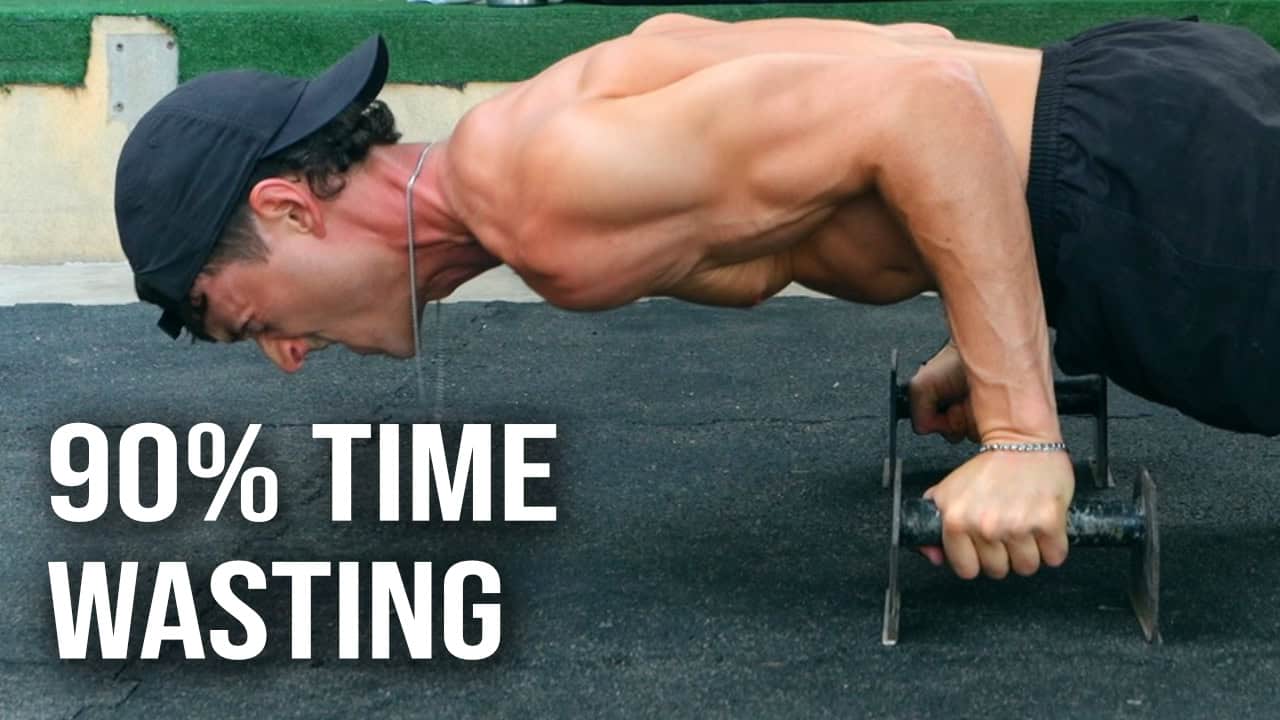
In this video we talk about why most of the training people do does nothing to change their body or progress them towards their goals. Here’s what we cover:
- The fundamental error people make by expecting even returns from different fitness activities
- My journey from training 10x the amount to my current barebones system (how and why I culled flexibility work, skills practice, prehab, most strength exercises, and more)
- The tiny fraction of my original routine that I kept, which allowed me to accelerate towards my lifetime fitness goals
Full transcript
Most people think that to get better results with their fitness, they need to work harder, do more. But if what you’re doing isn’t effective, it doesn’t matter how much more of it you do. Zero times a hundred is still zero. In this video, I want to walk you through the process of how I culled all the low yield filler from my training until all I was left with was the 40-minute a week routine that I use now that got me my dream body and has now worked for hundreds of other people as well. If getting results was as simple as just do more, then everyone who had an inch of motivation would be walking around as jacked freak athletes. Yes, you need to work. Yes, you need to do it consistently, but not all training is created equal. In fact, it would shock you at the discrepancy in returns you get from doing different sorts of activity.
And this is actually a really, really good thing because it means that if you are able to identify the tiny fraction of activities that get disproportionate results, then you can get in incredible shape for very little weekly time investment. And that’s sort of what I’ve made it my mission to help people do over the last four or five years. Think of it like this. If we plot time and effort against results, most uninitiated people who aren’t at their dream body yet see the wide array of things they could do to work on their fitness on a flat function like this. I could put in any time or effort doing anything and I’m still going to get pretty much the same results. If I go for a run, if I lift some weights, if I do a hit class, this is the most basic working model in people’s brains of how fitness works.
But in reality, it looks nothing like that. The real function is much more like this. And so while a large majority of things you could do, take up a bunch of your time and effort and get your very little back, there are a few things that will get you disproportionate returns depending on your goals. And this is where I spend all my time. In my mind, this is what you want your routine to be solely focused on. But this is why people can spend seven, 14 hours a week exercising and look very average and others can spend 10 minutes, three times a week and look like some fitness wreck. There’s a method to it. So when I was first starting out, getting into strength training and movement, callisthenics, I was doing way more. My routine was probably 10 times as time-consuming as it is now, but over time I just got sick of doing things that weren’t clearly progressing me in the direction that I wanted.
For instance, I used to do a bunch of mobility flexibility work. Once I sort of hit some decent ranges of motion with this, it could easily be in a prison where now I feel like I need to maintain this range and keep what I’ve gained. I don’t have that sort of discipline. If I’m not actively progressing, I don’t want to be spending all my time just staying in the same position. So I dropped it. Beautiful part about building mobility properly is once you get it once, it’s extremely quick to regain. I don’t have a problem opening up the splits on my pancake or my pack now. So after several months of focus on that stuff, dropped it, gone. Then there’s skills training. I think it’s really easy, especially with callisthenics, body weight training to confuse different goals. Now you can practise handstands, you can practise things like muscle ups, handstand presses, movement flows, things that require balance and coordination and skill.
But again, what outcome are you trying to achieve? I dedicated a lot of time in the early days to learning handstands, learning my gymnastics body positioning, to do all these movements with nice form. But eventually I realised that the bottlenecks to continuing to progress with these things ended up just being raw strength. There’s a common thread you’ll see here. I needed to build more muscle. I needed to get my body just physically more capable of exerting force if I was going to keep learning more advanced skills. And so seeing that was the path ahead of me, the most direct one to having the ability to do everything I wanted, I let that skills practise fall to the wayside as well so I could just focus on strength. Practising things like handstands is a great application of strength and mobility, but far from the most effective way to build it.
Then there was my 20-minute warmup routine with a bunch of prehab work, mobility drills, joint prep, general movement. And look, I’ve been harsh on these sorts of things in the past. This sort of prep work can certainly have a place as a tool, especially in the early days when you have zero experience and are easing your body into proper training. But if you are healthy and you approach your strength training intelligently, meaning you prioritise recovery, you manage fatigue, and you scale everything you do safely to a level that is right for you, then the specificity of your strength training accounts for all the joint prep and connective tissue work that you’re going to need anyway. And so when I say you don’t need extensive warmups, I’m coming from a place of having spent a lot of time going through motions that weren’t necessary, doing work that I thought I needed that was largely missing the point.
So the further I got into training, the more I cut. Flexibility work I dropped. Skill work I dropped. My big warmup prehab routine I dropped. And by a couple of years in, I was purely focused on strength training and pushing hard to increase my maximum strength. But even within strength training itself, there’s still so much that sits here in the tail of the curve that’s getting you a lot less return on effort than you could be getting. And part of that is low yield movements, mainly movements that don’t use a lot of muscle mass and a really specific not covering a large range of motion, which is quite a lot of skills that you could work on in the callisthenics world. So over time, wanting tangible results, wanting a body that was actually growing muscle, getting visibly stronger and bigger, I dropped basically all the work on static holds, single position movements, anything requiring balance, lots of coordination in favour of multi-joint, large range of motion, maximally heavy strength training so that I could just as clearly as possible, as efficiently as possible, signal to my body to grow as much mass as I could in order to get stronger and have that strength cover my entire body’s ranges of motion.
And so getting to this point was very good. Even with just really high leverage compound strength movements, you can still spend a lot of time not getting much back from it. And this comes down to the strength training that you’re actually doing with those movements. Any training where you’re not pushing hard to progressively overload the movements that you’re training. Anytime you’re spending training, not trying as hard as you can to be stronger, to use more load to make the movement more difficult than what you’ve done in the past is wasting time. You can debate all you want about the science of strength training and what is optimal, what’s not. There’s a never-ending rabbit hole to go down there. But most people simply do not push anywhere near hard enough to get stronger over time. And that is literally all building muscle and getting stronger comes down to showing up and trying and doing that consistently over a long period of time.
It doesn’t matter if you get a pump, it doesn’t matter if you get sore after training, it doesn’t matter if you feel fatigued. If you’re not trying with intent to be stronger than you ever have before, then you may as well be on the couch resting and recovering. That is the fraction of the work that makes the disproportionate difference to your progress, to your physique, to your strength. And so the crazy and insidious thing about training is that so much of the work you do can actually end up being negative if it starts to cut into your ability to recover from that work. So you try and do too much, your graph ends up looking more like this where you’re in negative territory detracting from your ability to actually recover and grow stronger. But look, I get it. The reason that I’ve been able to do so little and get results that I’m so happy with is because I went through the process of first doing a lot more and then eliminating down.
My goal with content and with my coaching is to help people shortcut that process so that you don’t have to spend all that time not getting much out of it. And most importantly, run the risk of either giving up, getting injured, or just never actually finding that high leverage work at all and staying stuck in this plateaued limbo state forever, which unfortunately is the large majority of people. Now that I’ve been researching so much again to look for ways to improve my own training and achieve some different goals, I’m reminded of what that’s like. There is so much information on the internet and it can be extremely tempting to want to do everything because everything has the potential for some payoff. And if we had unlimited time and energy and recovery capacity, you could just do everything. But unfortunately, everything also comes at a cost.
And so if you decide to put time and energy into certain things, then that’s time and energy and recovery that’s not going into other things that could potentially be getting you a whole lot more. So my advice, if you are starting out, if you are still not at a base of great muscle mass, lean body composition, and really solid levels of strength, focus on the stuff that’s going to get you there fastest. Then you can decide if you want to add more and optimise. If you want to help doing that, that’s what I do. You can watch a full overview of our system and see how we work for free using the link in the description below. Otherwise, hope this points you in the right direction for now. Not all training is created equal. Go to the stuff that counts.