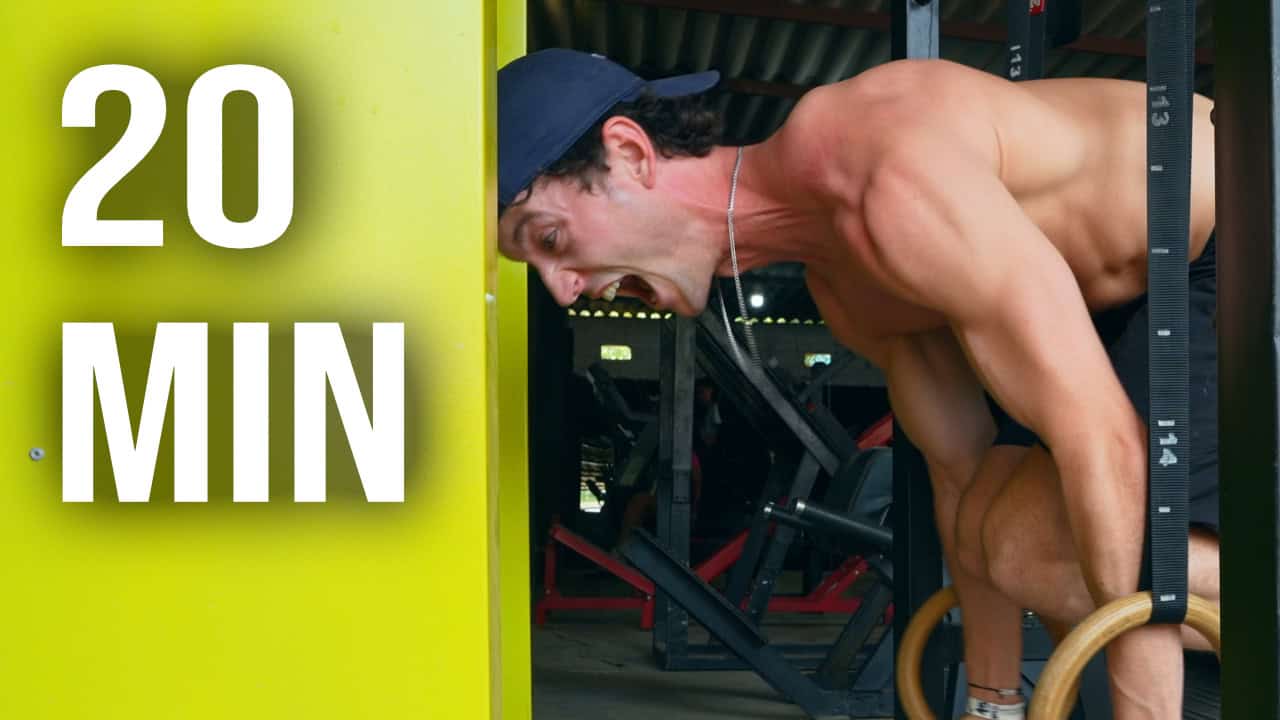
In this video I demonstrate half my week’s training, which took exactly 20 minutes start-to-finish. Here’s what we cover:
- Exercise selection
- Training volume
- Body composition, nutrition, and fitness priorities, and how travel fits into this
- Legs training alternatives when on the road
Video summary
This video demonstrates a time-efficient 20-minute workout designed to build strength and muscle while traveling. The routine features six fundamental movements split into two workouts for a total of 40 minutes of training per week. Key principles include prioritising compound movements to avoid redundancy, maintaining short rests between reps to ensure manageable training volume, maintaining quality full-range-of-motion work, and training at high intensity levels. Jack emphasises that simplicity and progressive overload matter more than exercise variety, and provides practical alternatives for equipment-limited situations, such as using dumbbells instead of weighted vests for leg training. The approach demonstrates that significant strength and muscle gains can be achieved with minimal equipment and time investment, while maintaining flexibility for lifestyle demands during travel.
Full transcript
You’re about to see one of the two 15 minute workouts that I’ve been hitting each week for the last few months while travelling to continue getting stronger. This is where Physique is at the moment. So I’m just going to walk you through the whole thing and explain what’s going on cover to cover. We’re going to go through exercise selection, body composition, nutrition, fitness priorities, how travel fits into this. And then I’ll talk you through some leg training alternatives. When you’re on the road in a similar position, I’ll also link some videos you can watch to get an idea of progressions for these movements because you’ll be watching me at quite a high level here. So you can see I’m starting with my horizontal pushing, working on plant pushup variations. Remember, you don’t need much. The reason I only use six movements is because as soon as you go beyond basic movements, everything just becomes redundant.
Like your chest doesn’t respond to how many different chest exercises you’ve chosen or how many sets and reps you do throughout the week. It just grows if it senses a need to get stronger at pulling your arm across your body, because that’s all the peck does. And so if you want to build a bigger chest, you just need to physically get better at pushing horizontally, pulling your arm across your body. And the good thing is all you need to do that is a set of gymnastic strings which fit in a backpack. And so here I’m just leaning forward as far as I possibly can. I’m pushing down the whole time, resisting the rings, just making things as tough as possible to absolutely shred the muscles that do push in that horizontal direction. If you hit your pushing muscles twice a week, you give it as good a nudge as you possibly can before you start naturally half assing it, then you go in and grow.
And so I have two pushing movements. I have this and I have a vertical pushing movement. And between them, hitting them twice across the week, I get ample stimulation for my chest, my shoulders, my triceps, everything that I want to grow. Simple is better, less is more. If you just have nothing but these two movements to focus on, you know what you do? You make sure that you actually push progress in them because anything else is just wasting time. Why am I bothering coming to the gym if I’m not going to try and be stronger at this than I was last week? One really important thing to note is you’ll see that I’m having quite a bit of a rest between reps here. This is a really common thing I see holding people back and people think that one set isn’t enough each week. A set can be like a proper set.
I would suggest everyone has a small rest and resets between their reps. That makes it so much easier to hit full range of motion when you’re training and just means that you can really milk out the most of the set. You don’t want to wait for too long because then you start to get into this mantle game of, oh, have I done enough? Should I do more? I think you want to keep your breaks short enough that it’s very clear as soon as you want to stop, then you’re done. But the break can be hugely beneficial in just allowing you to get quality reps in. So there’s nuance to this. Keep your rest really short. Still consider it one set and go as long as you want to before having a rest and then call it for the week. You’ll notice that my horizontal pushing set here is dragging on for over three minutes.
That’s because I really want to push hard on it. At the moment, you’ll notice that this is also nearly half the video. So priorities are made clear by the amount of time and putting into each thing. I always suggest to start your workout with the movement that you most want to push progress on because then you can really give it absolutely everything you’ve got. So you’ll notice I’m not super lean here. I mean, I’m still obviously in good shape, but I’ve been travelling at this point through Columbia for over a month, eating everything and drinking almost every day. Not being a good role model there. I’m not saying that that’s what you want to aim for in life, but I’m just also showing you what’s realistic. The good thing is when you hit your protein first in the day, you keep your training up and you already have a decent base of muscle mass.
You can get away with quite an egregious amount without really affecting your physique. Could I be a few killers leaner here? Sure. Have I been having a blast and doing everything I want to and not worrying at all about my physique and fitness? Absolutely. And do I still look great? Yeah, I’m super happy. And so I think the whole point of say learning to lean out and get your physique in amazing shape is that you know you can do that on demand. And so there’s no need to stress if you go through more relaxed periods like I have here because you can always come back and cut down and get leaner again. And so as long as you are say staying within a body fat percentage range that you’re happy with, what’s the stress? When I want to slow down and lean out, which is me right now a month on from actually filming this workout, I can just very comfortably hit a calorie deficit for a few weeks and look crazy again.
So for context, it’s been about seven weeks since I started this trip and now that things are easy, I’m doing a two week mini cut just to reset things and get my body fat back down to a level that I’m super stoked with. The point is that you don’t have to stress and try and be perfect all the time. Once you have the skill in your back pocket, you can go through periods of just being a hedonist and doing whatever you want, knowing that these things fluctuate, but ultimately you’re in control of it when you want to be. So now I’m doing horizontal pulling here. As I said, all these movements, I’m training at quite a high progression the whole time because I need that to stimulate my muscles to get stronger. If you want to see these three movements plus the other three and all their lower level progressions that you can use to build up to this, check out the free guide I’ve got going through all six of them.
So again, with these sets, I’m trying to keep rest in between reps minimal, every rep at 100% effort, just adjusting the movement so that I have as much load as I can possibly pull to pull against. And I’m really just going until I can’t give it 100% energy. So this set won’t go quite as long as my pushup set just because I find that I tend to tie quicker on horizontal pull, but there’s really no right or wrong in terms of reps or set length with this stuff. Again, your body is the best indicator of what is a productive amount of work for you to do. So if you can just learn to always be firing at 100% in your strength training and then listen to your emotional feedback to figure out, okay, well, how much is actually kind of fun to do? How much does my body want to do?
That is your best guide as to what’s a productive amount. So at that point I just couldn’t be asked giving it 100% anymore. I was done. Now, squat training. If you watch any of my stuff, you’ll see that we use weighted vests normally to load single leg squats and therefore get the squat pattern maxed out, 100% effort throughout the range of motion, get very efficient training done that way. Usually I’m only doing one to two reps per leg for these. In fact, that’s all I’ve ever done per week. I didn’t pack my 60 kilos of weighted best on my carry on this trip. Seeing as everything I’ve taken overseas with me weighs like less than 23 kilos, but there are multiple solutions that you can use to train your legs. And so you see here, I’ve literally just replaced the weighted vest with two 30 kilo dumbbells, and that gives me the same level of resistance.
And I actually quite like this because it pulls me down really deep in the bottom of the movement. I find it a bit easier to balance. The disadvantage to training your squats like this is that the side to side balance stability isn’t there. So when you’re able to use both hands on a sturdy platform, either side of you and the weight coming from vest, it means that you can always stay balanced and give yourself just the right amount of assistance with your hands. When you’re using your other foot, giving yourself assistance, you need to like lean a bit to the side. And so since this workout been experimenting with some other methods, I think the Smith machine is potentially the best go- to gym version of this, but I will save that for another video. So cutting out the gaps, my total working time for this workout was six minutes and 30 seconds.
From timestamp, I was in the gym a total of 20 minutes and that’s half my week’s training to build strength of muscle, which if you double that, it’s exactly 40 minutes. So I didn’t even plan that, but there you go. That’s what half a week’s training looks like in real time. Hope you found something useful in there. Let me know what you want to say next.