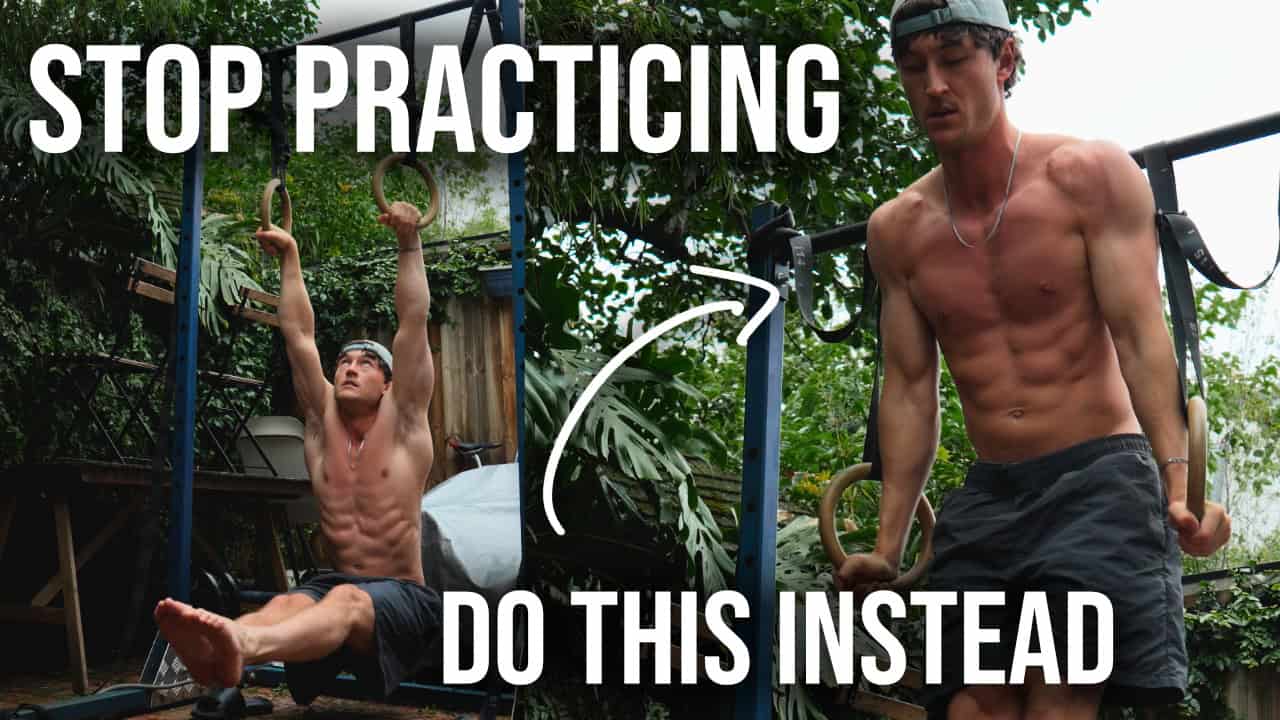
In this video we talk about why you still can’t do a muscle up, and what to do instead to achieve it fast. Here’s what we cover:
- Why practicing muscle ups is the worst way to achieve one if you can’t do it already
- The specific strength requisites you should already be working towards that will unlock this movement automatically once reached
- The only piece of technique you need to understand to do the movement, and how to learn it in a single session (with follow-along demonstration)
Full transcript
If you’re still practising muscle ups stop. There are only two possible reasons you can’t do a muscle up yet and neither of them are fixed by doing more practise. The muscle up is not an advanced move. In fact, it’s something you should be ticking off pretty early in your strength training career. But that said, it does require a degree of full range motion, strength, shoulder mobility, and lean body composition that fast surpasses the average human. And this is why most people, regardless of the tutorials they watch and the practise, they do have no chance of succeeding. You can achieve all the necessary strength from muscle up from home in less than half an hour a week with the right process, but it won’t just come about magically without some intentional work and certainly not by you just repping out efforts at Muscle Ops. Once you have the raw physical ability necessary for a muscle up, the only thing standing in your way is some simple technique, and if that’s the case, we’ll fix that right now in this video.
So I’m going to take you through the exact strength goals that you need to hit to be capable of doing a muscle up, and I’ll show you how you can achieve each of them fast with just a set of gymnastics rings in a few minutes a week. And then we’re going to go through a full technique tutorial step by step that you can use to test your ability and unlock the muscle up either today or as soon as you do have the required strength. So the muscle up is really just a demonstration of strength through three different plans of motion all linked together. You have the pull up component, which is just full range of motion, vertical pulling. You have the transition which is just horizontal pulling, extending your shoulder even further, and then you have the dip, which is just horizontal pushing so there’s nothing mysterious about it to be able to do the movement.
We just need enough strength in each of these planes of motion and a lean enough body composition so we don’t have excess fat mass weighing us down. And once we have those two things, a sprinkle of simple technique, which I’ll show you shortly, and the movement to piece of cake, the good thing is you don’t need to do any specific work at all to unlock a muscle up because while it might look like a unique skill, there’s no unique strength here. If you’re strength training your upper body properly, then you’re already building all of this strength and it’s just about the level that you get it to. So what does proper strength training look like? There are three strength requisites that I would recommend getting to as baseline targets that will then translate to having the ability to do the muscle up, learn it in a single session.
The first is your vertical pulling strength. The level that you need to get this to is a full range of motion to arm chin up, and what full range of motion means is from a dead hang up to the point where your wrists physically touch your chest like this. If you can’t pull your entire body weight from here to here, yet it’s going to be impossible for you to get into the position necessary to start the transition the second phase of the muscle. If you can’t do that yet, that’s absolutely fine. This is now your goal. You want to aim for in your vertical pooling strength. So you should have a vertical pool movement in your training and the key thing to get rider is to make sure that all your reps are starting in a dead hang and ending in this position where your wrists touch your chest.
If you’re trying to train this by wrapping out unassisted pull-ups that aren’t hitting full range, that’s not going to cut the master. We want to practise this range of motion all the way to the tops of the oo build strength there. The easy way to do that is just to make sure you guide yourself through every rep. If you don’t have the strength to get all the way up, use your feet to help you the rest of the way so that you can practise pulling through this full range of motion. I’d recommend testing this every time you train, seeing how much range of motion you can get unassisted, and then as you do your training race, actually make sure that you are guiding yourself through the full range that you get a chance to build it. Once you can hit a full range of motion unassisted rep, you now have the strength in the vertical pulling plane to do a muscle up.
For the transition strength, we need to get our horizontal pulling strong enough for this. I’d suggest aiming for a full range of motion tuck front lever row. What this means is getting your elbows past your body because we need to build the strength to extend our shoulder to this point because this is exactly what we are doing in the transition to pull our body over the rings, and this is pulling range of motion that the chin up does not hit. So you want to make sure that you have a horizontal pull in your training routine. You want to make sure that you’re getting your elbows past your body so that you’re training this full shoulder extension range of motion and then you want to progress it until you can get to the point of doing tuck, front lever rows. Just like with chin-ups, these scale down, you can start by doing body weight rows like this, add in tux for whatever range of motion you can train them for.
Again, just remember if you’re getting stuck before full range of motion drop down to your feet, finish the rep full range with whatever level that you can manage so that you actually train that end range and get it stronger. Because we’re not aiming to be impressive now we’re aiming to build full range of motion strength so that eventually we can be impressive and be able to do muscle ups and whatever other movements we want for free as a byproduct of the strength we’ve built. So work that horizontal pulling strength. Once you can get a full range of motion wrap in a tuck feet off the ground, then you now have the horizontal pulling strength to do the transition. Now the last requisite is the strength to do the dip. Now obviously you could say just be able to do a body weight dip. I don’t actually train dips per se.
What I’d suggest building the strength to do is a tuck plant pushup. If you build enough horizontal pushing strength, this is basically the same range of motion as the dip. There’s nothing wrong with dips but past this level they’re not really scalable and so they stop being useful. And so in our system we just do horizontal pushing. So I’d suggest building up from pushups which you can guide yourself through to eventually getting your feet off the ground. Once you can do a full range of motion rep in a tuck position like this, then you have more than enough strength to do a body weight dip and push from the deep dip position up to the top of the muscle up. The key thing with this in your training is to make sure that no matter where you’re starting, you’re getting your reps all the way down to this point where your wrists touch your chest so that you again are building that full range of motion strength from deep shoulder extension up.
So those are the three strength requisites, full range of motion, chin up, tuck, front lever, row and tuck, plange pushup. All three of these milestones are around level four in our training system out of seven. So that puts them bang at intermediate, so they’re not easy. You get to the point of doing these movements and you are strong and lean with good muscle mass by definition, but they’re far from advanced. These are very achievable and worth working towards as soon as possible for more than just the purpose of doing a muscle up. And the good news is you can train all three of these movements very efficiently regardless of your starting level of strength. All of these scaled down really easily to require zero ability and you can progress on them very effectively with just a couple of minutes of intense training a week. It won’t go into that on depth here, but I’ll link a couple of tutorials you can watch if you want to learn how to get started there.
All these strength requirements build in body composition because they’re all body weight movements. So just like the muscle up, these movements demand a certain level of relative strength to perform. So you’re going to need to have the raw muscle mass and the low body fat to be able to do these movements that will transfer over to your muscle up. Once you’re hitting these levels, there should be no reason that you can’t do a muscle up. So the rest just comes down to simple technique. It is a bit unique, but we can get that solved right now. There’s one essential piece of technique for the muscle up. Once you get this right, everything else is automatic. You don’t need to practise as long as you’ve hit those strength requisites, you’ve got everything you need. It’s easy. But without this technique, it doesn’t matter how strong you are, the movement is literally impossible, and that is the false grip.
If you’re trying to do a muscle up starting with a normal grip on the rings, it is physically impossible for you to do the movement. You have to somehow rotate around the rings, defying physics in the process. So what false grip is, is basically just maintaining the grip position that you’ll have at the end after the transition for the dip all the way from the start when you’re under the rings. And this is what allows you to pull yourself from under the rings to over them while keeping your hands in the same position. This is really easy to learn to do and the less you practise it, honestly the better because it will tell you a wrist up. You’ve got a grip on this soft part of your forearm, and so the more you do it, the more you’ll shred your skin, which is why there’s no point having this as a normal part of the practise in your routine.
You can build the strength of a lot less pain and once you do, you can just do muscle lots when you want to show up your strength to your friends. So the way to do false grip first is to use the right rings. This is much easier on wooden rings. You can do it on plastic ones, but you’re going to be fighting an uphill battle I train with and like the slightly smaller 28 millimetre Olympic gymnastics rings, these are commonly sold in a thicker format. They’ll still work. I think it might be easier with the smaller ones, but whatever you do, just make sure you use timber rings. Second step is to chalk up. So you’re going to be putting the weight of your body under the knobbly bit of your wrist, and so your upper forearm, lower wrist are going to be what grip the ring.
It won’t actually be your hand at all, not until you’ve done the transition in the deposition for the entire chin up portion. It’s below your wrist that is gripping you to the ring. So this is the bit that you really want to chalk so that it doesn’t slide on the ring and you have a solid grip. You don’t want to be moving. You want to be locked onto the ring with as much friction as possible to get into your false grip ear and just going to hang your knobbly bit of your wrist, get it on top of the ring like this, and then you can load your body weight onto the rings. It’s pretty uncomfortable. It might take a bit of getting used to. The idea is not to spend lots of time here, it’s just to cop it while you do the muscle up.
Once you’ve figured out how to hang your body weight on your full grip, you can then do the movement. So it’s as simple as going through a pull up, getting to the top here. Then to do the transition, you just need to keep pulling your elbows back until you get your chest over your hands and pull yourself up into a dip position. Again, this might take a bit of practise, but if you’ve held the full grip to the top of the chin up, it should be as simple as rowing your elbows back. Again. If you get stuck at some point here and physically can’t do it, it’s very likely that you just don’t have the strength yet. But if you’ve managed to pull yourself over through the transition into the starting deposition, it’s pretty straightforward to then just dip up and you’ve done your first muscle up.
If you’re right on the border of being able to do this, obviously the key bit to practise here is the transition, so you can just work this range of motion until you figure it out. As I said, the limiting factor here will probably be your wrist skin getting shredded, so practise sparingly. And again, if you’re struggling and can’t do a transition at all, keep working on your strength, you’ll get there. And if you’re managing to do the transition, then the full most challenging version is to go from a full dead hang, which with a false grip is an eagle hang where you turn your wrist out like this, maintaining false grip, pull yourself up through the movement and get all the way to a locked elbow ring support holder at the top. Once you can do that, then you’ve officially got the muscle up, there’s nothing else to it, and now you’ve got another move that you can add to your back pocket and claim is yours.
If this has allowed you to do your first muscle up, congratulations. Obviously, if it’s still outside your ability, that’s not a problem. It just means you have work to do and I think this is a really nice goal to have as an indicator of a lot of your strength progress coming together. As I said, you need to be around intermediate level across the board with your upper body training for this to be achievable. And so for most people, that means basically end goal strength, leanness, muscle mass shoulder mobility. As I said, it’s very achievable but also really worthwhile getting to it. And if you’re in that stage, you’re just building your strength. Don’t worry about false grip, don’t worry about transition practise. This is one of those things that comes for free. This is just there when you’ve got the strength and you’re ready to try out a new fun skill. If you want to help nailing this process, building the relative strength mobility required to do this movement and all the others at home from 40 minutes a week, you can learn how we do it below. Otherwise, let me know if this is useful. If you have questions or if something you want to see next, please lemme know in the comments. Lemme know where you’re up to with your muscle up strength and we’ll speak soon.