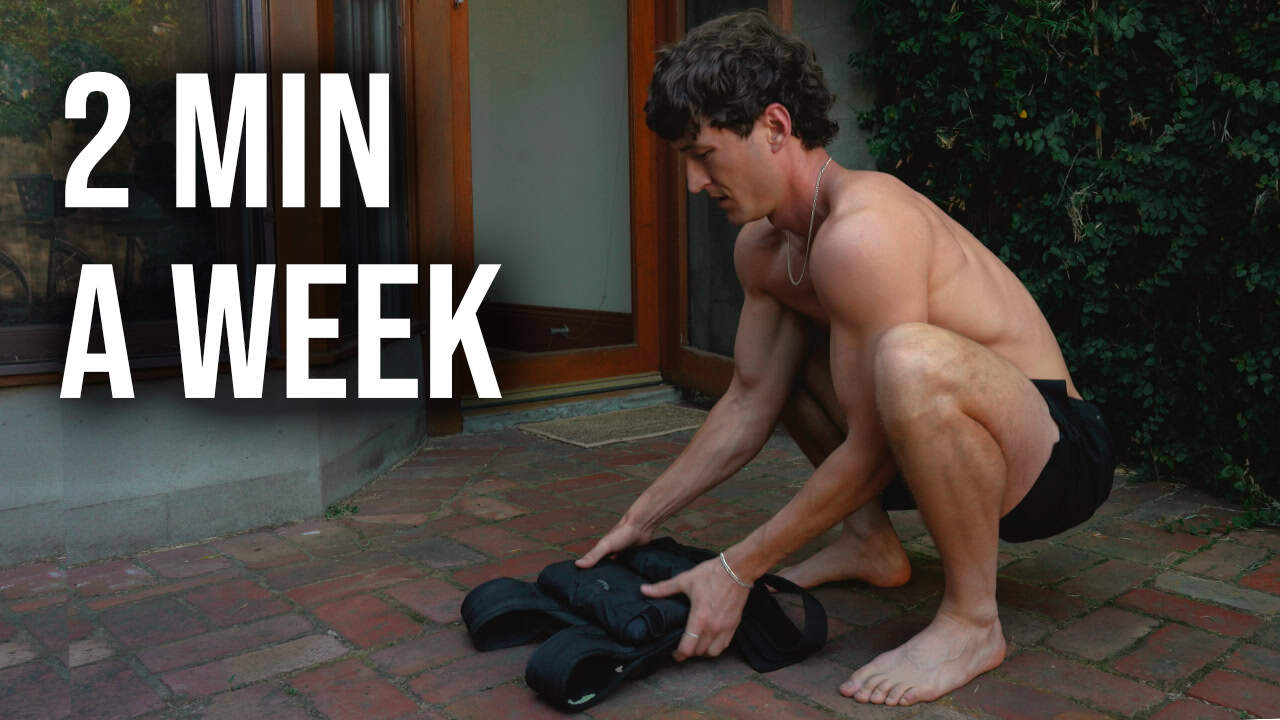
In this video we talk about the fastest way to unlock a deep squat, without the need for endless mobility drills. Here’s what we cover:
- Why proper lower body strength training is the fastest route to permanent squat mobility
- The two most common mistakes when training this movement pattern that sabotage mobility, strength, and joint health
- Simple method for fixing these problems and making maximum progress from an absolute beginner level up
Full transcript
If your squat currently looks like this, falling over backwards, here lifting up, knees rolling forwards, you don’t have a flexibility problem. You have a strength training problem. And left unchecked, this is why your leg training never really progresses. You feel sketchy or unsafe under load, and no amount of stretching ever seems to fix the issue. The good news is you do not need to be naturally mobile or wait until you’ve fixed your squat to start training it properly. In fact, the fastest way that I have found to unlock a deep squat is by loading a single leg squat through whatever range of motion you currently have. And trained correctly, this can be so potent that one or two hard reps a week is enough to drive serious strength, muscle, and mobility gains. In this video, I’m going to show you how to adjust your single leg squats so that regardless of your current ability, you can start getting strong immediately, train them safely and comfortably, and unlock a deep full range squat permanently without the need for endless mobility work.
The large bulk of your lower body muscle serves three basic functions. It extends your hip, mainly your glutes, it extends your knee, which is your quads, and it extends or plantar flexes your ankle, your calves. And together this forms the triple extension movement that happens when you jump. If we want to build a powerful functional lower body and unlock access to the deepest squat possible and put on as much muscle as possible, which is extremely useful, not only for longevity and health, but for being lean and looking good, then our goal is very simple. Get as strong as possible in this movement pattern through the full range of motion from the very bottom to the very top. Now, the easiest way possible to do that is to get on one leg, load up with as much weight as possible, and push as hard as we can throughout this whole movement.
Adjusting how much we assist ourselves to basically make every inch or one max. Is this extremely brutal and taxing? Well, yes, if you tried to do a crazy amount of it, but when you make your training this potent, you need very little to simulate strength gain and therefore muscle growth, which is why a couple of minutes of this a week is generally more than enough and all I’ve ever personally done. The rest all just comes down to recovery and allowing your body to adapt. Now we can talk all we want about training, volume, recovery, intensity, but regardless of how we approach that. For this movement specifically, there are only really two things that we’ve got to get right. The first is to get the load centred over our foot. If we don’t do this, then the load tips off our working leg and we never get a chance to actually push against the resistance, meaning it’s very difficult to load this movement up and make any progress with it.
And the second thing to get right is training it through the full range of motion that we can currently access. Because if we don’t, yes, we miss out on building strength across the full range of motion and getting as much benefit from every rep as we could in terms of muscle growth. But most importantly, we miss out on improving our mobility, meaning our ability to move through the end range of the squat uninhibited and ultimately get it looking like this. For example, if we want to get better ankle flexion, then we need to build serious strength in the deepest ankle flexion range that we can currently access. The stronger our body gets there, then the more comfortable it is allowing us to flex deeper. And while our mobility unlocked. And if you’re watching this, this is exactly what we want to achieve so that we can train better, but also just so that we can squat down to the ground and pick up a small human without even thinking about it, for instance.
That is functional strength. So for our squat training, very simply what this means is starting in a position of complete hip, knee, and ankle flexion as much as we currently have and working on building as much strength as we can from that starting point. Now there is some specific stuff you can do as well to work on the deepest part of the movement. I’ll show you that at the end. But first, let’s start with the fundamentals that are going to get you the large majority of results. There are several things I see stopping people getting these things right with their training, and without someone there to correct them, it’s what holds them back from ever progressing with their strength or mobility when it comes to lower body training. I’m going to save you the pain and show you how you can avoid those now. By the way, if you’re enjoying this and want to learn about the other five movements that make up my entire training system, I’ve just put together a free guide walking you through all of them.
In it, I go through what the movements are, what you can expect to achieve from each of them, and what strength standards you should be aiming for with each, depending on your current level and your goals. You can download that for free right now, first link in the description below. Okay, so the first limitation, and this is a free fix. There are no excuses for this to be holding you back. You can fix it right now, and it’s not supporting yourself properly through your single egg squat training. Training a max effort, single egg squat is hard. And if you’re trying to add balance into everything else that we’re doing, then you’re just massively handicapping your ability to work hard, to keep the plane of motion right with the weight centred on your foot, and to get the range of motion right and work all the way from deep triple flexion up.
There is enough going on here. Eliminate the balance part. You can practise that separately if you want to, and I’ll show you how you can do that. But just get strong enough and that will become easy. What you want to do is use two sturdy platforms, one either side of you, at least hip height, so that way you can balance yourself, guide yourself all the way down from the bottom position right to the top. And I don’t care if you’re doing this without any weight, get the support there so that if you need to, you can guide yourself through with zero weight on the working leg. A key principle with your strength training is that you should never need to be strong in order to complete the rep, because that’s a complete catch 22. If you need to be strong in order to train properly and therefore get stronger, then how are you ever going to do it?
We want to set our training up so that we never need any strength to move through the full range of motion, but we can opt to make it harder and use whatever strength we’ve got. So the second limitation is one that I see the large majority of my students struggling with initially. So if you’re experiencing this, you’re not alone. And that is they do not have the ankle flexion mobility to sit balanced in the bottom of a deep single leg squat. So if you’re experiencing this, you’re with the majority. What we don’t want to do is let this ruin our training. Now there are two problems that I see this causing. Most people sit in one of these two camps when they start. The first problem is when you keep your heel on the ground, therefore causing your weight to get shifted back off the centre line, because this takes us off plane and as we said before, means that we can’t actually push against the weight.
The harder we squat up, the more it tips us back onto our hands, and we never get to work anywhere near as hard as we could and build strength. And therefore the mobility that we need to be able to fix this problem, we stay in this vicious cycle. The other problem comes is if we keep the weight centred over our foot, but then roll our heels so far forward that our knee comes down, our hips open up, and we have this huge gap in our hip flexion. If we’re sitting in a position like this, we’re missing half or more of the hip extension range of motion when we do this movement. That means we miss out on nearly half the movement’s benefits in terms of glute development, building hip extension strength, which is massively important, especially for women if we’re trying to build our booty.
It takes all the load off that ankle flexion, which means we never actually get a chance to improve the very thing that’s causing this problem in the first place. And it also puts a bunch more pressure on our knees. And this is no good for longevity in training or in life. I’ve had students who really struggle with knee pain in this position and when we fix this starting position, that just disappears. So the solution to this, if you don’t have the ankle flexion mobility to start here, the way we avoid these two problems is by keeping our weight centred, keeping our hip fully flexed, but just reducing the amount of ankle flexion that’s needed. And there are two ways we can do this. Either you can just let your heel float in the air and be conscious of making sure that you do keep your hip fully flexed and weight balanced on that foot.
Or what I’ve found to be a much easier solution, especially early on, is to simply elevate the heel. So you can use anything from an actual wedge board to putting a small plank of wood or a book under your heel. Anything that allows you to drive weight onto your heel while reducing the angle of ankle flexion needed. Once you’re set up like this, full hip flexion, weight balanced on your foot, and heel in a position that allows you to do those two things, two 30 platforms either side, then anyone with any level of strength can guard themselves through the whole movement pattern with next to no load on that working leg, because if you get stuck, you just use your hands and your other leg to help you. And as you squat, you just move in sync, lead with your chest, drive your heel into the ground or whatever you’ve elevated it on.
And now you’ve got the movement pattern. And as soon as you’re ready, you can start loading this up with as much weight as you can handle, start maxing out your effort across that full range of motion and start getting stronger very fast. I use 60 kilos for this now. Most of my students start with 20 to 40 kilos until they start to find that too much of the movement becomes easy and then they just add more weight. You’ll need to help yourself lots at the bottom, but you’ll be surprised at how much weight you can move towards the top. And the key to improving your mobility with this is over time as you get stronger and build the ability to move more load throughout the range that you’re training is to progressively reduce the amount of heel elevation that you use. As soon as you can drop your heel a bit without toppling over backwards, then do it.
And your goal over time as you get stronger is to eventually get to the point where you can start with your heel on the ground in a balanced position and work all the way up to the top. But as you work this movement, don’t get distracted by mobility issues. The whole point is what we want to focus on strength gain. Set things up so that you can train it properly and then just get as strong as possible across your full range of motion. Build bigger, stronger muscles, a leaner body, the mobility will inevitably come as a result. If you want to do extra work to practise this deep range of motion and get better at the deep squat position, I’ll give you three drills you can do, depending on your level. The first is just to sit in the deepest double-legged squat you can and use an anchor point to pull yourself forward.
Think about driving your knees over your toes. Our eventual goal is to be able to sit, feet together, heels on the ground, hamstrings on our calves, full knee bend. And so if you’re toppling backwards at the moment, using the anchor point in front of you allows you to pull as deep as you can into it. Once you can sit in some sort of double leg squat comfortably, you’re well on your way to having the mobility you need. The next thing you can do is start to transition from a double egg squat into a single. So you can stick one leg out in front of you and practise balancing there. Your goal is to keep your heel on the ground and maintain full hip flexion, so not roll forward into this position, but stay in the deep squat. And once you can do that, the final level is to lower into that position with a single leg.
So do a single leg squat negative and finish in a balanced bottom position. Once you can do that, you shouldn’t need any heel elevation in your training. And at this point, you can just focus on building up to 75% body weight, unassisted single egg squats. The mobility is going to maintain itself by that training, and so all your focus should just be on getting as strong as humanly possible. This is an extremely common sticking point, so I hope this video helps a lot of you. Please let me know your questions in the comments below and I’ll get them in the works for future videos. Appreciate your get after squats. We’ll speak soon.