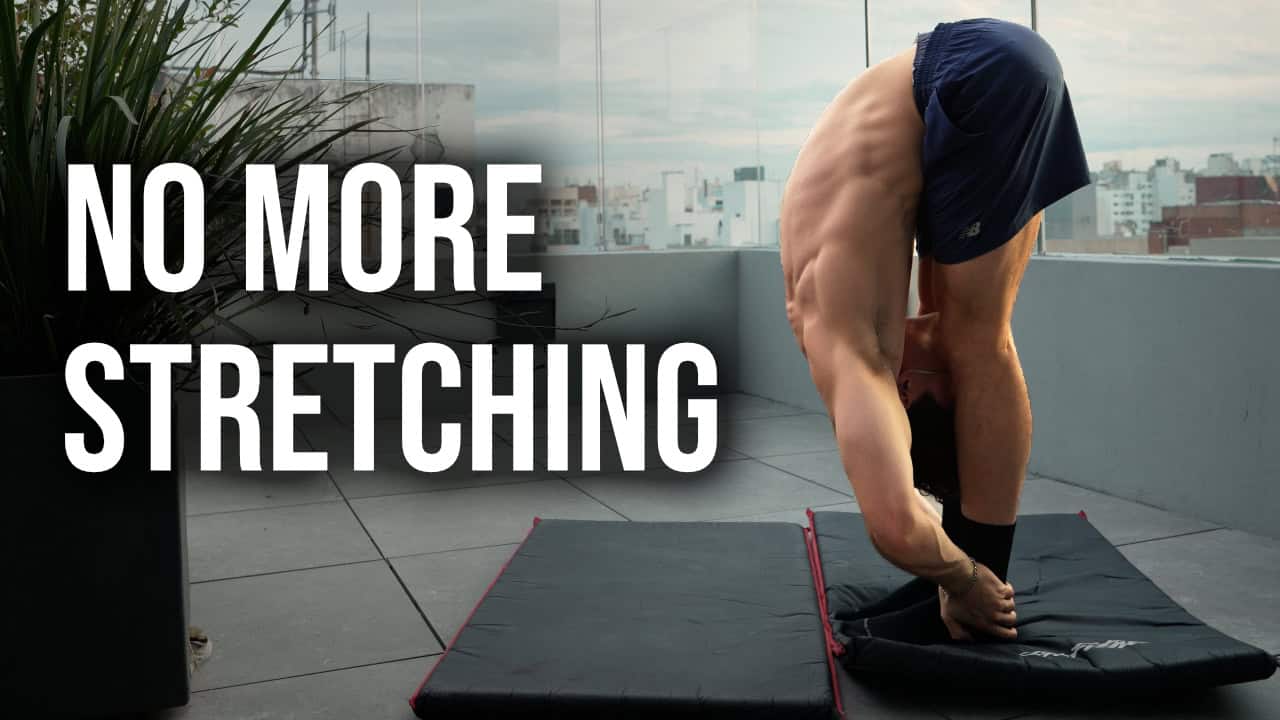
In this video we talk about how to build real flexibility once, and keep it for a lifetime. Here’s what we cover:
- Why stretching never leads to any serious flexibility gains
- The mechanism behind flexibility and why achieving properly results in a permanent upgrade to your body that is always accessible
- How you can achieve it in under 10 minutes of work a week
- A live demonstration you can follow along to start building pike flexibility right now
Full transcript
I don’t really put much time or thought into flexibility, but that is probably because about 10 years ago, I built more flexibility than I ever needed in a few short months flexibility, which I’ve maintained since then with almost no work. Currently I spend less than 10 minutes a week on flexibility, which slots in between my strength training to add practically no time staying well under 40 minutes of work a week in total for fitness. But let me be clear, none of this would’ve been possible if I’d have just stretched similar to strength. It’s only been through the application of a very simple but very potent training technique that I’ve been able to create such extreme and long lasting results. In this video, I’m going to finally reveal the secrets behind what that method looks like and show you the technique that I’ve used to build flexibility so efficiently, and we’ll go through an example you can follow along yourself so we can try this right now firsthand and see just how superior this is to the way most people approach this stuff.
Anyone can build a very flexible body and with the right method build up to movements like splits, straddle Ls, hand presses. Just like with strength, it’s a skill, a skill that can be acquired and as I said, with the right process that does not have to take long at all. So let’s get into it. Why is it that so few people manage to get flexible? Well, think about how most people approach it. They’ll think that they should stretch because that’s something you should try and do to not get old and stiff or to keep healthy during exercise, not get injured. And so you might stretch, it’s uncomfortable, it’s effort. You definitely feel it, but it doesn’t really do anything. You don’t actually get more flexible as a result of it. I’m sure you can relate to me on this. If you ever have tried stretching before, why does this not work?
Well, your muscles are not rubber bands. Flexibility is not the act of stretching them and trying to get them longer Flexibility or the lack of flexibility that you currently have is a protective mechanism. Easiest way to think about it is imagine that you were super flexible. You have the same body you have now, but you can move in all the ranges of motion you want. Imagine a diving into a super deep lunge, you’re playing basketball and you leap forward and then suddenly you’re in this splits position with your whole body weight coming down on your hip joint in a position that you do not have the strength to control or pull yourself out of what’s going to happen to your hip joint. It’s going to be potentially a very bad time. In that dynamic situation where you’ve lost control of the joint, the joint is very likely going to get damaged.
The more extreme, the range of motion that you move your joint in, the harder it becomes to control because your muscles are lengthened and they become more and more disadvantaged in their ability to pull you back into your normal comfortable range of motion. At the same time as you go into those extreme ranges, you’re also getting closer to the end of your joints maximum range of motion. And what happens when you go past your joint’s? Maximum range of motion is you start to damage the joint, the connective tissue and the bones forming the joint itself start to be at risk of damage. And if there’s one thing your body does not want, it’s a ruptured hip. And so what does it do to help avoid these situations? Or you’ve already experienced this countless times whenever you’ve tried to stretch and go to your end range.
What does your body do? It stops you before you get there by your body contracting your muscles, whenever you start to reach the ends of your comfortable, stable range of motion. Your central nervous system is basically keeping you within those limits all the time, keeping you within ranges of motion that it knows you are strong and capable enough of moving safely within. You start to go beyond that. It says, nah, contracts the muscles that are getting stretched while it still can, rather than allowing you to get to this point where suddenly it’s too late, it doesn’t have the strength of the ability to save your joints and then you’re in real trouble. Your body’s very smart. These mechanisms have evolved over millions of years. So it’s as simple as that lack of flexibility is your body keeping your joints safe? Now obviously this is involuntary.
You don’t get to choose. It’s an automatic reaction, which is why it works. So in terms of getting more flexible, we understand that our lack of flexibility is serving a function, a very useful one. If you didn’t have it, as we said, you would get in a lot of trouble. So if we want to increase our flexibility, we need to do it with respect to the function that it is surfing, which means, and this should be somewhat obvious now, and if you followed me for a while, you are not going to be surprised what the answer to this question is. It’s strength specifically in this case of flexibility. It’s strength in the end ranges of motion, IE. We want to increase the range in which our body is stable and comfortable handling movement, knowing it can pull itself back to a neutral position safely. As you increase that, you increase the range of motion that you have accessible to, and this is real range that’s available at a drop of the hat all the time.
It’s now your functional range and you build enough of that strength. Eventually you have the range of motion to do the movements you want to do and voila, now you’re doing splits like they’re nothing. And this is why building real flexibility lasts. Sure, it may take months to build, but because of the nature of strength, once you’ve built it, it doesn’t go away quickly. It’s accessible whenever you want it without a warmup and you can neglect it like I have for a long, long time and is very slow to diminish. And anything you do lose over time is very quick to gain back. The other good news with this is that if you are just looking for functional flexibility, I get a lot of people asking me about mobility. What can I do to make sure I don’t become stiff and unflexible? And the answer is that if you are training properly, you are doing your strength training across full range motion at maximum intensity as it should be if you want to be making it as effective as possible and you’re doing that for all your basic plans in motion.
Then for daily mobility and function, you don’t really need anything else. Flexibility is built into the strength work that you’re doing to get bigger and stronger and leaner. But for any specific flexibility goals that you have, like the splits, we can just go and apply the exact same principles of our strength training to that and get some serious results very quickly. So rather than ya at you as to what that would look like, I’m just going to show you, I suggest watching this video and then going back and having got it yourself. Because when you do this properly, you’ll see in a single session just how potent proper flexibility training is because you’ll notice gains in the range that your body allows you to move through in this session. It’s that powerful. So we’re going to apply this now to a pike touching your toes.
If you can’t happily put your palms on the ground with locked knees, this is going to be one of the lowest hanging fruit wins for you to achieve this movement. Not only because it’ll make you feel more competent, but because the amount of tension that this will release through your posterior chain and lower back is pretty unbelievable. So the principle is with this, we don’t want to try and maximise range of motion. We want to maximise strength, hence intensity somewhere at the end range of motion. You can try this with your P. If you stand feet together, lock your knees and bend over. We’re just thinking about hip joint here. So the image you can have in your mind is trying to fold your belly button onto your thighs. You’re trying to close yourself like a book at the hips to find your limit. You can just stand in this position and start to do that hinging, close your belly to your legs and you’re reaching the end of your comfortable range of motion when your body starts contracting.
So you’re going to notice your calves and or your hamstrings start to tense up involuntarily when you get to a certain point. That’s great. What most people do is subconsciously trying to avoid this, they get this sensation back off because it’s uncomfortable, it’s painful. We want to do the opposite. We want to lean into this because that contraction is our body’s natural reaction to getting to the end of its range that it’s comfortable in. We want to now get stronger there, which means tensing those muscles as hard as we possibly can so that we get our body to then go and build strength, get stronger in that position so that next time we come back, our body allows us to go a little bit further because it’s a little bit more confident. It’s as simple as that. So as you start to bend at the hip and get to that point where your muscles contract, this is now where we want to start actively contracting.
And what we want to think of this as is literally just max intensity strength training from here to as far as we can comfortably go deeper into it. So the way I used to achieve this, the classic movement that is used for this and it’s brilliant, is the Jefferson curl. You can use a 20 kilo barbell or a weight vest and pull yourself into it. I have realised for both enjoyment and convenience that you don’t really need the weight. What you can do instead is just pull yourself with your upper body. So I like to hook my hands around my ankles and use a bit of my hip flexors, my core to pull myself down so you’re using the rest of your muscles to pull yourself into it. And as you do that, you want to tense the elongated muscles along the back of your leg and try and pull yourself out of it.
So you think of this in two parts. You’re pulling yourself in with your hands and you’re trying to pull yourself out of it as hard as you possibly can with your hamstrings, your calves, your posterior chain. That’s the movement. You’ll find that this is extremely intense and uncomfortable. Excellent. As soon as you’ve done that work for a second, you can pull yourself out of it. And that’s a rep. And again, there’s a few different protocols thrown around for this, but what I found to be the most effective is rather than doing static holds, moving in and out of reps. And so what you can do is stand up and then go back down and repeat this process. If you get more inter motion, great, but again, it’s not really the purpose. The purpose is getting as stronger contraction in the stretch muscles as you can, building strength.
Now over time, as this becomes easier for you, you’re going to want to go deeper to encourage yourself to tense harder. That’s how this will work. So don’t think too much about range of motion. Think about intensity. Range of motion will come as a natural byproduct of you building strength towards that end range. And you can basically just repeat these reps until you start to build diminishing returns. I’ll give you a number as an arbitrary goal of 10 reps because I’ve found that to work well. But again, I think the best indicator of efficacy diminishing returns is to go until you start to feel like there’s not a huge purpose to it left. And that’s it for the session. Do one set, go until you’ve had enough done. Just like with strength training. And what I’d encourage you to do, hopefully you haven’t started this trial yet, is test your flexibility before and after.
Do a standing toe touch measurement. See how far down you get along your leg, or if you’re touching the ground, see what part of your upper body you can get touching the ground. And then at the end of the set, do it again and see how much you gain. You should feel more limber and able to go further protocol for this. Do your set of 10 reps one to two times per week. If you can do that consistently and really go hard when you do it, you’re going to make progress. The most important thing with anything where you’re trying to achieve a goal, choose a routine that you know can comfortably stick with that seems unreasonable not to get done consistently. The great thing about these mobility movements is you don’t need any equipment. You don’t need to get set up for it. You can literally bang it out in a minute in a hotel room.
So it’s a nice tool to have in your kit. So that’s basically it. Flexibility is not rocket science, but I think it’s important to know that if you want to build it, there is a process. And much like with the rest of your strength training and nutrition, you need to be intentional about the result that you’re trying to get if you want it, because none of this will be something that you do just voluntarily without the intent of the goal behind it because it’s not comfortable. It can be quick and easy just like with the rest of your strength training, but it is intense that something’s going on. It actually takes a lot of effort despite what you might think of stretching as normally. So hopefully this is useful. This is some different training content to what we talk about a lot here. So you’ve got questions, please let me know and I’ll try to address ’em in future videos. If you want to see the full lower body flexibility routine that I’ve been doing, lemme know as well. I’m happy to make a video on that if it’s useful. Otherwise, get implementing this. Let me know how you go with it. I’ll speak soon.