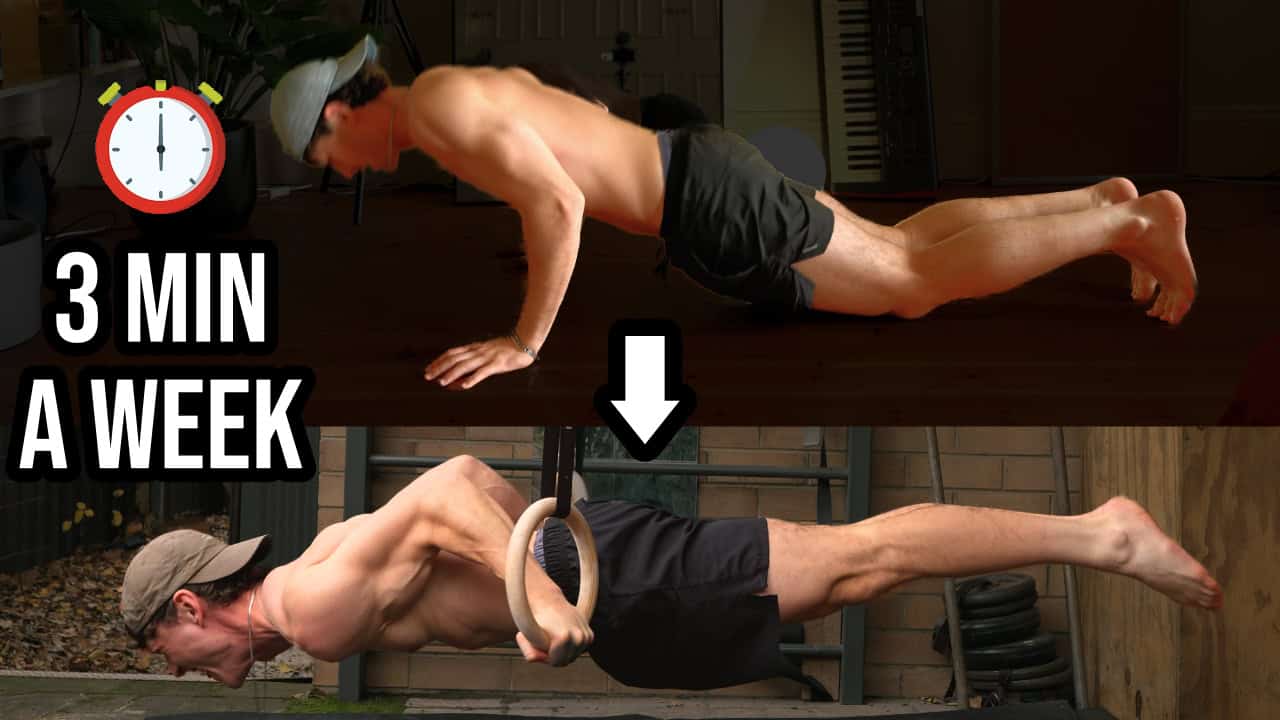
In this video we talk about how to build pushup strength insanely fast. Here’s what we cover:
- How to build all types of pushup ability as fast as possible with less than 3 minutes of work a week
- The loading mechanism to implement this training method regardless of your starting ability
- A complete step-by-step walkthrough and protocol you can start using today, with just your bodyweight and the floor
Full transcript
If you’re trying to achieve your first pushup or you’re wrapping them out and want to actually achieve some more serious strength, then I want to show you a completely new way of approaching pushups. One that will allow you to build all the way from this to this about as fast as your body will allow or training this movement for less than three minutes a week. And if that sounds too good to be true, then you’re going to want to see how this works. I can guarantee if you follow this video along and try this for yourself, you’ll see immediately why every form of pushup training you’ve tried before is so ineffective. If you haven’t hit your first pushup yet, then this is the fastest way to build to doing multiple reps and beyond. It’s the exact process I take all my beginner students through and yes, this works if you are older female or have never done a rep of strength training in your life.
If you can do pushups but haven’t built to these more advanced levels yet, then progressing onto them is going to allow you to start unlocking movements like back levers, planches and muscle ups. This is the same process I’ve used to get there myself, and of course build that sort of strength and you’re going to have the chest and shoulders lean, muscular upper body to chauffeur it, which is not a deal for three minutes of work a week. So if you’re ready, let’s dive in. I’m going to start by going through the theory of how to maximise strength gain in this movement so you understand the process of what’s going on. If you want to dive straight into the how to feel free to skip this chapter for now, but this is how it works To get better at pushups, we just need to increase our maximum strength in the horizontal pushing motion.
Everything else is simply a derivative of this. If we want to hit our first pushup or first plant pushup, then obviously we need to increase our maximum strength. It’s the only way to get there, but even if we just wanted to increase our endurance, the most effective way to do that is to increase our maximum strength because if we increase our max, then every pushup we do is a smaller percentage of our maximum capacity, which means we can do more reps because every rep is easier for us. Think of endurance as learning to use the hardware that you’ve got more efficiently increasing your maximum strength is like upgrading the hardware. We do enough of that and the result is physical growth in the prime movers, our chest and our shoulders, which allow us to move more force in that direction. Now there’s a problem with normal pushups that makes them horribly ineffective for building the strength and muscle mass, and if we address it, not only can we make way more progress without the need for fancy equipment or complicated training protocols, but we can make that progress in extraordinarily little time.
Here’s the secret, improving our maximum strength is really simple. We just need to practise it. Think of it like this. The closer we are to needing all our strength to do the movement, the stronger signal we send to our body to build more, which is pretty logical, right? If we have loads of strength left in the tank, why does our body need to go and upgrade itself? If we just wrapping up pushups, we’re clearly succeeding. There’s no incentive for our body to change. On the contrary, if we’re spending our whole time busting our ass, barely able to budge another inch, then there’s a clear gap between our current ability and what’s being demanded of us and our body takes this as a signal to adapt, to build more muscle and get stronger so that next time we face that situation, we’re better prepared to handle the challenge.
I cannot overemphasise the efficacy of this. If you want to elicit changes in your body every second we spend at this point of failure, trying as hard as we can is like a potent elixir that screams at our body to improve. Most people spend hours a week in the gym trying to accumulate a decent amount of it when in reality we only need a couple minutes a week to get our body’s muscle building factories humming along at full tilt. But the issue with normal pushups is that we almost never get a chance to do this practise because if you think about it, we spend all our time doing reps that are well within our current ability, and then as soon as we finally get to that point of maximum effort, we fail and we have to stop. If you can’t do pushups yet, then you can’t train and as soon as you can do pushups, well there’s no way to continue overloading and keep getting stronger.
And this is the reason why traditional pushups take so long and aren’t very effective at building strength. The difficulty is always the same, but does it need to be Instead of basing our training on the difficulty of the pushup, what if we flipped the script and adjusted the difficulty of the pushup to suit us because that way we could keep it as hard as we could handle the whole time cutting out all the time wetting fluff and only sending the clearest signal possible to grow, which would reduce training time dramatically and we could constantly scale the movement up to keep meeting our strength limit as it evolved, meaning we maximise progressive overload and strength gain. In theory, it should then only take us a few minutes a week to maximise progress from any starting level and we’d be able to eventually build the strongest set of chest and shoulders possible using just our body weight and the floor.
It would be literally like trucking out all the waste and sculling the elixir of maximum potency. And the awesome thing is we could do exactly that, which is what I’m going to walk you through. Now, all you need to do this is understand a simple loading variable and that is the horizontal distance between your shoulders and your hands. Put simply, this is easy, this is hard, and somewhere in between is a point that’s maximally challenging for your body at this exact point in time. Our goal in training is just to find that level and stay there the whole time. We train adjusting as we go to keep it at a level that allows us to try it as hard as possible while still training as long as we want so that we accumulate enough volume to satisfy our body for the week. And you’ll experience this just by doing it, but if you’re interested in why this is so difficult, it’s just leverage.
The moment I’m here is shorter, so the force required is minimal, but if we lean forward far enough the force required of our muscles to generate the torque necessary to move our body becomes equivalent to that of doing a hundred kilo bench press to our muscles. There’s no difference in where the force demands come from and this is why p plange pushups, even though you might just be using your body weight are so freaking difficult until you build the necessary muscle, it’s just physically impossible. So that’s the theory. Let’s get into the practise. I’m going to take you through a full demonstration of how to do this starting from absolute ground zero beginner level. What I suggest is watch this through once so you get an idea of what it looks like and the protocol and then you can come back as many times as you want to practise this yourself.
So just get enough space where you can do a pushup. We’re going to start with the negative. And so the key principle here when we’re talking about pushing as hard as possible the whole time is that rather than lowering, we’re going to actually dial things up so heavy that it forces us down. This concept is so important that I made a whole video on it. You can check that out here if you haven’t already, but what we’re going to do basically is bend our elbows slightly and then start leaning forward until the point where we start to get forced down. As soon as you start to find yourself failing and lowering, you want to push the ground away from you as hard as possible as if the ground is a barbell that you’re trying to bench press and you’re just going to keep pushing the ground away the entire time.
The only thing that you’re actually going to vary as you do your rep rather than the amount of force you’re pushing with because that’s always going to be at a hundred percent, you’re going to vary how much you lean. And so if you’re stationary currently and succeeding and resisting the negative, then you’re going to add more lean until you start to fall down. If you’re falling too quickly, then you can back off the lean until you gain some control over it. And so just by manipulating that amount of lean, you’re going to force yourself inch by inch down to the bottom of the rep. Our goal is to get all the way down to where our chest and hips touch the ground and that is our negative finished. Then we can start the positive. So on the way up again, we’re going to push the ground away as hard as possible.
That doesn’t change max effort pushing horizontally. Initially, this should be impossible. If you’re in the same position you just failed to, then you’re not going to be able to push back up because you’re already trying to push and you are failing. So what we can do is back off slightly again until we get to the point where we can start to win and now we’re moving upwards again. As soon as you find yourself rushing through, you’ve got momentum or it becomes easy. You want to add more lean until you get stuck. And so as you do the positive, you can keep finding these sticking points where it’s impossible and you are stationary. Whenever you’re stationary, you know that your maximum strength is exactly equal to the difficulty of the movement, so you’re working at a hundred percent and that is perfect. It’s where we want to be basically the whole time.
So if you keep finding these sticking points by leaning forward until you get stuck as you go up through the rep, then you know you’re always working very close to a hundred percent, and that is how we send the strongest, most potent signal to our bodies to improve our maximum strength and grow. And you’re going to continue this process pushing hard, leaning forward, getting stuck, backing off, repeating that cycle until you get to the very top. And here we want to basically get our elbows completely locked out, keeping our hips roughly level with our shoulders the whole time. And once we reach that complete elbow lockout, you are finished your first complete rep. That first rep is by far the most important because that’s when you’re going to have the most strength. Everything from here is bonus, and so you can keep going, continuing this exact same process down and up until you’ve basically had enough.
When you feel like you need a break, you want to have a rest, then that’s your sign that you’ve done enough and that’s it for the week. Bear in mind as you do these reps, every single one is going to be weaker than the last because you’re building up fatigue, and so you need to be ready to scale down further and further and further making it easier so that you can keep training. There’s no reason to ever stop training because it’s too heavy because you should always be able to scale back until the point where there’s no weight on your hands whatsoever. And so you decide when you want to end the set because you’ve actually had enough. If it’s too difficult and you can’t do this version on your feet, all you just get tired and need to make it easier. From here, all we can do is bring a foot or a knee forward to take weight off our hands and make the movement easier.
So you should be able to take all the load off your hands to the point where here I can take my hands away and I stay in the same position, meaning I’m actually at zero difficulty here. So you should always know how to scale down to this point where no force is required whatsoever, so that no matter where you’re at, how fatigued you are, how weak you feel, you can still go through the motion. And so that’s it in terms of protocol. You want to maximise your progress on this movement. Do this once every week. That is plenty less is more. One of the most common questions I get is if I train more frequently, will I get more progress? Realise here what we’re doing is sending a signal to our bodies to grow. We don’t make gains whilst we’re doing these pushups. We make progress in the aftermath when our body goes and does the building of the muscle tissue, which then allows us to exert more force next time we’re doing pushups.
So you can try adding more sessions, but what it’s going to end up doing is just cutting into your recovery and meaning you’ve got more work to do that’s harder, that you face more emotional resistance to there’s just no benefit. If you want to do more work, I’d suggest adding in other movement patterns to your weak. This is one of six that I train. And so while you’re recovering from your pushups, you can go and stimulate some other movement patterns to get stronger. And it’s just this, it’s one set. As I said, you do continuous reps, try and rest as little as you can in between your reps, and once you’ve had enough, you’re done. Again, you could try and do multiple sets, but that’s even worse because what ends up happening is you just dilute the quality of the sets that you do do.
So if you try and do multiple, your body’s pretty smart. It doesn’t just allow you to do the same quality of work again, it will start to compensate by allowing you to exert less force on the sets that you do so you end up with more work, more volume that your body and your joints have to recover from, but all of it’s less quality, so you don’t get any marginal benefits in terms of strength gain from it. In addition to this being more taxing on you, taking more time, you’re also going to get more emotional resistance to it. You’d much better off to just have higher quality, more potent training that’s easier on your body and easier mentally to motivate yourself for. That also takes you less time. And every time you train, remember that your sole focus is on increasing that maximum lean. You should literally be aiming to go further every single time you train.
And to do that, all your focus should be on that first rep. The first rep before you’re fatigued is when you’re going to be able to demonstrate your maximum strength for the week. And so if you can just get more lean, a further distance between shoulders and hands on that first rep, each time you train, then you know you’re progressing, which means you are building physical strength and therefore lean muscle tissue. That’s your measure. That’s how you know you’re making progress and you stack enough weeks of doing that up. You’re going to have physically rebuilt your upper body. And as I said, that strength and muscle is yours to keep forever take time off. It is not quick to go away, and anything you do lose comes back very easily when you start training again with strength like this, you really only have to gain it once. It will pay dividends for the rest of your life, so you go, that’s how you build pushup strength insanely fast. As I said, this is one of six basic movement patterns that I train totaling less than 40 minutes of working time per week. If you want to learn what this looks like as part of a complete system, free training on the whole thing, link below. Otherwise, get after this, get implementing, and let me know how you go in the comments and I’ll speak with you soon.