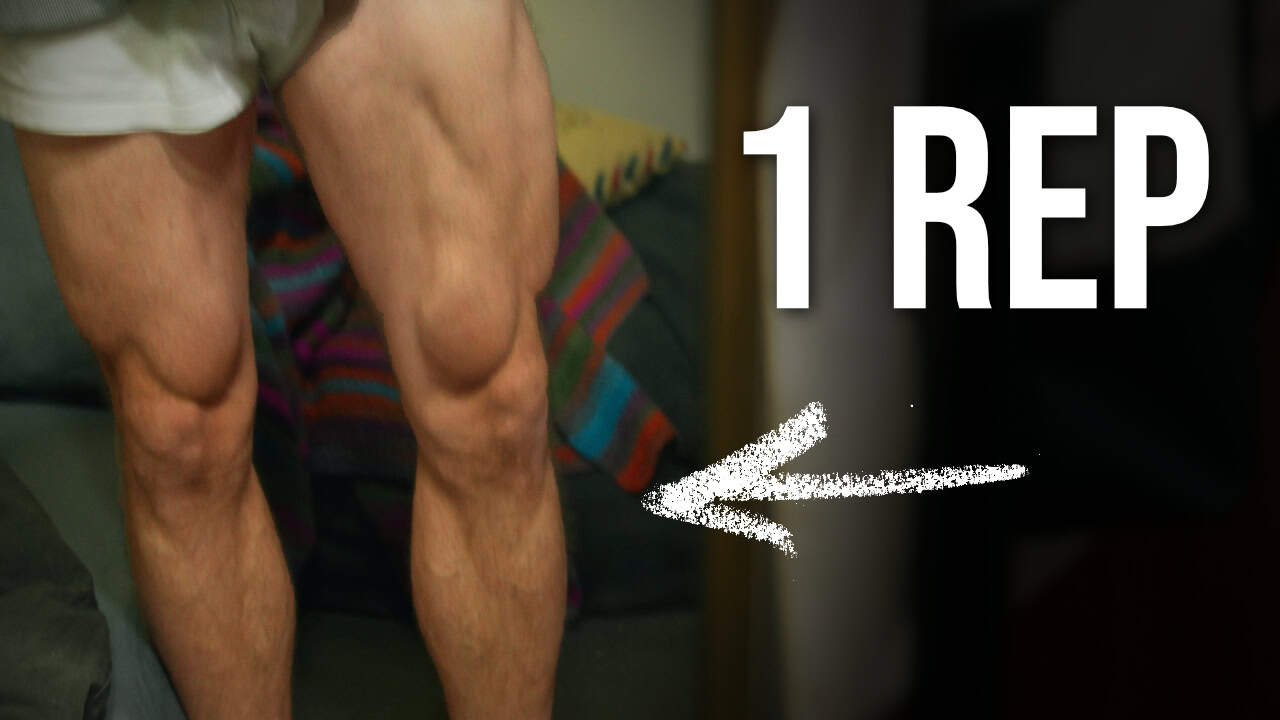
In this video we talk about
- Why proper leg training is crucial for developing upper body strength and aesthetics
- The reason traditional leg training makes consistency and results so hard to achieve
- The method we use to build leg strength fast in as little as one rep per week
- Step-by-step demonstration of technique, programming and common mistakes
Video summary
In this video, I discuss how training legs consistently was a key factor in achieving my physique. [00:00] Despite focusing on upper body strength and diet, I was unable to reach my desired body composition until I started training legs just once per week. I outline the method used, that involves performing a single, maximum-effort set of single-leg squats per week, with the goal of training the full range of motion at the limits of your strength. [05:35] This approach, combined with supplementary exercises like Nordic curls, allowed me to build significant leg muscle and improve my overall body composition, while minimising the time and effort required. [02:50] I provide detailed instructions on how to properly perform and progress this single-leg squat protocol. [08:20]
Full transcript
There was one key moment in my training career that utterly changed the trajectory of my strength and athleticism, and that was when I finally started training legs consistently for a number of years, I trained my upper body really hard and nailed my diet, but despite my best efforts could never get anywhere near that really lean body that I was trying to achieve, kid you not. Within a year of training my legs consistently, I finally got shredded and looked like a completely different person. You want to know the best part about this? It only took me one rep a week to get all these results with my leg training, transforming not only the strength and athleticism of my lower body, but my overall physique. So in this video I want to show you why leg development is such an important part of your training. Even if your goals are purely upper body strength than a six pack, how it is possible to cover the majority of your needs in one rep of one movement a week.
And then I’m going to walk you through the specific method that I use and now teach all my students. So you can try this yourself and start building stronger legs today. If you want to skip the background and get straight into the what to do, I’ll leave chapter marker so you can go do that. But if you want to fully understand why and how this works, then let’s dive in. I’ve always known that you should train legs, but that didn’t mean that I was necessarily consistent with it at all. And there’s a few key problems that I think held me back. One is that leg training as it’s normally done is physically exhausting. Not to mention time consuming. It seemed impossible to do it well without a gym. And in the face of all this, my motivation was already low. All I cared about was building up my upper body strength moves and having a lean, good looking physique.
I didn’t want big legs and didn’t want to be able to squat heavy. And the result was that I never really stuck to any serious leg training long term, and this proved to be a problem for several reasons. The first is that there is so much muscle mass in your lower body that it makes a huge difference to your body composition. And secondly, if you’re trying to cut and get leaner to actively improve that body composition quickly and you are not training your legs properly, you’re just going to burn through muscle. If you’re not aggressively training your full body to get stronger and you put it in a calorie deficit, you don’t get leaner, you get smaller. And if you want slim defined athletic looking legs, well you need to get lean. And I only really realised all these things in hindsight, and when I did, I wish I’d been training legs for the previous five years.
The reason I eventually did manage to break through and build a leg training process that worked and that I stuck with had nothing to do with willpower or a mindset shift or anything like that. It was because of a fundamental change in my process, which basically solved these problems. First, I found a way to train them really effectively at home with some simple equipment, meaning without a gym I could make incredible progress. And secondly, I massively cut down the amount of training I was trying to do. I didn’t realise that that had been getting in my way, but I did realise that I wasn’t being consistent, so doing anything was going to be better than doing nothing as I currently was. And so in a sort of experiment, I decided to commit to the minimum amount that I could see myself doing each week, which would give me zero reason not to do it.
And that was one single grant. Lo and behold, that turned out to be one of the best things I ever did. So let’s look at how this process works. To build leg muscle, we basically needed to increase our maximum strength through extension of two joints, the hip and knee. If we build enough strength through these ranges of motion, the result is physically larger quads and glutes, which make up the large majority of the muscle mass on the lower body. Now, we can also work flexion the opposites of these ranges of motion. I’ll talk about that later. But for now, we’re going to focus on extension, which makes up the large majority of muscle mass. It’s also what the majority of traditional fitness and strength training focuses on. So traditionally building this strength is done with two basic types of movements. The first are squats or knee extension variants like leg presses, leg extensions, and these focus on extension of the knee.
They’re quad dominant movements. The other type are deadlifts or hip hinge variants like hip thrusts, and these focus on extension of the hip. They’re posterior chain dominant movements, namely the glutes. Now if we look at the movement pattern of a squat, this movement pattern actually covers full range of motion knee and hip extension. The problem with traditional squats is that only the hardest part of the movement is loaded anywhere near failure, meaning it is the only part of the range motion where we actually build strength. Once we pass this sticking point towards the bottom, the top becomes a lot easier, and with that amount of load that we have to use to allow us to do the hard part at the bottom, it’s impossible to load the top to anywhere near enough difficulty that it actually stimulates strength gain and therefore muscle growth throughout this range of motion.
Now, the bottom part of the squat is limited largely by knee extension strength, meaning we build a lot of quad strength here because it’s the limiting factor. It’s not until the top part of the movement that our hip extension strength becomes the limiting factor and the movement becomes a posterior chain dominant movement, which is why if we’re using a fixed resistance like a barbell, we need separate movements. One to be able to load the squat to max intensity and get knee extension strength and quad development and another type of exercise to load the hip hinge to max intensity and build hip extension strength and glute development. But because we have everything here in one movement pattern, if we were to actually just keep the difficulty at a hundred percent throughout the entire range of motion by adjusting it as we train, then we cover both these types of exercises and more in one single movement pattern.
Meaning for everything we’ve just talked about, we only need to train one movement and obviously it takes us a whole lot less time to accumulate effective signal for the week to tell our bodies to grow. So we can very feasibly in one rep a week send sufficient stimulus to make gains. And if you have no idea what I’m talking about, go and watch this video. It’s a nice explainer. So let’s look at how to do that so you can get the benefits of squats and dead lifts and all your other classic lower body exercises in a single wrap of training a week. So I’m going to walk you through progressions, how to scale to zero, how to scale the difficulty up and find that max intensity. We’ll look at programming, training, volume and frequency, and then I’ll show you how you can measure progress with this.
So you can guarantee results long time. So first progressions, like with any of our movements, the first thing we want to establish is full range of motion reps with zero load because that way you can have zero strength in your squatting pattern. You’re still able to train full range of motion reps, which means you can start building that strength and improving. So zero for this is really easy. You can just not add any weight and guide yourself through full range of motion squats using both your legs and your arms on a platform either side. If you’re limited in the range of motion your knees can do, then you can just practise going through whatever range you’re able to comfortably control. Anything is better than nothing. If you do have fully functioning legs and are able to move through full range of motion, then our standards for range of motion standing at the top, moving all the way down to where your knees are fully bent, meaning there is no gap between your hamstring and your calf.
So that is knee flexion. The other thing we want to see is as much hip flexion as possible because remember, if we were trying to build full range of motion strength in knee and hip extension, then we want to start both those joints as flexed as possible. So for hip flexion, you basically want to think about getting your knee to your chest so as little gap in between your thigh and your stomach as possible. So if your heel needs to come off the ground to allow you to get all the way down, fully bend your knee, that is so fine. We want do that. You can also use things like SL boards and stuff. You’d want to chalk your ankle up to help you do this. What we don’t want to do is roll over so much that we don’t achieve any hip flexion and then don’t get to train hip extension as a result.
So ideally get something like this. If you need to progress your way there over time, that’s fine too. Get into a nice deep stretch. The more you train under load throughout whatever range you currently have and you get a nice stretch and you practise going deep, the more that is going to improve with time. Use the range you’ve got, get it stronger, and it will improve naturally as you build more strength. So you’ve got zero load on, you’re moving through full range of motion. The last basic to tick off is to make sure we’re moving in the right plane. And so basically for this movement, we want to say balanced on our foot. The key mistake I see a lot is people, especially once they get weight vest loaded, is have the centre of gravity way behind their foot and be relying on assistance to stay up.
We don’t want this because we want to practise actually squatting straight up with the load centred over our foot. And the easy test you can use for this is to take your hands away and see which way you fall. If you fall straight down, then you’re good and you’re balanced and that’s excellent. We can start. If you fall backwards and become a total on your back, then there is room to improve this and get your weight more centred forward over your foot. Again, if your heel needs to come up, that’s fine. Okay, so now that you’re moving full range of motion through the right movement pattern with zero load, we can add load and start training this at your strength limit so you start getting stronger. To do that, remember as we’ve discussed earlier, we want to make the entire range of motion maximum intensity or as close to the full range as possible so that we build all the strength and develop all the relevant muscles.
So the first episode, obviously take a leg out of the equation, start training this as a single leg squat. Then we can add weight. And the easiest form of this is just weighted vest, which you can stack on top of each other to add load when the movement’s easy enough to do without help. Then when it’s harder at the bottom, we can just use assistance from our other hands from our foot to guide us through. Now in terms of how much weight to use, as soon as you get to a point where you no longer need your hands or your other foot to assist you, and you can do the squat with just the working leg, the rep is over. Every part of the range of motion from then on is sub maximal and therefore is no longer really stimulating growth. So we basically want to use as much weight as possible so that for as much of that range of motion as possible, we still need our hands to help us and it won’t be the whole range.
I get to about here you can see in my squats, and then I’m able to lift my hands away and finish the rep unassisted. So from that point where my hands are coming off, I don’t count as training anymore, it’s done. This is 60 kilos, so 75% of my body weight. You don’t have to start that heavy, but just be aware that the effective range of motion that you’re training is where you actually need assistance to be able to move. So in short, use as much weight as you can comfortably handle. You can always start with less and increase it with time. So now that we’re loaded up, we’re training single leg squats with as much weight as we’re comfortable using. For now, all we want to do is as we train this movement pattern, we know we’re going to need the help as we train, but we’re going to constantly try to not use it.
Realise that you are going to need to help yourself a lot throughout this movement. That’s the point. You’re going to need a lot of assistance throughout the bottom, which is why the best thing to do is use really sturdy platforms and be ready to use your other foot if you need as well. The whole point is that the bottom’s going to be really tough. As we squat up throughout this movement, it’s going to get easier and easier just because of the biomechanics that we discussed earlier. So you’re going to want to use less and less and less help as you squat up. The easiest hack I’ve ever discovered to get this right every time and to make it foolproof is to just take the help away and test doing it unassisted 10 times throughout the route. Every time. You should find that as soon as you take your hands away, you fall and fail a bit.
That’s fine. This ends up working in force negatives into our rep, which is a great outcome, no downside whatsoever to that. But more importantly, it guarantees that you know you’re at your limit because you continually fail as you try and squat. And if you do this properly, I’ve done for most of my time training this movement now only done one rep a week, and it’s been ample because I’ve worked so hard throughout that entire rep at my point of failure. It’s extremely effective. It’s extremely potent. Now, a note at this point on safety, I know a lot of people see this and start freaking out before you go and get worried about blowing a knee, need to make this point clear. If you had the strength in your legs to injure yourself purely through squatting, you would not need to be doing this training in the first place.
Your muscles just aren’t that strong. Your tendons are able to withstand way more force than you’re going to be able to produce by doing this. So by all means ease into it. Take your time figuring it out, but do not be worried about training intensely being a source of injury. Your tendons can handle a lot more force than your muscles can produce. Your ligaments and other connective tissue shouldn’t be getting stressed. We’re moving through a natural range of motion under control. The current biggest risk to your lower body’s health is weakness by not training intensely and building up this strength in the first place. That’s how most people end up getting hurt, especially with age. So the important thing is just to keep control of the movement, make sure you’ve got your support, make sure you’re able to adjust the difficulty as needed and so that you don’t topple over and hurt yourself by falling.
And then just don’t try and do too much work per week. Allow your body to actually properly so that your muscles and your connective tissue will stay healthy, which is a nice segue to the next point. Training volume and frequency going to give you the protocol that we use for this. So you can start implementing very simply one set once per week. If you’re splitting your training up over the week, as I suggest if possible, I pair this with your knee flexion movement, your Nordic car. So you’re doing one set. That set is max effort from the start. You start at failure. You assist yourself just enough to keep moving through the rep. You’re constantly training as heavy as possible. We don’t do any rest, but you can stop and reset for a second in between reps to ensure that you’re hitting full range of motion and a balance and confident with your form.
So you’re continuously training max effort. The way you know when you’ve done enough is when it stops being fun. As soon as you don’t want to do any more training, as I said, I’ve done as little as one rep for most of my time training this. If there’s slightly quicker reps, I might do two. But once you’ve done one full range of motion rep, you’ve done enough to progress. You don’t need to do any more work. Go and recover. Allow your body to get stronger, build muscle tissue in response to the stimulus you’ve just given it, and then come back and repeat the process. Strength gain, muscle gain is truly not about hours spent training. It’s about weeks spent repeating this cycle of stimulating growth and allowing it to happen. It takes me less than three minutes a week from picking up that first vest to putting the last one down and finally, measuring progress.
As you do this, because you’re always training against way more weight than you can handle for most of the range of motion, you’re going to feel stronger, but it’s hard to see it objectively. And so for this reason, a nice way you can measure your progress with this squatting strength is you just do a test before you train. And so you can practise unassisted before you put your weight vest on. And the progression scheme that we use is basically firstly testing a two-legged squat, then testing a negative single leg squat, and then a positive single leg squat. And then from there you can start to load incrementally more weight. So you can do 10 kilos and then 20 kilos and 30, then 40. And the high level goal that we ultimately aim for this is I still can’t do doing 75% of your body weight.
So for me, at about 80 kilos body weight, that’s doing a 60 kilo squat, which is what I actually train with, and I’m very far off being able to do. But if you wanted to give an equivalent to the upper body goals that we aim for, it’s a reasonable benchmark to shoot for. That’s it. That’s the process. If you are doing this, as I alluded to before, you want to make sure you’re training the opposite of extension, at least at the knee. So for that, we use Nordic curls like a video can go watch if you want to learn how we do that. In an ideal world, we would also train hip flexion. I don’t. The best resource I have on this is Ben Patrick’s work, knees over toes guy. It’s probably the only hole I see in our training system. So if anyone has elegant suggestions on how to scale a hip flexion movement, constant max intensity, I’m open to hearing it. But go make this happen. If you want to learn how we do this in the context of a full training programme, nutrition, everything, you can check out my free training on that link is the first in the description. Get squatting. Lemme know what you want to see next in the comments, and I’ll see you in the next bit.