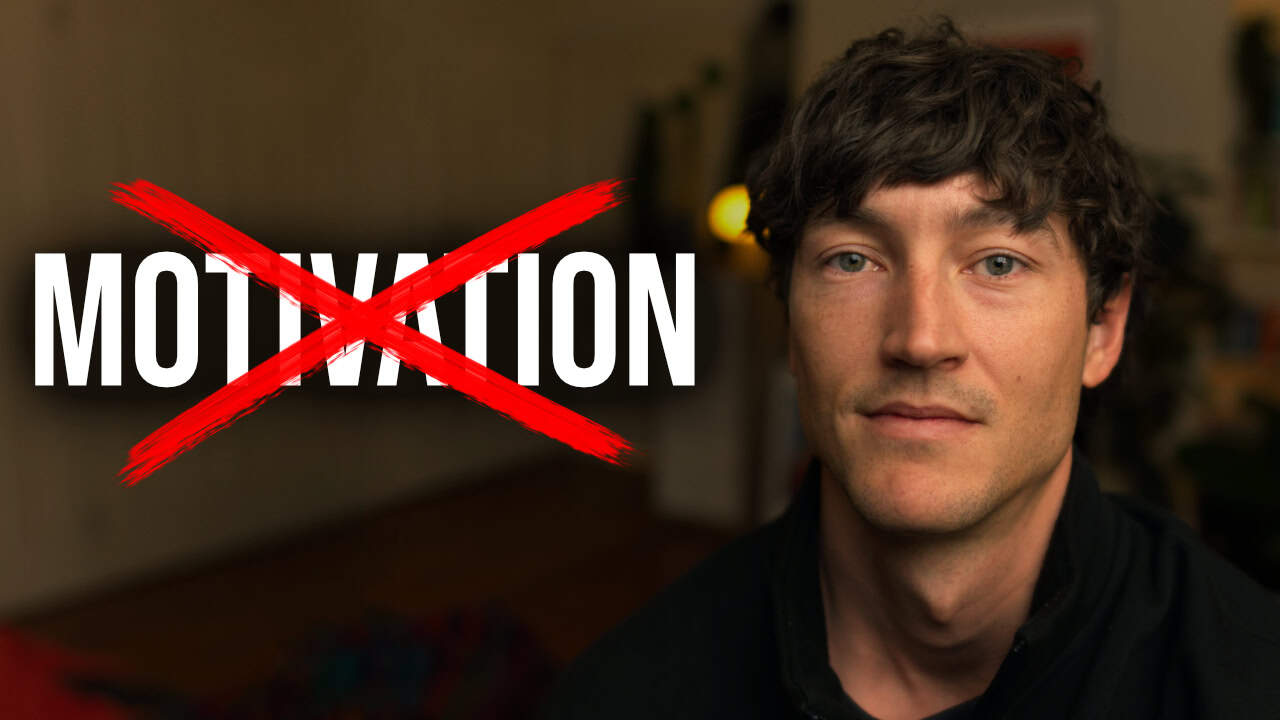
In this video we talk about why you should forget about motivation, and what to do instead to reach your goals. Here’s what we cover:
- What low motivation tells you about your goal achievement process
- How to fix this gap to both remove the need for motivation and increase the speed and reliability of results
- How to apply this principle to exercise, nutrition and fat loss so that you never need to motivate yourself again to reach your fitness goals
Full transcript
This is not another motivational video. The truth is you don’t need one. In fact, if you want to get killer results in fitness and in life, then you’re going to need to give up on motivation entirely because your very lack of it is pointing you towards something far more important that you’re missing. The reason that you don’t want to go to the gym or stick to your diet or follow through on any other goal that you’ve set yourself is not because you lack motivation. If you did, you wouldn’t have set the goal in the first place. The reason that you find it difficult to follow through is because of flaws in the way that you’re trying to achieve the goal. Your brain recognises them and it’s trying to point them out to you. So I’m going to show you in this video how you can use that very lack of motivation to fix these gaps and improve your process, giving you some simple steps you can apply to your exercise and nutrition and fat loss to remove the need for motivation from your routine entirely and reach your fitness goals and any other goals you have faster and more efficiently.
As a result. When I was at uni, writing to me was the hardest thing in the world. It was a core part of what I had to do, and when I got to my fourth year working on my own thesis, it seemed as if the more time I had to work on it to write the more terrifying the prospect of it became. I found it so hard, and this was one of the biggest learn experiences for me because looking back on it now, the reason for my lack of motivation seems bleedingly obvious. I had no structure with my writing process. I was focused on a lot of the wrong things. I was also spending ungodly amounts of time getting it done, and this is all while producing work that now I’d consider very mediocre and on reflection, it’s like is it really surprising that I didn’t enjoy doing that?
I never had a motivation problem. I wanted to be at uni. I loved the things I was doing, but when it came to writing, I had a process problem because now writing is the foundation of what I do for a living. I produce so much more work, it’s at such a higher quality, but it’s never been faster or easier or more enjoyable, and the more streamlined my process becomes, the simpler it gets, the faster it gets, the more I enjoy doing it. The resistance that I was experiencing was not inherent in the thing itself. It wasn’t that I’m not motivated to write. The resistance was in response to the inefficiency of how I was going about doing it. Everything that you want to do that is hard to motivate yourself for is hard because right now you are inefficient at doing it. You are not able to get a result without investing a large amount of time and effort to do so.
I share this story because I’m still in this process. I’m still learning to get better at the writing process. I still find this difficult and I have to grapple with motivation every single day, but that’s not a bad thing and it’s helping me get better at it very quickly. Once you realise that emotional resistance, low motivation is not inherent in the activity itself, but in your approach to it, then you realise that there is a path that’s going to allow you to do this with zero friction and never needing motivation again, and that is worth looking for because when you do, it’s going to mean that you are actually achieving results way more efficiently with way more certainty and have all these resources of time and energy back to spend on other parts of your life. So for exercise, very common story, forcing yourself to go to the gym four or five, six days a week doing hours of exercise, cardio, mobility, drills, everything that you’ve seen and think you should jam into your routine, more is better.
The problem with this is that you end up doing so much more than what is necessary to get results. That your ratio of results to time invested per week is just way too low. Think about your brain, your motivation system as wanting return on effort. The lower that this ratio becomes of results to time, the less motivation you’re going to feel. If you were spending a full work week working out and you were barely noticing changes in the mirror every three months, do you think that any human on earth could sustain the motivation to do that? If you could, there’d be something fundamentally wrong with you because you’d be the least efficient human ever. If we stayed motivated on every low yield pursuit like this that we went after, we’d never actually achieve anything in our life. So when you’re not motivated to spend six hours a week in the gym to get mediocre results, it’s not because you lack motivation.
It’s because you are smart and don’t want to waste the only resource that you ultimately have, which is your time. You take nothing else away from this video. Just remember that you are not averse to work. You are averse as a human being to wasting time doing too many exercises, too many sets, aimless stuff like cardio for no real goal. It’s not going to cover it. So what I eventually landed on after years of tinkering with this was just six movements. One to cover each basic plane of motion, training that as hard as possible across the full range of motion to get maximum strength benefit from it, but do nothing else. That ends up getting you heavily diminishing returns and even negative returns after 15, 20 minutes of work a week across those movements. So less than 40 minutes a week spent in your training area and you’re sorted.
I feel at this point that I’ve genuinely maxed out that ratio as far as it will go, and so I’m serious when I say the training takes no hype up and no motivation whatsoever. I genuinely get keen to do my sets to the point where I’m travelling and don’t get to train for a bit. I get pretty antsy and keen to just spend my energy on something. So that is training. Let’s talk nutrition generally. If you need to motivate yourself to stick to your day-to-day diet, whatever nutritional structure you give yourself, there are big problems. Forcing yourself to eat what you think is healthy or adhering to a rigid structured diet that limits your flexibility of eating, food, drinking, or just constantly having to try and restrict yourself. Again, similar to exercise, doing any of this is going so far beyond the essentials of what’s needed to function well, look good, be healthy, that it’s no wonder that again, it’s difficult to sustain because if you’re trying to eat multiple structured meals a day or avoid certain foods or track everything all the time or stick to a strict eating window, there starts to be very real negative effects on your life.
Specifically two key areas are extremely important for wellbeing. One is your social life, a huge part of which often revolves around food and drink, sharing those things together. The other being generally just the enjoyment of food, which is one of the most pleasurable experiences in human life. So again, your brain’s not stupid. If you’re giving up a big chunk of these things which are so important to your wellbeing and therefore your health in order to not really get any specific tangible outcome, eventually your motivation system very logically is going to kick back and say, Hey, why are we doing this? Remember, the only way that your brain can speak to you and override these logical systems that you’re trying to impose on yourself is through bottom up regulation, emotion, and in the case of what we’re talking about, motivation to want to do things or a lack thereof.
So the solution, again, after trying all these things and doing many of them for years, when I eventually realised what mattered was cutting back all my structure to just one intentional meal a day, getting enough protein in, getting the majority in that single meal, the meal that would have minimal impact on my social life for the rest of my day, which is usually for me lunch, getting high quality protein in while also giving me lots of nutrients to make sure I’m fueling myself well, being as healthy as possible, and then that leaves me with after flexibility the rest of my day to cook for my housemates to go out and eat dinner to enjoy some drinks if I want to do that. Again, in terms of results to cost ratio, the downside to this is basically nothing. If I don’t have that quality high protein meal each day, I feel I feel weaker, I feel less energised, I feel less satisfied.
So it takes negative motivation to do this, and the upside is maxing out my recovery, my progress with training and muscle gain, staying lean effortlessly and functioning nicely as a human being. And another specific really important component of fitness that we can discuss here is fat loss. If you are finding it difficult and requiring a bunch of motivation to hit a calorie deficit and lose weight, then again, there are problems with your approach. If you’re finding yourself crashing in energy, experiencing lots of hunger, finding it just physically, really difficult to sustain a calorie deficit as you’re finding yourself yo-yo dieting, losing some weight and then rebound and gaining it all back, or just getting to a fat loss goal but then never being able to keep it off long term. More often than not, all of these things stem from trying to lose weight at a rate that is physiologically unsustainable.
Once you go past a certain rate of fat loss, which tends to be around half a kilo, one pound a week for most people, then you start to get a whole host of physiological negatives, which again, massively reduce our results to cost ratio. The cost here being basically all the physiological knee jerk responses to extreme calorie deprivation, which make it near impossible to sustain fat loss long enough to get lean and also to keep any weight off that is lost. So you basically have a two-pronged issue of not being able to go far enough, and then when you do go there and lose that weight, having it rebound and gain all the weight back often. So again, early on when you’re finding it difficult to push through and hit your calories or your meal plan, however you’re hitting a deficit, that difficulty, that lack of motivation is again, a really useful important thing.
Your body is trying to tell you that, Hey, weight loss is not sustainable. Let’s back off and again, what I learned here after many efforts of pushing on and just trying to get it done thinking that motivation was my problem and I needed to just push, I realised that if it’s hard, I’m just going to actually increase my calorie intake, slow down, and then it becomes suddenly easy required no motivation and get too way leaner levels with a fraction of the effort, which then brilliantly is easy to sustain. If at a slow pace there’s no degree of fat loss that can happen without needing to really push and grind to get there, then I’ve learned that you probably lean enough and the most productive thing to do then again is eat more, gain muscle, get bigger until the point where fat loss is easy again.
So those are some examples. I’m sure there’s more, but hopefully that gives you an idea of how if you are struggling with motivation fitness, it’s probably for good reason and you are probably not the problem, but your process very likely is. But it’s worth saying very clearly that in no domain are you going to start with the perfect process that requires no motivation to do. The only way you get to this point is by starting facing resistance and having the adaptability to listen to that emotional feedback, not as a sign that you suck, but as a useful sign with time you’re going to be able to work with, to constantly refine the efficiency in your ability to get results in whatever goal it is that you’re pursuing. The tricky part truly is figuring out what the signal it’s pointing you towards and knowing what to change or remove in order to make those improvements.
Obviously, one thing that can help massively is having a guard or mentor to help you do that. And again, that’s not a plug to say, come and work with me, although it is a great idea, but having someone there to point out the gaps in what you’re doing, to point out your inefficiencies and to give you the confidence to eliminate them and just focus on less because they’re telling you that it will work. That for me, has accelerated my progress massively in areas like my riding with my honour supervisor, with my business coach in all these endeavours with my Spanish teacher in Spanish with my guitar teacher in high school. There are so many examples where you can figure it out by self and with enough tenacity long-term, you absolutely will. But if cutting years off that process is going to be the difference between getting a result or giving up, then getting guidance is a very, very good idea. Anyway, I hope this helps. Realise that on the one hand, while things yes are going to be difficult, whatever goal you’re pursuing, realise that there is a utopia that is achievable where things are easy, and try your best to enjoy the process of improvement between now and then.