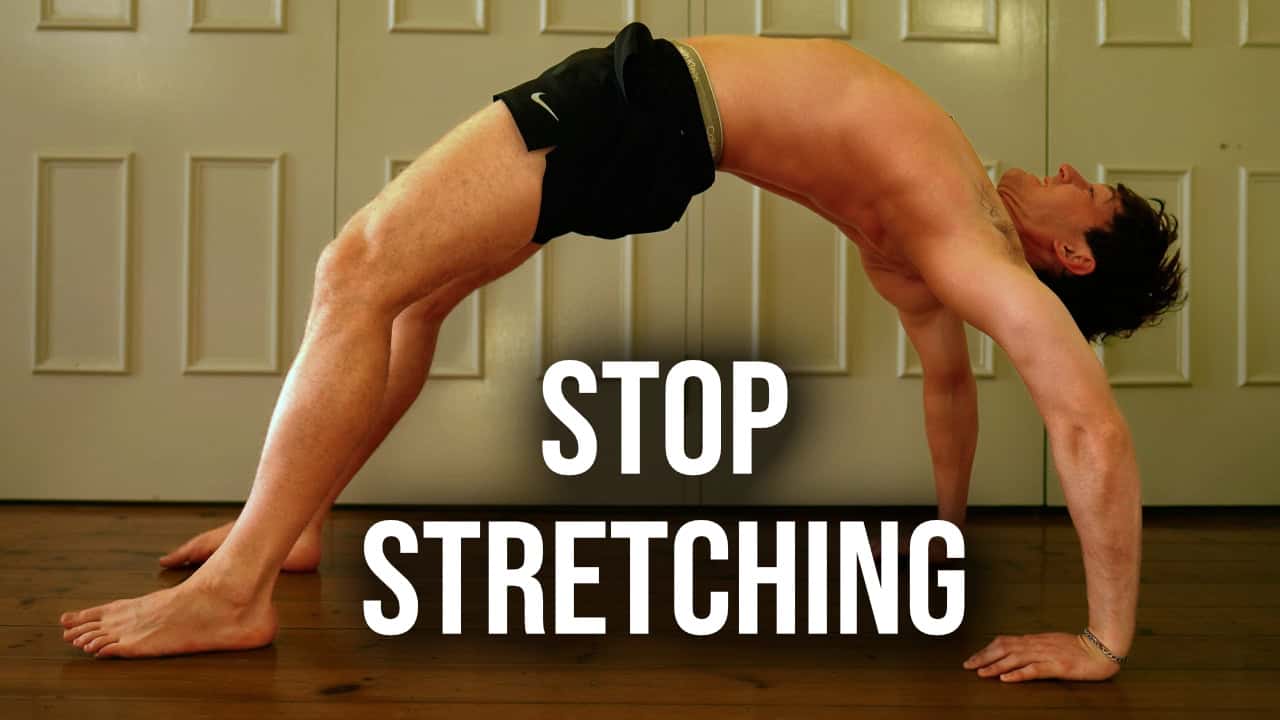
In this video we talk about how to unlock tight shoulders and open up overhead range of motion permanently. Here’s what we cover:
- Why normal shoulder stretching routines don’t unlock any permanent range of motion
- The mechanism keeping your shoulders and upper back tight and stiff
- Guided tutorial to unlock a full back bridge in 5 minutes a week just with your body and a wall
Full transcript
If you can’t easily flex your shoulders overhead, you’ve got problems, yes, for doing movements like this, but for normal daily pain-free living, this is just essential mobility that I think everyone is better off having, being able to do this, not quite as necessary, but it all comes from exactly the same process. Process, which can be done in less than five minutes a week with just your body and a wall and achieve more or less permanently in a couple of months. If your shoulders aren’t flexing. We’re not dealing with a loosen up the muscles and prey problem here. We need to actually build an upper body that can move through that range of motion. Uninhibited, I did this about 10 years ago and it served me brilliantly today. It won’t come from doing some half-assed light stretching routines. It takes intent and it takes effort, but it doesn’t need to take long and you’re about to find out exactly how to do it.
Fix this problem forever. Go ahead and unlock a full back bridge if you want. Then you can take that new range and start building up to some high level movement goals that will make you bogle at the fact that your shoulders were ever in the current state. So we’re going to cover the mechanism for unlocking this range of motion permanently, the specific anatomy for doing this for shoulder flexion, and then I’m going to run you through a guided tutorial so that you can do this yourself starting today. As always, if you want to jump straight to the how to feel free, but here’s how this works. Why can’t your shoulders already do this right now? It’s natural to think that we’re just stiff and need to stretch things out to unlock range when in reality there’s a simple mechanism holding you back. But once we understand, we can actually address the root cause of your current lack of flexibility and fix it fast and permanently.
Imagine someone hurls a basketball at you from the other end of the court and you jump up as high as you can reaching overhead, flexing your shoulder to try and catch it. Now imagine your strength in that overhead. Fully flex position is really weak as the basketball reaches your hand without the strength to push back against it. What do you think is going to happen? Something in your shoulder’s probably going to go snap because if you’re already as flexed as you can be and your muscles can’t resist further flexion, then something has to give, which means you’re either going to get muscle damage, tendon damage or worse, your shoulder joint itself is going to get injured. That is very costly for your body because that means a long extended recovery and often irreversible damage to that joint. So as a system, your body obviously wants to avoid such catastrophes happening.
So what does it do instead? It stops you getting into those situations in the first place. The reason you’re tight when you try and flex your shoulder is not because your muscles are short or your joint capsules somehow inferior and super tight. Your nervous system is simply regulating how deep you can go into that shoulder flexion by making your muscles tense before you get too far so that it minimises the risk of having one of its most important and least stable joints destroyed. Because although you might not think about it at the time, that would be a far worse outcome than you missing the ball. So it’s our nervous system that limits our functioning range of motions to that which it knows we are safe moving it. So if we want to increase that range, what do we do about it? Will we increase our strength specifically adjacent to the range that we want to improve?
Because that way over time as we get stronger, we prove to our body through repetition that we are safe moving, then we have the strength to pull back out of it even under load and it’s all good. We teach our body that we are strong enough to catch the ball and not get broken in the process. And so now without any effort, we have new range accessible for our enjoyment and we’re safe moving through it. And there are no warmups required, no 30 minute relaxation routine, just functional range available to us at the drop of a hat. So for this overhead range of motion, we’re working on shoulder flexion, which comes from a combination of shoulder joint scapula and thoracic spine mobility. The muscles that are elongated and therefore need to get stronger for us to unlock more range are the ones that help us extend our shoulder, bringing it down from overhead.
So this involves our lats, our pecs and other muscles. The muscles themselves don’t really matter because whatever’s a limiting factor for you will get targeted first and that process will continue as you progress. If you focus on building the movement, improving your strength and unlocking progressive amounts of range of motion as a result of that, the muscles will adapt accordingly. They have to. So we basically just want to get near our end range of shoulder flexion practise, extending our shoulder as hard as possible against the stretch, and over time that will lead us to have more and more flexion at our disposal. So how do we do that? Super simple. Find a sturdy wall that you can place your hands on. You can also use the gymnastics rings or a hip height bar, but you’re going to place your hands on it roughly level with your hips, arms straight, and then you’re going to move towards your end range.
Now the queue for controlling the range of motion, you can think about bringing your chest down to towards the ground. The angle that we’re increasing here is that between your torso and your humerus. So don’t get confused by where your hips are or your feet or your shoulders. Just think about this angle and working to increase that in order to get deeper into the movement. Increase this angle until you start to feel some tension and now you know you’re in proximity of your current limit, and this is where we want to start working. Remember, you don’t need to be at your end range of motion just near enough that you start to feel this involuntary tension in the stretched muscles. And this is where we want to start tensing those muscles hard. The movement we’re trying to do is shoulder extension. So your cue is to try and bring your hands down to the ground like your closing a car boot or pulling down a garage, roll it door with straight arms.
Think about doing that as hard as possible. Flex those muscles with every ounce of strength you have in them. And then after a few seconds of doing that, relax, move out of the movement. That’s your first rep. Then you can repeat this as many times as desired chest down. Go to the point where you feel tension. Push as hard as possible trying to bring your hands down to the ground. Tensing the stretch muscles with as much strength as you have. Do a few seconds come back out. Every rep you’ll most likely notice a little bit more range of motion. Unlock that is normal. As your body learns that it’s okay there gets a bit more comfortable in that range, you can do as many reps as you want. Feel free to keep going until you start to get diminishing returns on that rep to rep progress or just until you get bored, tired becomes a drag.
The important thing is that you’ve done something and we want to keep our focus on the actual effort, the intensity with which we tense those stretch muscles because it’s by building strength that we’re going to unlock more range of motion, not just by trying to go deep into range. We don’t yet have over time, as you keep coming back to doing this session to session, you should notice your overall accessible range improving as a result of long-term actual strength gains in terms of programming. Like everything, keep this simple. You do one set, you can do a couple if you’re enjoying it and feel like you’re getting more out of it. My rule of thumb is just to keep going as long as it feels productive and you’re actually motivated to. But remember, you’ve done the work after your first set. So if it’s becoming a drag, call it quits.
Come back next session. You’ve done what you need to do to stimulate progress. I’d suggest probably doing this a couple times a week until you get to your goal, which I’ll talk about in a second. After your upper body training, you can do it on off days, that’s fine. But the easiest way I’d suggest doing it is once you’ve trained your upper body, have this as a attack on at the end of your workout. If you’re training like I do, you should only be doing 40 minutes of training a week anyway. Add this on as another five minutes to your week. As long as it’s fine and you’re making progress, shouldn’t have a problem. Being consistent with this time certainly won’t be the issue. And if you split your training up like I do, training up a body twice a week, then you hit this twice a week, that’s perfect.
Now, in terms of goals, it’s up to you where you want to get this to. I’m not a huge mobility guy. I’m having basic functional range of motion that will allow me to do the things I want to do. Being hypermobile is not really worth it or even beneficial in my experience. We don’t really want hypermobile joints. Remember this mechanism here is a safety mechanism, is there for a good reason. We want to build enough end range strengths that we are actually stable and therefore safer when we do extend ourselves. But past a certain level, I don’t think there’s any point. So for this, you can either get to the point where you’re comfortable with your overhead range. If you want to movement goal to aim for, I’d suggest working towards a solid back bridge. And so what you’re going to do to test your progress on this is just try bridges and see what your current shoulder mobility will allow.
This is as simple as starting on your back, pressing up with your hands and feet, chest to the sky and just think about extending your arms and your legs as straight as they’ll go. Once you’re doing one of these that you’re half satisfied with, you’re pretty good. And honestly at this point I would just move on your shoulder. Mobility is not going to just dissipate if you’re strength training. And while more mobility is not always better, I think more strength always is. So once this is at a decent level, I’d shel it. Go back to focusing on your primary strength moves. Build them up to crazy levels through full range of motion. You’re going to maintain the shoulder mobility that you’ve built with this specific work without any to do more of it. So that’s it. If you want the complete upper body mobility overhaul, I’d suggest pairing this with your German Hangs, which will cover the opposite shoulder range of motion building extension.
If you can just build up to a full German hang and back bridge, your shoulders are set for life and as I said, once you’ve got ’em, you can drop ’em and put all your effort into strength training. That will be something you do forever. This doesn’t need to be, if you’re not already doing that strength training, obviously don’t wait to start it. This will pan nicely with it. If you need help with that or any of this stuff, you can learn more about our system below. This video has been requested by many of you, so I hope it helps. If you’ve got any more stuff you’d like to see with mobility or strength specific stuff, I’m always reading your comments to find out what you want to learn about. So please keep letting me know. Let me know how you go with your shoulder flexion gains and we’ll chat soon.