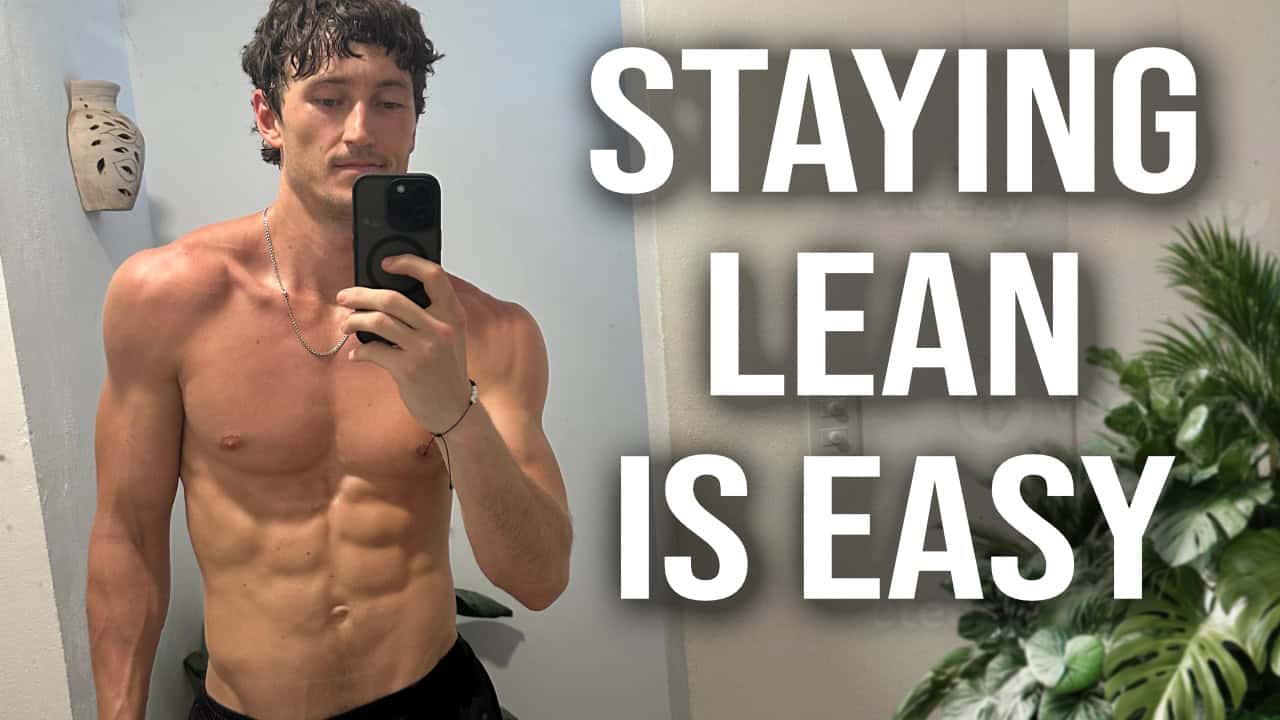
In this video we talk about how to keep body fat off forever once you’ve lost it. Here’s what we cover:
- Why getting lean is the hard part, and staying lean is actually far easier than you think
- The three reasons fat loss can feel so difficult
- How to transition out of a cut without regaining any of the fat
- The simple protocol I use to make staying lean year-round easy
Full transcript
There’s no point losing body fat if you’re just going to gain it all back again once you’re done. But this is exactly what so many people I work with are terrified of once they finally start getting lean. Hitting dietary targets feels difficult now. It requires constant discipline and focus every minute of the day, and it only seems to get harder. So how the heck are you ever going to sustain that once you’re even leaner? If these are the thoughts that have crossed your mind, then this is the video you need to watch because I’m going to show you exactly how, and I can always guarantee it’s a whole lot easier than you think. I’ll take you through the technique, but honestly, the how-to of staying lean is actually really easy. And there’s no point discussing that if you don’t understand the nature of how it works.
So many people shoot themselves in the foot before they even get to their body fat goal because they think that the difficulty that they’re encountering on the road to a leaner body composition is going to continue once they get there. Need you to get super clear on this right now. Losing body fat and getting lean is infinitely harder than staying lean once you get there. Yes, there are things you need to do. It doesn’t necessarily just happen by itself, and I’ll take you through exactly what that looks like. But you don’t just get there and bounce right back up. The work you do in that period, it’s much like moving house. You start a cut at a certain level of body fat that you are, for whatever reason, unhappy with. You want to get sharper, you want to look better, you want to be able to perform better.
All the benefits that come from being lean. It’s 100% worth it. So you start in this house of high body fat. A calorie deficit for however many weeks is the process of moving house to a lower body fat percentage. And once we’re there, the goal is that that’s now where we live year round as we continue to train, build muscle, and live our lives and enjoy ourselves. The difficulty that you experience in that moving process when you are in the calorie deficit, it’s easy to think that that’s coming as a result of your body being leaner, but that’s rarely the case until you are getting to fitness model bodybuilding levels of low body fat, sub 10% for men, sub 20-ish percent for women, where you’re getting very, very lean. Until you’re at that level, the difficulty that you experience, the hunger, the focus on food, that is a result of the rate of change in your body fat levels.
Me sitting around at 10, 12% body fat, it’s just as easy for me to maintain that as it is for a male at 25% body fat to maintain that. And this is because your body is really good at homeostasis, at keeping everything the same. If it starts to notice that you’re losing a significant amount of weight, its alert sigmas go off and say, “Hey, we need to stop this and get things back to your baseline.” And so the reason that at some point if you want to get leaner, you need to go on an extended period in a calorie deficit is to do that shifting of the baseline, to move house and establish a new leaner body composition that your body then accepts as normal. And so cutting’s not fun. Eating in a calorie deficit consistently or your body tries to tell you constantly to eat a little bit more isn’t fun, but realise that all you need to do is get to your goal level, get to where you’re happy with, and then it’s over.
Ending a calorie deficit is always everyone’s favourite period ever, because it’s the point when you’re both lean, so you’re really happy with how things look, but now you’re also not hungry because you’re eating at maintenance again. Your muscle glycogen stores replenish, you start training better, your muscles fill out, you look better. And for everyone who’s doing this properly for the first time, it’s the moment that you realise that the weight does not just jump back on. You are just lean and you get to keep it. There are only three possible sources of difficulty where your hunger signals are chronically elevated and things are difficult. First is, as I said, rate of change. So any calorie deficit is going to eventually make you hungry, which is why you want to do the cut properly at a sustainable rate so that you can sustain it while staying sane for long enough to get to your goal.
The second cause is if your body weight gets too low. So wherever you are right now in terms of your muscle building journey, there’s a certain body composition that you can reach and comfortably sustain. If that is higher than you’d like it to be, then the solution to getting leaner is actually to go and build more muscle. Talk about that more in this video. And then the third possible reason, which is by far the rarest, is what I mentioned, which is actually getting too lean. Now you’ll have a very clearly defined six pack, be leaner than anyone actually needs to be before that’s a problem. But this is the reason why bodybuilders can’t stay at stage level conditioning year round because it’s just not healthy. However, I would argue there’s no point ever even getting that lean for most people because if it’s not sustainable, then why bother getting there?
You’d be shocked at how good you can look year round while feeling good and well fed and training well if you have enough muscle mass, your diet is nutritious, so you’re not nutrient starved and you have a reasonably healthy lifestyle, you’re getting adequate sleep, you’re getting your steps in each day and you’re not overly stressed. By the way, if you want to see an example of how I put my daily food plan together to hit a deficit or maintenance, you can download my free cheat sheet using the link in the description. So once you get to this goal level, how do you actually sustain it? What do you need to do? Well, if you’ve done the fat loss period well, then you’ve really set yourself up for very sustainable leanness because all you need to do when you end the cut is just increase your calorie intake to maintenance.
Now, long-term, you don’t want to have to be worrying about actual exact calories, and I really don’t think you need to, but what can be a useful tool when you’re transitioning and you’re obviously scared of losing all the progress that you’ve made in the cut is to keep exactly the same habits, but just increase your calories by three, four, or 500, whatever you think your deficit was and then start hitting that. What will very likely happen when you do this is that you’re still in a moderate deficit and so you might actually still lean out a bit further until you reach the floor of your sustainable body composition. This is what inevitably happens to me if I do a fat loss period and then shift to this conservative maintenance is that then I feel all the positive benefits of being at maintenance, but because I’m still a little bit under maintenance, I lean out until the point where I’m super lean and then hunger jacks up and I’m naturally forced to increase calories to the point where my body’s actually at maintenance.
And so I think the key thing with all of this is you can have your calorie target, you can use that as a guide, but ultimately you want to listen to your body if it is telling you to eat more, then you have the ability to just do that, listen to it. Remember, once you are lean, you don’t need to do anything crazy from here. If you want to maximise muscle growth, you just need to not be in a continued deficit. Roughly maintenance is a really good target for everyone to build muscle from. It’s all going to be driven by your strength training and if you can listen to your body enough to fuel it with more food when it needs it, when it’s telling you that you’re actually hungry, then you’re going to give it more than enough to build muscle. The way I think about calorie intake now in terms of staying lean and supporting muscle growth is just maintenance forever is the ideal situation because you’ll naturally eat more when you need to eat more.
That very moderate surplus is going to be more than enough to fuel strength training. Again, if you can just trust your body, give it what it needs when it needs it. The things that make that easier, as I said, are making sure you are reasonably active. So eight to 10,000 steps a day, your strength training sessions, and then maybe the odd bit of fun activities here and there if you can sprinkle them in, like sport, getting your heart rate up a bit, and then getting most of your energy from whole foods, nutritious sources. I’ve talked about this before, but it’s so important. The more that you can just fuel your body with highly nutritious food, the less of a nutrient deficit you’re going to be in, which means your body’s not jacking up your hunger to make you eat more to get nutrients. It’s only jacking up your hunger to get the calories it needs to build muscle.
And so if you can set up your lifestyle to work with your body like this, then all this stuff becomes so easy and you’re literally optimising to feel as good as possible in order to hit your physique goals, which is a pretty awesome way to live life if you ask me. So to sum this up, get lean at a sustainable rate. Stop once it’s hard. Aim for a maintenance target until you are confident enough just running your daily routine and listening to your body’s signals to tell you when you need more food. If you’re not happy with how lean you can get for now, then your best bet is to just maintain and get to work, fixing your training, make sure you are progressing as fast as possible, building muscle because the more of that you do, the leaner you’re going to be able to comfortably sit at.
Almost everyone underestimates how much body fat they have to lose in order to get as lean as they want. The flip side of that being they also massively overestimate how much muscle mass they have on them. Once you strip the body fat, it’s very humbling how little muscle you have. So regardless of what stage you’re currently at with your diet, get to work on the training that’s going to build your body up, make it strong, make it functional, make it mobile and healthy. That’s going to make you look as good as possible. Now it’s also going to give you the greatest functional longevity long term. If you need help with any of these components, the training, the muscle gain, the diet, getting lean, this is the exact process to take all my clients through. You can learn how our process works by watching the free training linked in the description.
But I hope this both gives you a plan and some hope in that once you get lean, you do this process once. Keeping it year round is a whole lot easier and it’s a very awesome place to be, loving what you’re seeing in the mirror and just being able to fuel progress with your strength training, with your muscle gain, and you just look progressively better every single month. Anyway, I hope this helps. If you’ve got questions, let me know in the comments and I will do a follow-up video. Speak soon.