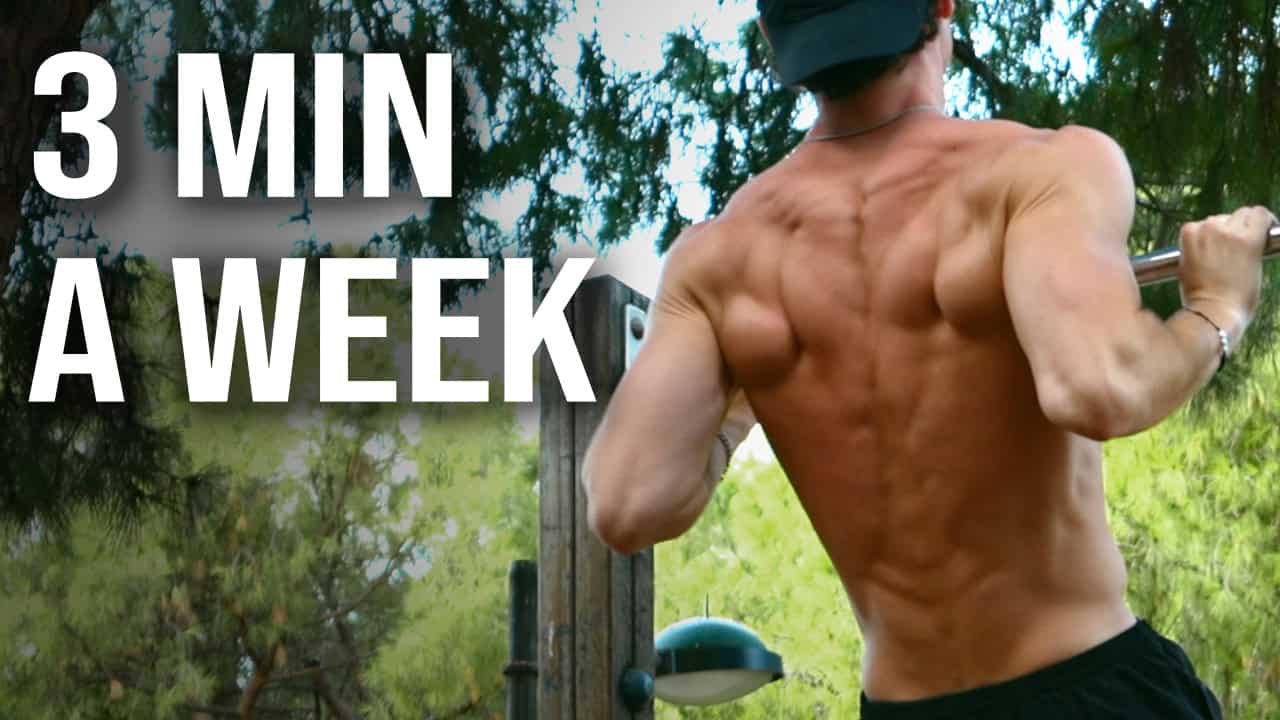
In this video we talk about how to build chinup strength insanely fast. Here’s what we cover:
- The problem with how most people approach learning chinups
- The faster, more efficient way to increase chinup strength, endurance, and unlock skills like muscle ups and one-arm chinups
- Guided demonstration, common mistakes, and complete training routine recommendations
Full transcript
If you want to get all the benefits of chin-ups, you actually don’t need to do a lot of chin-ups. You just need to get very strong at them. The method that I used to do that took me a couple of minutes once a week and built me about as much back and biceps muscle as I could want while giving me the strength to pull my entire body weight with one arm. In this video, I’m going to walk you through it. If you’re a beginner trying to achieve your first chin up, then this is the most direct route to doing so, fast, safely, and efficiently. And then once you’re easily repping them out, you can use this exact same method to continue progressing on to harder goals and build the strength to easily do things like muscle ups or one-arm variations. The key mistake that most people make trying to learn chin-ups is that they make their training either way too difficult or too easy for themselves.
And because of this, they never allow themselves the chance to progress anywhere near as fast as they could. Stop thinking about chin-ups as a skill that you’re trying to learn. Whatever should really be if we want to nail this is reshaping our bodies into an upgraded version that can easily do this movement, which just means getting the relevant muscles bigger and stronger. If we can get our strength in this vertical pulling movement pattern to a high enough absolute level, well beyond the strength required for a chin-up, then repping out chin-ups is going to be easy. And that’s why I think regardless of your goal with chin-ups, if your motivation for training them is a stronger, leaner, more powerful, capable body, then just focus on increasing your maximum strength. Don’t worry about improving endurance or building the perfectly efficient chin-up form. Just get so strong that all of that is irrelevant.
If I asked you right now to wrap out as many shoulder presses with a broomstick as you could, you wouldn’t struggle because it’s so far below your maximum strength. That’s our goal here with chin-ups. And the great thing about that approach is while it may take months and months to build significant levels of muscle mass and strength, you only have to make those changes once. They are more or less permanent. Even if you go and take time off training, they come back very quickly and it only takes a couple of minutes of work a week and you have these massive unavoidable changes in your physique as a result. The way I’m going to show you how to train, the only way you continue improving your maximum strength is by continuing to build more muscle mass. And regardless of your goal, that is good for longevity, that is good for your physique, and that is good for your chin up strength.
So how do we do this? Well, you don’t want to just jump on the bar and start trying to do chin ups. The reason is if it’s too hard for you to do a full range chin up, then trying to do it is just a very ineffective way of getting you better at it because you never get a chance to practise the entire movement pattern. If you can do a chin up, then it’s better, but it’s already too easy for you and you need to now be scaling up to a harder goal because you’ve already learned that movement. And so while the movement itself is a great goal, as soon as it’s within your capacity, it’s no longer the most effective training stimulus. We can keep it as our goal, but we want to throw it to the wayside as a tool for building to the goal and instead take the control of the difficulty into our own hands.
The concept here is that we want to show up once a week, work through this movement pattern with the maximum effort that we can muster against a level of resistance that’s just easy enough for us to do and work through a full range of motion, but hard enough that we have to work for it because it’s by that intentional effort across a full range of motion that we signal to our bodies to get better at doing that. When we have to focus and try as hard as possible to do this movement pattern, randomly our body gets better at doing that. And so then we come back next time, we can now pull with a bit more force. And now because we’re always controlling that difficulty to keep it challenging for us, we’re going to do a slightly harder version. And then we go and rest and recover for another week and let our bodies grow a little bit more muscle.
When we come back, we’re a little bit stronger again. And this is progressive overload. We’re very simply just doing the work that signals to our bodies to adapt. And by scaling that difficulty up or down constantly to be just where you need it to work as hard as possible to get through your reps, you constantly sit in this Goldilock zone of optimal signalling. And that’s why you only need a couple minutes of really focused, really high effort work each week. And as long as you keep scaling it up as you progress, then you keep signalling to your body to continue developing, building muscle tissue and growing stronger. So in order to scale the difficulty and do this properly, you’re just going to work one arm at a time. And the reason is as soon as you get the strength to start doing partial range of motion chin ups, then as I said, the movement’s now too easy.
So if we set our upper limit as being a one arm chin up, then that gives us plenty of buffer room beyond the chin up to keep increasing intensity when it’s too easy for us to make sure we’re always bringing it up to challenge us maximally. To scale back down, super easy, we can just use our feet. So if you guard yourself with your other arm and with your feet through the full range of motion, you should be able to make this movement not require any strength whatsoever. And that’s how if you’re starting off at a much more beginner level, you can still train this, you can still use the exact same protocol, apply these same principles. If champs are super easy for you, then you scale all the way up to most of your body weight being on that working arm. So the foolproof way to get this right is to just find your strength limit.
If you’re inexperienced at strength training, then the best way to know where your limit is, is to just get stuck. You’re not going to hurt yourself by trying because if it’s too hard for you, you’re just not going to be able to get anywhere. So start by trying to not assist yourself at all. Feel what it would be like to try and pull your entire body weight with one arm, and then titrate down to the point where you can start moving. So you can just add in as much feet assistance as needed to allow yourself to get that first inch, and then just keep adjusting from there. If you’re finding the movement too easy, try and take the help away. Finding your limit on the way down is even easier. What you can do is just hold yourself in the top position and take help away until you find yourself being forced down.
Doing forced negatives like this is probably going to feel like the most intense training you’ve ever done. Treat it with care. It’s potent, but it can be a really fast way of learning to use your maximum strength and signal growth. And all you need to focus on is trying to pull as hard and as fast as possible the whole time with the working arm. At first, it’s going to feel awkward. It might feel really hard. With practise, you’re going to quickly learn where your strength limit is and how to give yourself just the right amount of help to give yourself the chance to use all the strength you’ve currently got throughout that full range of motion. Now this might feel really challenging, but that’s exactly the point. If you think this is the hardest thing you’ve ever done, then you probably need to realise that you do not need much of this at all.
One rep each side per week is going to be enough to stimulate growth and get you progressing. Less with this is so much more. Because this is so intense, because you’re pushing so hard, you’re going to very quickly accumulate a lot of fatigue. So especially early on with this, you’re much better off doing less, making sure you’re recovered by the time you come back to do it than absolutely blitzing yourself and just burning out and getting hurt. I would just alternate arms and work this for no more than a minute or two, but you can use a rule of thumb of stopping either when it’s no longer fun or when you really start to notice that your strength is dropping. That will be more than enough. Key mistakes I see people making with this movement. The big one is missing large chunks of the range of motion.
This is a big movement involving a lot of muscle mass and the engagement of various muscles changes over the range of motion. So if you miss out on training, say the top half, you’re missing out on a huge amount of the benefits of the movement in terms of muscle growth, and you’re also missing out on building key parts of the strength that you’re going to need if you want to be banging out chin ups or learning muscle ups or one-up chin ups or anything like that down the road. If you’re going to be showing up and doing this, don’t skip out on a chunk of the benefits that it can give you. So the standards for the range of motion for this are just start in a dead hang with your arm completely relaxed overhead, hips hanging straight down, and pull all the way up until you physically touch your wrist to your chest.
That’s how you know you’ve completed a rep. Do that every time and you’ll know you’re getting everything out of it. The other big problem I see is people pulling out of planes. So if you’re going to hit that range of motion standard, you’ll notice you’re going to need to put your feet up on something for the top half so you can actually guide yourself all the way to the top. But I would highly recommend only stepping up onto that once you can no longer reach the floor because if you start in the bottom position like this, tilted back, you’re no longer practising the movement pattern of the chin up, but you’re practising something else. And specificity here is really important. We want to be training the movement pattern that we’re aiming to train so that we build the relevant muscles and motor patterns to eventually be able to do the chin up.
So that’s it. Work this full range of motion that we’ve covered in this vertical playing of motion as hard as you can, alternating arms, scaling the difficulty to give yourself that challenge by just using more or less assistance from your feet. Go until you cook so you can’t pull as hard anymore and call it quits. It will feel like not a lot of work. You’ll be like, “What’s next? Is that it?” But that’s the point. You want to be fresh. It doesn’t take a lot of work to signal to your body to make the changes that we want it to make. And progress in this, just like with any of your movements, all just comes down to consistently showing up, sending that signal, allowing recovery, and most importantly, progressing that difficulty week to week so that you keep increasing the challenge as your body adapts.
And so you keep on signalling to it to continue improving. That’s it. Do this once a week. If you want another pulling movement to train those muscles in a different way, I would have a horizontal pull. Do that space three or four days apart from this one each week, and that will cover your pulling muscles beautifully. If you want to see all six movements that I use to build my entire body, along with their various progressions, you can download my free guide on that using the link in the description. If you’ve been plattered with your chin up strength, then hopefully this is the solution that gets you moving forward. There is no reason not to be progressing with this if you just get the right work done and do it consistently. So I hope this helps you do that. Speak soon.