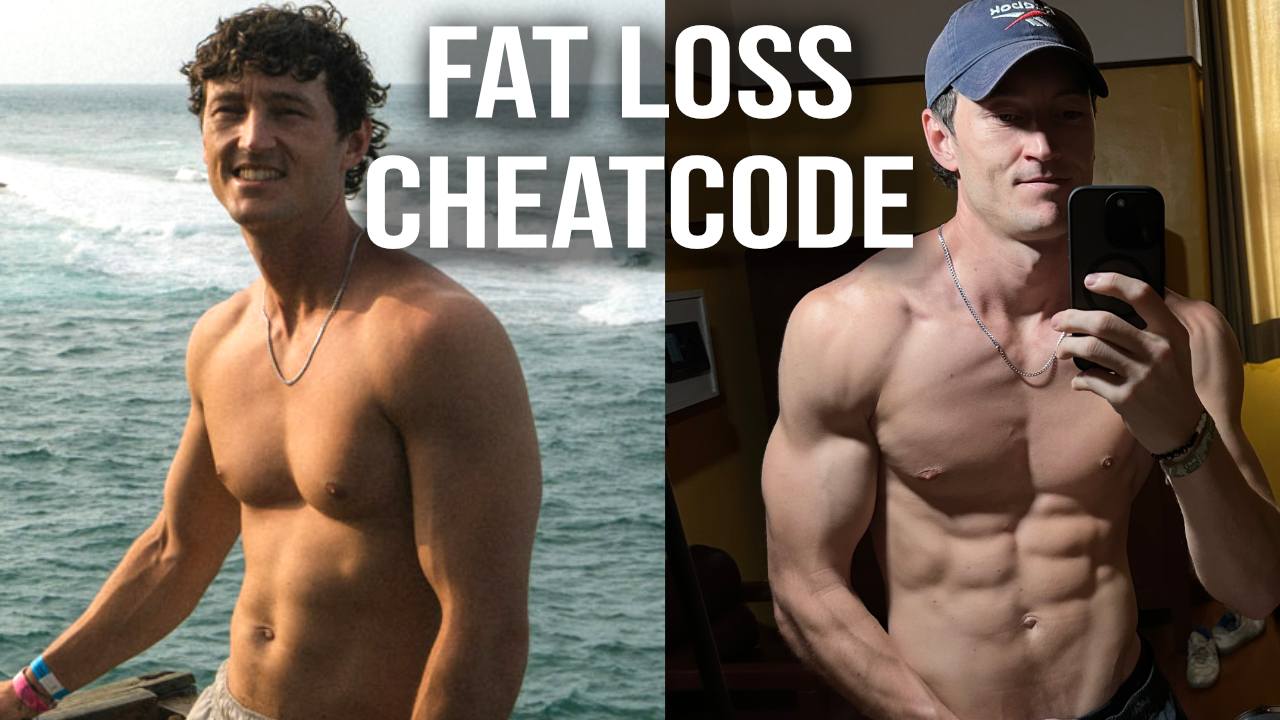
In this video we talk about how I recently dropped a rapid amount of body fat in just over two weeks. Here’s what we cover:
- Why so many people fail with the traditional “sustainable weight loss” approach
- How to kick-start the fat loss process regardless of your age, metabolism or genetics
- My exact numbers, what I ate, and the results
- How to make sure this method works and doesn’t backfire
Full transcript
I recently dropped from about 13% body fat to sub 10% in 17 days and not through anything extreme. I felt great the whole time. And if you’ve been counting calories eating a specific diet and you’re still not losing weight or the whole thing just feels overwhelming and you don’t know where to start, then you need a hard reset. Stop consuming information, stop looking for reasons why it’s not working. Follow this method to a T and you will get leaner fast. So many of my students who come to me struggling with weight loss have this thing in their head where they think that their weight, their body fat is out of their hands. Because they’ve tried for so long to lose weight and have had very slow results or none or results that don’t last, they start to get in the head and think that the problem is age or genetics or they’re not doing enough cardio.
And that’s the biggest problem with going slow with your fat loss, especially when you’ve got a lot of fat to lose is that it gets to your head. Let me make this super clear. If you want to lose one pound of body fat, that is the equivalent energy of about 3,500 calories. So if over a week you’re hitting a daily deficit of 500 calories on average, then you are going to lose a pound that week assuming you’re doing some strength training, eating enough protein to maintain your muscle. So that’s what gets recommended by everyone as the optimal standard way to lose body fat. And that is great in theory if you could hypothetically just nail that. Very few people who are overweight have the skill already to just nail a 500 calorie deficit every single day consistently for enough weeks to get to their goal body competition.
And so what ends up happening is they might do it a little bit or they might do some days where they do it, some days where they don’t. And either way, they all end up in the same position, which is basically exactly where they started. And this is why I think a moderate, sustainable, standard approach for most people who are trying to kickstart their weight loss is such a bad idea because in practise it’s extremely hard to implement. Let’s say here is your maintenance calorie intake. Let’s say it’s a 20% calorie episode about, which for most people is that sort of 500 calorie day mark, losing a pound a week. Sustainable, stock standard. What most people end up running into is that they aim for this, but then when they slip up, they’re closer to here. They often slip up back on the other side.
So this is to be clear where you lose weight, this is where you gain weight. And again, weight changes all happen at the aggregate level, the week to week, month to month, what your average intake is. Day to day, you can have days here, but if you swing back and spend most of your time in the gain weight section, the net result of that is that you gain weight. And so most people aim for this moderate target, but then every slip up brings them back closer to maintenance. Further sleep ups put them in the gaining weight category. And so it doesn’t matter how many times you come back here. If your goal is just decent weight loss, then that’s like best, best case scenario if you have perfect adherence. And so what ends up happening is people try this for a while, don’t get results, then start to think it’s all these other factors like their metabolism or they need another magical diet or more cardio.
Nothing will get you around this fact. This is all areas. And so if you want to actually lose weight and kep it off, we need to break this cycle, get you getting results, build the belief that it works and the only way you’ll actually believe it is if you see it happen as a result of your actions and then you’re off to the races. And so the way to do this, in my opinion, is exactly how I got so leaned so quickly just recently, because we talked all about this side of the line, but what about the other side of optimal? If we think about this zone here as being kind of ideal recommended fat loss, what happens if we aim for something more extreme? Just because doubling this deficit might not be sustainable for long-term fat loss, if you’re not losing weight consistently at at least a pound a week, if you’re heavier, you can go faster than this and it’s still sustainable.
If you’re not already killing that and getting consistent results, your concern is not a lack of sustainability. It’s a lack of fucking results. And so if we can swing this pendulum so far to the other extreme that you start to actually see some momentum, naturally you’re going to swing back towards something more sustainable in the middle. If you’re stuck on this side of perfect, then let’s get you far over this side, find the other extreme and then you can find a middle ground that works for you longer term. This strategy also works if you’re like me and just want to quickly reset your body fat. The downsides to this side are really not that great. If you’re doing a long cut, 12 weeks, there are downsides in terms of muscle loss and it’s going to be harder, but in the short term, two to four weeks, even if you’re super lean, it’s really just a more efficient, fast way to get this done, strip the body part off you and then you can go back to eating to maintenance and focusing on growth, which is ultimately the most productive thing you can do.
So I’m going to show you how I did this. If you were in this camp of just wanting to get weight loss happening, it’s exactly the same process. So I’m going to walk you through the exact numbers, what I ate, what sort of results you can expect. If you want all of this in one place, my meal plan, the calorie numbers I use, an example of what it looks like day to day, I’ve put it all into a free cheat sheet link for that’s in the description. So how I approach this, the way to make this easiest on yourself is to commit for the next couple of weeks to just going all in on a hard cut. If you can prepare as much of your own food as possible, it’s just going to eliminate error and make this way more straightforward. Again, think about the pendulum.
We’re swinging to the extreme here intentionally. As soon as you start to get results and get comfortable and understand how this works, you can come back and have a lot more freedom eat out all the time. Once you know what you’re doing, cutting is quite easy, even while eating dessert every day, but first we want to get you to the point where you know you can do it and you know how to do it. So for the next few weeks, I would suggest going all in. It will be probably the best investment that you ever make in your life if it gets you losing weight and getting leaner. So step one, wipe your slate completely clean. We’re going to design your daily diet from the ground up. We’re going to choose everything that you’re going to eat day to day until you start to see momentum rolling and then you can kind of add back in what you want.
So the first thing we’re going to add in is protein. Now I’ll give you some numbers to base this off and what I’d suggest doing is follow along with me and write this out as we go so that by the end of this video you have your own plan ready to implement. So normally I’d say track your body weight the whole time you’re doing this every day, get a reading and then you can measure the averages. In my case, I’ve been travelling, I haven’t had scales, but I’ve got a fairly good idea of my body. So I’m estimating that I cut down roughly from 80-ish to 77 and a half. Very rough ballpark, but I’m basing this off what I know from my body. So we did this. Firstly, shouldn’t surprise you. Prioritise protein every day. It’s all the more important when you’re losing weight to make sure you’re training well and eating enough protein because they are what send the signal to your body to hold onto muscle.
So as we implemented this deficit and lose weight, we lose body fat rather than our body just burning up muscle as well for energy. So you can aim for 1.8 grammes per kilogramme of gold body weight. For me, I just always hit 140 grammes a day. So calculate your number. We’re going to intentionally leave lots of buffer with calories, but for a very quick estimate of your maintenance calorie intake, you can just go gold body weight again by 33 and that’ll be the calorie. So for me, that’s something around 2,600. Again, give or take. I don’t want you to get too hung up on this number, but just as a reference point, it’s worth calculating that as well. So you should have your maintenance calories, protein target, and then we can build out your diet. So this is going to be super simple. We’re going to go protein sauces, we’re then going to add in some carbs and then we’re going to keep a big buffer until the fat’s falling off you.
So for protein, you can choose literally whatever you want to hit this target. What I do, if you want to coffee me, you can. 500 grammes of meat, usually in one meal. Again, it doesn’t have to be in one meal. I’m just making it as easy as possible on myself. So that’s 700 calories, 100 grammes of protein. In Columbia, I would just buy steak or beef mints from the store, marinate it, fry it up each day, very fresh and delicious. I then have six eggs in some butter coming in at around 500 calories with about 40 grammes of protein. Simple as that. Sometimes I’ll say some cheese, which had a bit of protein as well. So that’s 140, 150 grammes done. Assuming I had all of that, that’s 1400 calories so far and I’ve hit my protein target. So the rest I can eat whatever I want.
Now we set up here I’d probably be around here for maintenance. I’m a little higher than that because I’m pretty lean and muscle takes a lot of energy to keep up, but we’ve still got plenty of room here. And so what I did was then add in just enough extra energy so that I basically could feel good, train well, but as little as possible to keep this maximised and stay in a deficit. So this is where the nuance comes in, but basically I’d recommend you do at least two to three serves of fruit or some sort of carb sauce equating to two or 300 calories because that way in this case we end up at 16 to 1700 calories, which is a roughly 1000 calorie deficit. Now you’ll notice that that is about double what we said over here as being standard best practise and that is perfect because if you’re struggling here, then if we double the deficit we’re aiming for, then we’re well in this zone past the sweet spot where we should get things moving.
And so that’s it. I literally would have my protein sauces. Again, plenty of healthy fats here, plenty of micronutrients. I’m getting only very quality food in all of this. There’s no filler, but it’s enough to feel good. I’ve got some carbs in here to help with training and sanity and running that for literally two and a half weeks, got the results that you’ve seen on screen. And based on these numbers it adds up, that’s about one kilo a week and I did two and a half weeks. I dropped 2.5 kilos, which again aligns with the perceived body fat change. I think the most important thing to bear in mind as you go through this process is that doing this well relies on being able to listen to your body. The reason I was able to do this so fast and successfully is because I had the flexibility to respond to my body signals in both directions.
The fact that I didn’t have the appetite to eat more is the reason I went so low and just found that this worked so beautifully for me. But at the same time, when there were days where I was really hungry, I would just eat more. I would add it in some chocolate, more fruit, whatever I needed, because it’s all well and good to go really hard and get a result, but the more extreme that you try and go, the more important it is that you have the adaptability to, if you need, come back towards the more sustainable zone so that your body doesn’t kick back too much and you risk the pendulum swinging way far the other way. So use this as a tool to actually get things happening, realise that it is not a prison. The plan and the targets are more like a map, but your appetite, your body’s feedback is your guide.
It’s the one that’s going to take you there, show you the shortcuts, give you the most direct route if you have the adaptability to listen to it and follow it, but that’s it. That’s your plan. Two weeks, follow it exactly, you’ll know how to lose fat for the rest of your life. Cheat sheets below if you want it. Hope this helps.