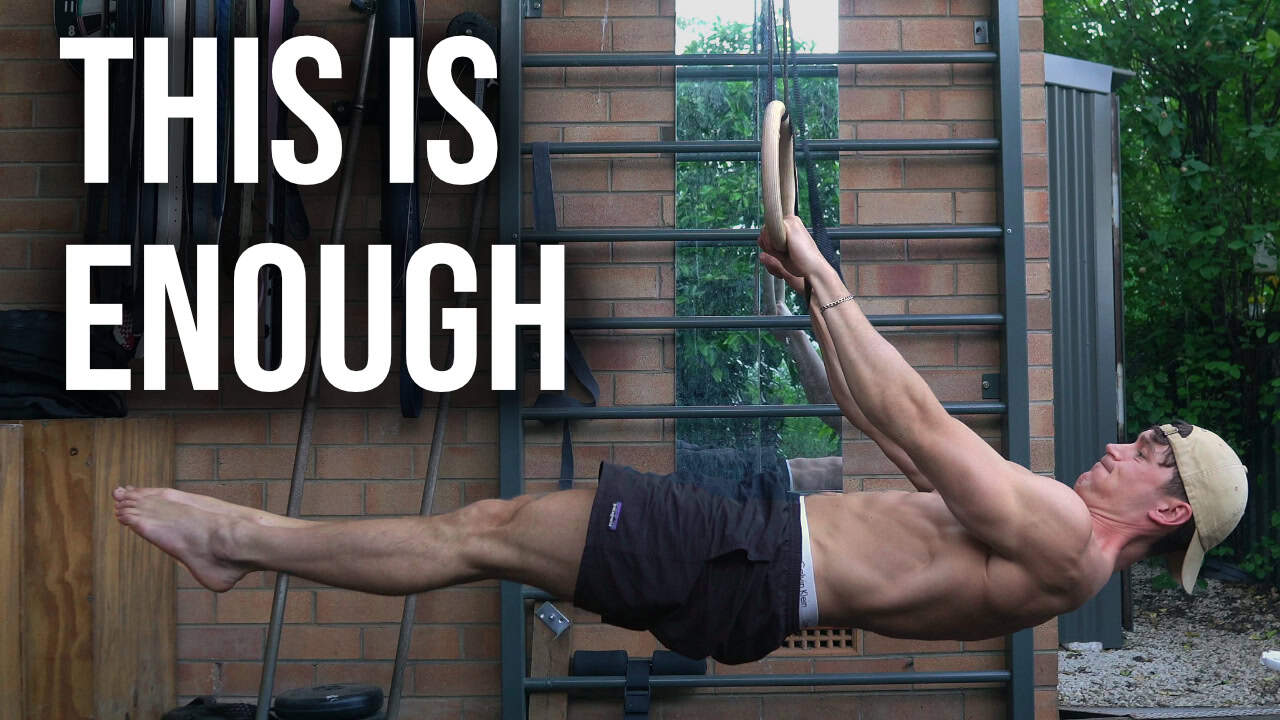
In this video we talk about the only six movements I use in my training. Here’s what we cover:
- The six movements and why I chose them
- What each one gives you specifically in terms of muscle growth, skills, mobility, and functional strength
- What you miss out on by training these exclusively
- How to ensure you get the most out of them if you adopt a system like this yourself
Full transcript
I’ve trained the same six exercises for the past six years for a total less than 40 minutes a week. This is the body that’s resulted from that. Most people think that results come from doing more, more exercises, more variety, more programmes, more new stimulus, and if you’ve ever felt like you’re showing up training lots, working hard, but not really getting anywhere, then this is probably why. The problem isn’t that you’re not doing enough. It’s very likely that you’re trying to do too many things and simply not getting strong enough at the few that matter. Because the more exercises you add to your routine, the more you dilute your effort, the slower you recover and the more time and effort it takes you making it harder to stay consistent long enough for anything meaningful to happen. When you look at how the human body actually works, there are really only a handful of movement patterns that you ever need to get stronger at.
So instead of trying to train everything, the real goal is to train as few movements as possible to cover our full functional range of motion and then obsess over getting brutally strong at them. In this video, I’m going to show you the six movements that I’ve used now for years, exactly why I chose them, and what each one gives you specifically in terms of muscle mobility skills and real world strength. I’ll also show you how to make sure that you train them so that you keep on progressing without adding time or complexity. This is the simplest system I have ever found for building a lean, strong, capable body and it works. Let’s start with the upper body. The first thing that we want is a horizontal push. This movement pattern is how we build a thick chest, bulletproof shoulders in this extended position, and when we get it strong enough, this is how we unlock movements like planers, plange, pushups and back levers.
The main muscle used here is our PEC major, which works to pull our arm forward and towards the midline, flexing and adapting our humerus. So we just want to get as strong as possible at flexing our shoulder from this extended position behind us, and we can go as deep as we want here to build shoulder extension mobility at the same time. How do you load this up? Very simply, you just load a push up by leaning forward enough until eventually you feet can come off the ground. Then from there, you can keep leaning further forward, extending your feet out until eventually you’re in a plange. That’s it. So three basic levels for this. At ground zero, you can just guard yourself through the movement pattern, no weight at all on your hands, no forward lean. Your checkpoint to work towards is where you can lean far enough forward that your feet can come off the ground and you can get into a tuck plan like this.
And the end goal is to work up to a straddle planche at the top or a full ben arm plan like this at the bottom. By the way, if you’re liking this and you want to know how I actually train each of these movements for maximum progress in under 40 minutes total a week, and how I dialled my nutrition to shed body fat and get lean at the same time, have a full video training on the entire system. You can watch that for free first link in the description below. So the second movement is going to be the opposite to the horizontal push, and that’s a horizontal pull. This movement is how we build a thick upper back, balance our body out and fix our posture. And when we get this strong enough, this is how we unlock movements like front levers, front lever rows and front lever pulls the main muscles used here, those of our upper back, our traps, our rhomboids, our rear adults, as well as our lats, which work together to retract the scapula and extend the humerus, pulling our arms down and back.
So for this, we basically just need to get really strong extending our shoulder into this extended position, how well we can basically just load body weight rows by pushing the rings away towards our feet until our feet can come off the ground and then again from there we can just keep pushing the rings away and extending out our feet until eventually we’re in a full front lever. And so levels for this ground zero, you can just be working body weight rows with zero weight on your hands. Your big checkpoint to work towards is being able to push the rings far enough away that you can get your feet off the ground into a tuck position. And then the end goal to work towards is being able to extend out into a full front lever that covers our horizontal pushing and pulling. The next movement is a vertical push, and this is how we build those wide cap shoulders and big triceps.
It’s also the best way to build overhead stability in your shoulder, making you safe when you’re moving in these positions. And when we get strong enough at this, it’s when we unlock the ability to do things like handstands, handstand presses and handstand pushups. The muscles used here are primarily the front and side heads of your dealt, which work to flex the shoulder, bring your humerus up into this overhead position and your triceps, which simultaneously extend the elbow, helping you straighten your arm out. So the goal for this movement is just to get disgustingly strong at flexing our shoulder and extending our arm overhead. How do we load it? We can basically just go through this movement upside down with as much of our body weight on our hands as possible until we can do the whole lot. So your ground zero is doing a park pushup like this with no weight on your hands, just guarding yourself through weight on your feet checkpoint to work towards is getting your entire body weight on your hands for the bottom position.
And then the end goal is to be able to work from there through the entire range of motion unassisted, a full free standing handstand pushup. And the final upper body movement, of course, is a vertical pull. This is how we build wide lats and get that V taper as well as our biceps. This is also going to allow us to open up our shoulder overhead, build hanging strength and like with the row under a lot of postural issues if you spend a lot of time at a desk. And when we get strong enough at this, this is how we unlock movements like chin-ups, pull ups, muscle up, and eventually one arm chin-ups. So the main muscles involved here are your lats, which work to extend the humerus, pulling it down from this overhead position and your bicep, which flexes your elbow, helping you to bend your arm.
So for this movement, we just want to get as strongest as possible at pulling our arm down from overhead and bending it. How do we do this? Well, we can just assist ourselves through a one arm chin up movement pattern, putting as much of our body weight on that working arm as possible until eventually we can do all of it. So levels for this ground zero is just guiding yourself through all your body weight on your feet. Again, none on the working arm. Your checkpoint to work towards is where you build the strength to do a full range of motion, two arm chin up, and then the end goal here is to be able to do a one arm chin up full range of motion, no assistance whatsoever, and a quick reality check. If your training does not make you measurably stronger on movements like these, it does not matter how optimal it looks on paper.
It’s all about progressing. Now let’s talk about legs because this is where most body weight training programmes fall apart, but it’s absolutely critical if you want to build a great looking and functional physique. The big movement for the lower body is the squat. This is how we build sculpted proportioned legs and develop jumping and athletic power. We get strong enough at this and we unlock a deep squat and the ability to do single leg squats, not just body weight but with load as well. The primary muscles used here are your glutes, which work to extend the hip and your quads, which extend the knee. And so we basically want to get as strong as possible at exploding up all the way from a deep squat to standing. How do we build this? Or we can just load up weight on a single leg squat and guide ourselves through it, putting as much weight as possible on the working leg until eventually we can do 75% of our body weight on our backs unassisted.
The levels for this will ground zero. You can just add no weight and guide yourself through the entire movement pattern with your hands and your other foot, no weight on the working leg. The checkpoint to build towards here is where you can do a full range single leg squat with just your body weight unassisted and the end goal is to be able to do the same thing, but with 75% of your body weight loaded on your back. So for me, at 80 kilos, that’s 60 kilos of weight vests. Now the final movement would hypothetically be a reverse squat for this. We focus on a hamstring curl. This is how we build up the back of our legs massive for injury prevention and knee stability as well as sprint speed. And when we get strong enough at it, we build the ability to do a body weight Nordic curl.
The main muscles involved in this are your hamstrings, which work to flex the knee, bringing a heel to your butt, and we can load this one simply by guiding ourselves through a Nordic curl, using as little assistance as possible and then getting our body as straight as possible. Ground zero, just guiding yourself through no weight on your hamstrings, just going through the movement pattern. Your checkpoint is to get to the stage where you can do some of this movement without any hands. And our end goal is a strict Nordic curl, no hands straight body. That’s six movements at this point. You may well be asking, what about the other muscles core lower back calves forearms? In this video I have focused on the main muscles involved in each movement, the prime movers. In reality, there is tonnes of crossover as the body works as a whole to move through space and you then have all your stabilising accessory muscles that des assist the prime movers through these movements.
So your core is massively involved in all of these, especially movements like front levers than one arm, chin ups, single leg squats. Your lower back needs to develop for handstand pushups, for planers, for Nordics, your forearms are essential for all your upper body movements, especially the pulling ones like rows, and I can’t describe how much work your calves get when you are loading a single leg squat with that much weight. Long story short, if there are any weak links in your body, they will catch up in order for you to keep progressing because they have to, and this is why focusing on movement patterns is so much more effective than trying to build individual muscles. The body changes its form in order to achieve function. In other words, a good looking body is one that is actually strong. The only things we’re really missing here are hip flexion and ankle flexion or dorsiflexion, completely optional.
If you want to work on those two, those will mainly be performance and injury related. Not going to affect your results and not something that I worry about unless you have a specific reason to do them. Just focus on these six. You’re going to get everything you want from progressing on them. Now, how do you best do that? I said, I’d tell you how to make sure you train these properly. There’s basically two things you want to get right to make sure that this all works. The first I have alluded to, and that is progressive overload. You have to get stronger at these or it is all useless. It’s not about training volume, it’s not about how smart your routine looks on paper, I do one set per movement per week. It all comes down to how strong you get. The second thing is range of promotion, both training across the full range that you have access to so that you build mobility as well as raw strength, and then also ideally training that whole range of motion at your maximum intensity.
Now, traditional training where you push a fixed load through space doesn’t do this. It only trains a small part of that range to failure. And the big secret if you want to make your training really efficient and get the most out of it, is just to adjust things as you train so that it’s all failure. That’s how you get really effective training done in less than 40 minutes a week. If you want to learn more about that. As I said, free training below, I go into much more depth there. If you attempted to cut back your movements but worried your routine will be missing something, take it from someone who’s achieved more than I ever wanted. When I started out with strength training. Five years from now, you will not care how many exercises you trained. You’ll care whether you actually got stronger, more capable and built a physique you hardly recognise as a result. This is how you do that simply sustainably for life. Hope this helps. Peace.