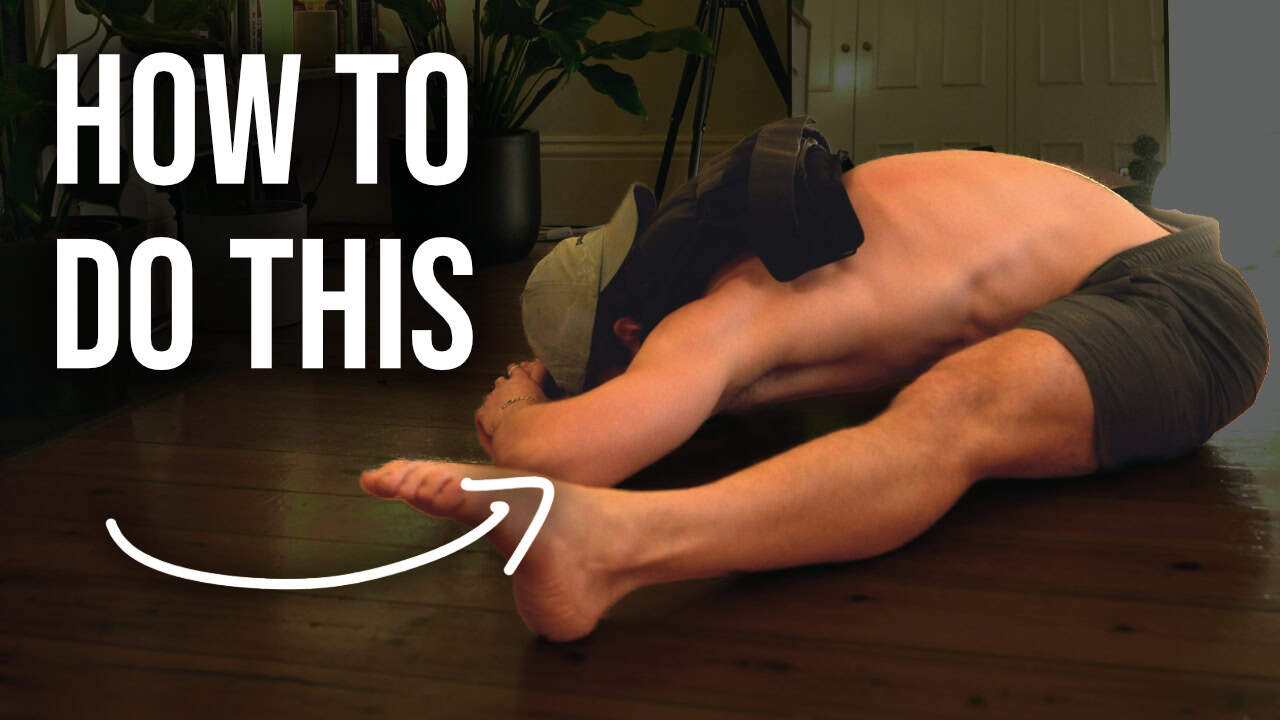
In this video we talk about the single best flexibility movement and how to achieve it with under 5 minutes of work a week.
- Why the pancake is the movement I would prioritise building before worrying about any other flexibility goals
- How to unlock a chest-to-floor pancake permanently with a few months of focused work
- Step-by-step tutorial to do it yourself
Full transcript
I got a lot of things I want to do with my time and stretching is not one of them. So when it comes to flexibility, I want two things. A means of building it fast and permanently, meaning a couple of minutes a week for a few months and then I’m done and I want to apply that to movements that are worth building and if I can only choose one flexibility goal to add to my strength training, it would be this. The pancake with one flexibility movement built to a decent level, you unlock straddle ls and with enough overhead pushing strength, you get the full spectrum of handstand skills all the way from straddle pressors to stall pressors. Not to mention what this does for opening up your hips. If you haven’t achieved this yet, it’s the first place I’d start before worrying about anything else with your flexibility, work a few months of the right technique and you should be able to get chest to ground or pretty close with about five minutes of work a week.
Then you can move on to something else. Or even better, just forget about flexibility entirely and focus on your strength training. But if your current efforts of doing a pancake looks something more like this, don’t worry. Anyone can build range of motion in this movement from any starting point and you don’t need any equipment other than what you’re currently sitting on. Here’s how we’re going to first cover the mechanism that makes it possible to even do this so fast and efficiently. Then we’ll look at the mechanics of the pancakes specifically and I’ll take you through a full guide of demonstration how you can do this yourself if you want to skip there and get straight into the how to feel free, but here’s how this is going to work. First up, if you haven’t already built all the lasting flexibility that you want, we need to give you a better process because our goal is not to stretch our muscles, they’re not rubber bands.
To demonstrate how real flexibility actually works, I want you to do a quick experiment for me. Whatever you’re sitting on now, I want you to move forward to the front of your seat, spread your legs, keeping them straight, and try to lean forward, tilting your pelvis forward and try and bring your belly button down to the ground. If that’s too easy and you don’t hit a limit, try the exact same thing on the ground legs, spread straight, trying to touch your belly button to the ground. One of two things is going to happen. Either you’re going to get into a full pancake position, chest on the ground, in which case you don’t need this video. Or at some point you’re going to start to feel serious tension in certain muscles that stop you going any deeper into the movement. Now that tension that you felt in your muscles that stopped you going deeper, was that you?
Was it voluntary? Of course not. What you’ve just experienced is an automatic reaction from your nervous system to stop you going past a certain depth and it’s a very useful reaction. The reason it’s there is to stop you moving into range of motion that your joints aren’t safe in. The only way that your body will allow you to go deeper is if it knows you are stable there, able to pull yourself back out of it even under load and keep your joints safe. And if that’s not the case, it’s going to make your muscles contract before you get there, pulling you up short so that you don’t just destroy your hips in daily life, which is a fair deal, right? What else could it do? So how do we increase the range of motion We have access to. Think of it like strength training, near end range of motion.
If we get really strong here in the range of motion adjacent to our current limit, then our body’s comfort zone range is going to increase. We have a bit more buffer now in terms of the range of motion that our nervous system will allow us to move in because our body learns we have strength in this position, we’re able to pull ourselves back out of it and so it increases the range that we have access to and voila, we now have more range accessible to us at any time of day. No warmup required. No incense or 30 minute routine needed. Just an increased baseline of flexibility that we can access at the drop of a hat and if we repeat that process over enough cycles, that range stacks up until eventually we go from how flexibility looking like this to this. If you want more depth on this topic, check out this video.
So the range of motion we’re going to build for the pancake is hip flexion with our legs straight and abducted. The muscles we target with this movement don’t really matter. If you progressively build the movement, you’ll build the strength, the flexibility in the relevant muscles for the movement. Just like when you make progress with your maximum strength, the muscles necessary to do that will grow as they need to grow. But what you’re most likely going to feel is tension and progressive strength gain in these muscles here because these are the ones when you’re in this position that help you extend your hips and move out of the pancake. So I’ll show you how you can do this right now, but the process is basically get into a position where we can move through our accessible range comfortably, pull ourselves into hip flexion until we start to feel our muscles tensing involuntarily, voluntarily tense, those muscles as hard as possible, pulling against resistance, and then repeat that for reps.
So the beginner version of the pancake is exactly what you experienced in this demo. What you can do is get on the edge of your chair and spread your legs straight and sitting on the chairs just going to allow you to get more leverage to get your hips over. It’s going to make this easier starting out. If you’re already comfortable sitting straight on the floor, you can skip to the intermediate version. Once we’re in this position, we’re going to keep our legs straight and the movement is just hinging at the hips. So thinking about bringing our belly button down and trying to touch it to the ground. As soon as you feel tension in the stretch muscles, they’re the ones you want to start to flexing as hard as possible. We can get leverage to flex against by grabbing the chair underneath us. You can also do this movement with weight, but if there’s a version that requires less gear and fluffing around, I prefer that.
And then you can do this practically anywhere. So just use your muscles. We’re going to use that leverage thing about pulling our hips over and the harder you can flex the muscles of your inner legs to try and pull yourself back out the better. And so we’re trying to create two opposing forces that are as strong as possible. One pulling you into the movement and the other resisting trying to pull yourself back out. Remember that you don’t need to be at your end range. Just close enough to it that you naturally feel those muscles tensing in response to the position. Do a few seconds of this tensing as hard as possible and then relax and come back out of it, and that is your first rep, and then you can start to repeat that for reps. As you do this, you should very likely feel yourself progressively gaining range of motion rep to rep.
That is completely normal and great as your body builds confidence in that range of motion before you’ve even built any strength. As you do each rep, just keep moving deeper until you start to feel that natural tension. Then lean into it tense heart. If you’re doing this on the floor, it’s exactly the same process. You can gain leverage either by pulling on your feet or by having some anchor point in front of you that you can use to pull yourself forward and get your chest down. I also like to just do this using my hip flexors, pulling myself into the movement with them and trying to resist and pull myself out with hip extensors, the stretch muscles, whatever feels comfortable to you and allows you to just focus on getting deep and getting tension and resisting with the stretch muscles. In terms of the protocol for this, I’d keep it super simple.
Do one set. You can do a couple if you want to because you’ll very likely feel once you’ve done one and have warmed up those muscles that you’ll have much more range accessible to. So if you want to do more, you can, but just remember diminishing returns. You’re going to get most of the benefits just from having a go at this and that set or a couple of sets can go for as long as you want. I end up doing quite a few reps for this just because it feels productive and I can feel myself progressively gaining range of motion once it starts to plateau out and I’m not really gaining any more and not having any more fun with it, that’s when I stop. The right amount is whatever you can be bothered doing. Don’t overthink this too much. Less is more. Once you’ve shown up and done something, you’ve stimulated your body to make progress.
You can do this once or twice a week. I would suggest doing it twice if you want to just get in and get this done because we’re only going to do this until you reach your desired range of motion. It would be utterly hypocritical of me to say, do this forever because I haven’t. I spent a couple of months doing this about 10 years ago, got the range that I wanted and then I’ve barely used it since. Spending your precious time and energy on staying in the same place to me is insanity. I would do this once, get a result that you’re happy with and then put it in your back pocket for when you need it. If you feel stiff, want to limber up, unlock a bit more range. You can bust this out and do a set whenever you want in terms of working this around the rest of your training.
You can do this on your off days when you’re not strength training. If you want to do it on the same day, just make sure you do it after your strength training session is done, especially if you’re training lower body that day. Two reasons. One, it’s going to preserve your maximum strength so you can actually channel that energy into the work that matters with your strength drain, which is better for it, and you’ll be warmed up looser and be able to get more depth when you do your flexibility work, which is better for this. And that’s pretty much it. Remember, this is great. It’s always secondary to proper strength training of your basic major planes of motion, so make sure that’s dialled in before you start worrying about flexibility moves. You’ll very likely find that you don’t even care about specific flexibility once you’ve built the general functional mobility and strength that comes from building up full range strength in your basic plans of motion. If you need help with that, links are below, and if you’ve got that sorted and decide that the pancake is your next project, then implement this and let me know how long it takes you to get chest to ground.