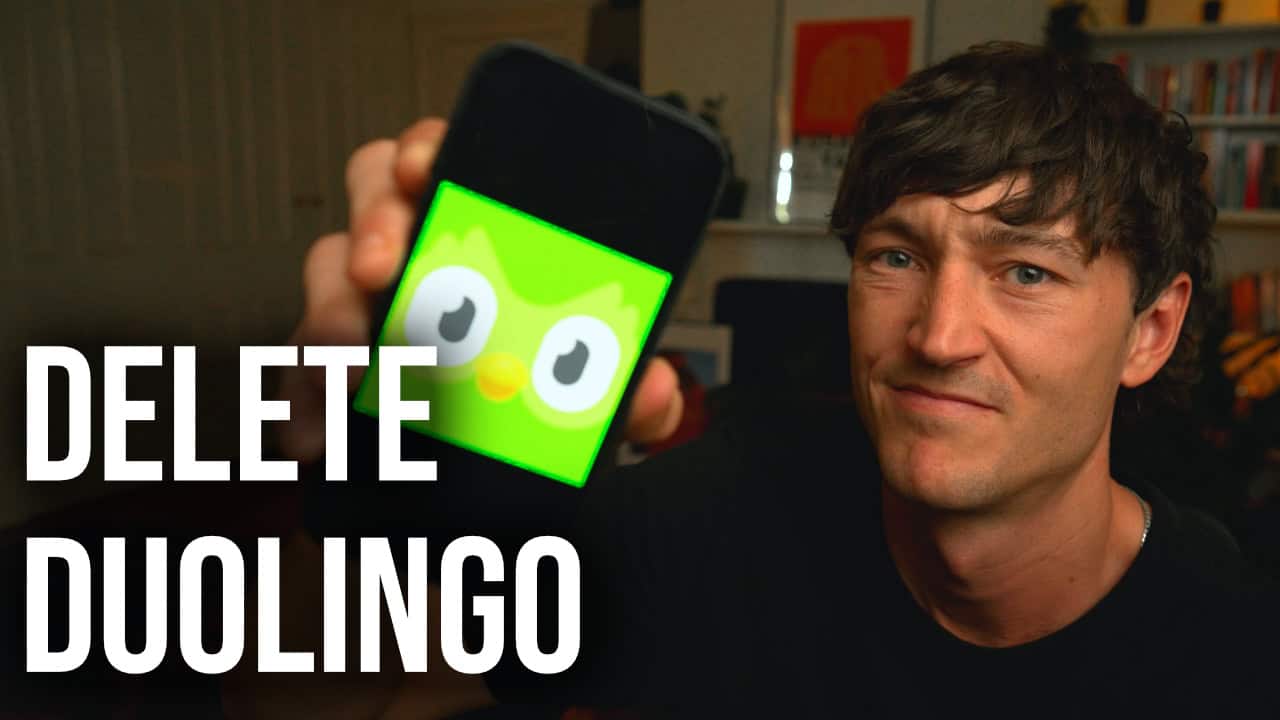
In this video we talk about why most people never learn anything, specifically when it comes to languages. Here’s what we cover:
- The big problem with apps like Duolingo for language learning
- The 2-phase method I used to learn my fourth foreign language faster and easier than ever
- How I went from zero to reading novels in Spanish in 6 months from 5 minutes of practice a day
Full transcript
If I have one more conversation about language learning turned into, yeah, I’ve been using Duolingo, I’m going to punch a wall with the amount of time I see being burned by people tapping away on language learning apps only to develop zero practical ability. Six months in I felt compelled to share some thoughts. I’m currently two years into learning Spanish, which is the fourth foreign language I have learned to at least conversational fluency. And I got there dedicating under an hour a week to it. And for context, I’m now halfway through my second novel. I watch dialogue heavy TV shows all in Spanish. There are friends I have made that I’ve never spoken a word of English to.
It is this is the fastest, cheapest, easiest and lowest effort that has ever been to get to this point and by far the most fun. And before you say no, I do not have a language learning brain any more than I have a fitness body. Anyone can learn to speak a language. You have already done it once when you learn English. It’s just that much like with fitness, most people’s process sucks. So in this year I’m going to take you through the three core principles that I think have allowed me to nail it this time and walk you through a specific demonstration of the process that allowed me to go from zero to reading my first novel in Spanish in the first six months with just five minutes of work a day. So first, let’s talk goals. I’ve studied language at high school, at university, I’ve used the apps.
My goal going into Spanish was not to win points or get practise streak badges or even pass exams. My goal was to speak Spanish. And so I knew that I needed to define a clear outcome that I could work towards that would allow me to leave behind practise and textbooks and flashcards and start just using the language. Much like with fitness and strength training, if you don’t have a clear goal to reach, that’s measurable. It’s very difficult to build an efficient practise that has any coherence or direction and it’s very hard to push for progression. How can you progressive overload in your strength training if you don’t have heavy strength goals? For me, the most obvious goal is just to be able to read a novel. If I could read books in Spanish, then I wouldn’t need to practise anymore. I could just read books and that’s something I’m doing anyway in English.
So that would mean as soon as I get to that level of ability, I could just sub out my English text for Spanish ones and for no extra time per day be accumulating hours and hours of exposure to the language every week, constantly rewiring my brain to understand Spanish better and better for no time cost, doing something I enjoy anyway. If you watch the name of my stuff on fitness, this is how I like to approach things. I figured that there’s no way you can read a novel in a language without learning to speak that language pretty well. And then speaking and listening skills just become application of what you already know. The next thing to Darlene was routine. And before we even talk about lingo and specific techniques, this is where I see so many people failing just like in fitness because the most counterintuitive thing I’ve learned in language learning is also probably the most important.
And that is that you do not learn when you are practising , which might sound crazy, but think about it. What is the purpose of practise? It’s to stimulate learning. Because much like with strength training, all the changes happen in the aftermath of your practise sessions when you’re off sleeping, eating dinner, relaxing on the couch, that is when your brain is going about rewiring the synaptic pathways that literally are the ability for you to speak. The language with strength training is obvious. You go about stimulating muscle growth and you know that while you’re resting and recovering, your body’s building muscle getting stronger. But it’s the same thing in your brain when you’re trying to learn a skill like a language. And so there’s no point grinding out hours and hours of practise expecting to get better in the learning session itself from cramming a bunch of words into your short-term memory.
You won’t. And if attempting to do that is coming at the expense of you showing up and practising consistently over the long-term, then you’re better off doing five minutes a day. And so that’s all I did for the first six months until I got to the point where I could read. I just made sure that what I was doing in those five minute sessions was effective at stimulating the changes that I wanted. And that takes us to this specific practise from all this. You know what I’ve learned is the biggest killer of learning. It’s boredom. The way I know my language practise is effective is if it’s fun and I’ll show you what the specific process looks like in a second. But the guiding principle for me with Spanish, after doing French and Chinese and Japanese, the metric I looked for to know what I was doing was effective, was how engaging and enjoyable my practise was.
And here’s the huge problem that I see with lingo and other apps. By their nature, they don’t adapt to you. And what I mean specifically is that they do not scale up to be nearly hard and challenging enough for you to get any real efficient learning done. It’s like trying to get stronger on a Smith machine with preloaded plates, no ability for you to actually find your own limit and work there. You end up spending all your time doing lots of reps and sets of really low intensity stuff that doesn’t stimulate your brain to actually adapt anywhere near the rate that it is capable of. If we want to learn fast, we basically want to scale up the difficulty of what we’re doing to be as challenging as possible all the time so that every second of our practise, we are stimulated, we’re engaged, we are trying hard.
And the only way that I can conceive of doing that is to take off the training wheels to guard yourself through this process. Apps just don’t cut the mustard. And obviously that requires setting up your own structure. But as I’ll show you, that really doesn’t need to be hard or complicated at all. And once you’re doing it right, it is so much more fun than sitting on Duolingo for an hour a day. And as you’ll see if you apply this, so much more rewarding because it actually works. So when I was designing my own process, I just wanted something that cut through all the crap. Everything that was boring was thrown to the side and I just got straight to what I found to be the most interesting, stimulating, rewarding work that I could do right off the bat, six months into doing what I’m about to show you, I went to South America and realised I could already speak Spanish.
It was basic, but it worked. And when I came back I realised I was done with all this practise stuff and I was itching to just use Spanish. And so then I just started reading my first book. And so looking back, there’s really two phase process here and phase two is what I basically spent the last 18 months in and will continue to stay in forever. This is where you’ve reached a critical mass where you can start reading or consuming whatever media you want. So the language is just a normal part of your routine. You’re enjoying consuming the media for what it is. For me, it’s my novels. And the more I read, the better I get. The more I get out of reading, the more I can then read with less brainpower. And the better I get at the language. Phase one, which was the first six months for me is from where you know nothing to the point where you can actually start reading consuming media.
The goal of phase one is purely to get to phase two as soon as possible because it only needs to take five minutes a day of structured work. But our goal is to not have to do any work whatsoever. So I’m going to show you now how I did that. This is where things get a bit more technical and this isn’t necessarily perfect, but this is what’s made sense for me. Take from this what’s useful for you. The important thing is that you apply something and if you follow the three principles I’ve outlined to this point, you’re going to do very well. So in my five minutes a day of Spanish practise, there’s three things I set out to do. Get examples of real Spanish, break those down to figure out what’s going on and then practise putting them back together myself from scratch. So let’s do it together.
I’ll show you how simple and fun this is. So the first step was get real examples of the language. I use this dictionary, spanish dictionary.com. If you learn a different language, any resource works, word reference is really good for a lot of European languages. You want to find a database of examples of how the language is actually spoken. So starting out and I did the absolute basics, so things like how to say hello, cool, so I get that and go and put it in my database and this is literally just a place where I can put the sentence and then over here it’s meaning. So do that for all the basics. Might want to know how to order a coffee and then I might want to know how to say drink. And so I started with really simple single phrase sentences like this focusing on things I actually say in real life.
Key thing is I wasn’t interested in learning anything in isolation. I wanted to learn vocab, grammar, everything together as Spanish is spoken in the real world. So it was always complete sentences. And initially this is just like doing flashcards word meaning, but the geniuses in how it quickly evolves to incorporate much more complexity. Step two was to break the Spanish down and figure out what was going on. So I’d be asking myself what word means what? Why is the verb like that? Why is that ending on that adjective? Obviously it’s simple here, here is a little more complex, but it doesn’t take much investigation to figure out that it means please, that means two and that’s coffees. Here’s a bit more complex to really get this. I’d have to go into understanding air vista being the perfect tense. I need to know that law is a direct object pronoun referring to him, your is me, this is conjugated for me.
Tamara is in the infinitive and then that’s the noun. And so I go down a lot of rabbit holes researching these things. The key is this is completely scaled to you because if you already get what’s going on, you’re good. You don’t have to look anything up. It’s just a simple sentence that you understand. If you haze you on something, you might want to go rehash that concept. If you verb conjugations for that tense suck, then you might want to go practise them. But the basic question I’ll be asking myself the whole time is, do I have the necessary knowledge to reconstruct this sentence myself? If not before I learn this sentence, do I get it now? If not, then I’d want to go kind of figure that out. And if it was too complex for me now overwhelming, I just choose a simpler example.
And that’s because the next task is to put it back together myself. So that’s how I started to construct database of my own example pieces of Spanish that I had broken down and understood. But the main task each day, the third activity and what my practise was structured around when I did my daily five minutes was testing myself on my ability to reconstruct the authentic Spanish only from the English prompt. So I’d block out the Spanish, read the English, and then do my best effort of saying that sentence inauthentic Spanish. And as I said, obviously at the start, this is as simple as doing flashcards. Hello is all, but you can’t just rot learn forever. As the complexity increases, the only way that you can possibly keep up is if you start to see the patterns in the language and are able to reproduce the grammar yourself.
And this works so well and so quickly because we’re just constantly feeding our subconscious through exposure and use. We have all this trial and error with instant feedback and correction. And here’s the beauty of it, I realised I could fast track my learning here by reading up on grammar, by learning verb conjugations, by practising things in isolation. But I only did so when and for as long as it was the most fun thing to do. And remember, that’s the core principle here. As soon as that sort of stuff got tedious or overwhelming, I get straight back to the practise of just testing myself and see this is reversed to how most people learn. Most people study grammar rules and drill ’em and then try to apply them and it’s the most boring thing ever because there’s no incentive. But here you don’t have to learn any grammar.
There’s no textbook to work through. But as you start to progress, you’re going to start to be intrinsically motivated to, because firstly, you’re going to start to get curious about why sentences are constructed this weird way, why it looks different to English, what these different patterns are that you’re starting to notice in verbs and adjective, agreements, whatever else is going on. But secondly, it’s going to just help you get better at this so much faster. And that is extremely satisfying as you start to find shortcuts to being good at this. Grammar stops being this boring set of isolated rules in a book and starts to be cheat codes to a game that you’re trying to win. And it works because none of this is the theoretical, it’s application first. You’re choosing sentences that you want to be able to say. And then theory is just there if you want it to fill in the gaps.
Kids don’t have the ability to do this when they’re learning their mother tongue, but you can make your learning process much faster by figuring out what’s going on. So that was a three step process and that’s all I did in my daily five minutes I’d find new sentences, I’d break them down and figure out why they were constructed the way they were. And then I practised testing myself to see if I could recreate them from scratch. This is awesome because I got exposure to everything. There were no training wheels. I was constantly seeing what existed in the Spanish language. But because I was choosing the sentences that I was going to learn, I could keep things simple enough that I could always understand what was going on and I was able to control my own rate of progression based on where I was up to and what I felt comfortable with.
And so doing this, the difficulty scales perfectly to you and it advances as your skills advance. And so looking at my own real database in Spanish, this is where I started very simple sentences that I knew I’d want to say when I went to Spain and South America. And by the time I got towards the end, I was doing much more complex stuff to try and understand subjunctive tense and idiomatic expressions more complex stuff. By the time I graduated from this phase, I had 555 examples by which point I’d never get through practising the whole list anyway. And so there stopped being any point having it, and at that point I was ready to move on. So it remember the goal of this phase was just to get me to the next phase where I was able to start reading books and using Spanish. And so how did I know when I was ready?
Back to principle three, it was basically when this practise started to become boring. Not because of how I was approaching it, but because I was just getting too good for it. And as soon as it started to become too easy, the intensity was now too low for me. It stopped being as stimulating and fun and I knew it was time to progress the challenge up to the next level. And so I started my first book, which was donkey Hot there. And admittedly this was challenging. I think there’s going to be always growing pains when you’re progressing into first using the language. I maybe would suggest not starting with an antiquated classic like this from the 17th century because when I moved on to my next novel, a much more modern one by Mario Varsa, it has been much easier to read. And I don’t think that’s purely down to my skill development, all that to be part of it.
But once I was eager to read, I just started and I was such a fish out of water. But learning to be okay with that discomfort of using language that you’re not yet good at is a huge part of getting good at language learning. Because the only way that you start to get your brain adapting is by being in the uncomfortable situation of not understanding what is going on. And so I used chapter summaries to help me fill in gaps that I didn’t understand and I just pressed through. And as I said, by the time I got from that book to my next, I was understanding 95% of what I was reading, which is a pretty exciting place to get to. So if I have any advice that’s helped me massively for getting to this second stage and beyond, it’s to be okay diving head first in nothing is going to happen to, if you don’t understand the things you’re consuming entirely, just start, keep applying.
The second principle of routine, allow your brain to make the adaptations day by day by day. And you will look up a few months down the track and realise you were speaking a language that you had no competency in 12 months ago. Learning languages has been one of the most rewarding things I have ever done in my life from the adventures I’ve had, the people I’ve met in Japan, in China, in Europe, in South America have been some of the best experience of my life. And so if this can help some of you break through the normal barriers that I see holding so many people back from being able to learn foreign languages, then that makes me very happy. If you’re cluey and you’ve watched any of my other stuff, you’ll see that all I did with this was apply the same principles that I’ve applied to fitness, brutal focus on progression towards a clearly defined end goal, much like with the six strength goals, using the strongest stimulus possible, very little and very consistently over a long period of time to signal growth and adaptation from your body, just like with the 40 minutes a week of strength training that I do.
And then listening to your intuition as your body’s own guard for how to apply that and get the perfect intensity to stimulate growth for your body, your brain, much like we do to find max intensity in the perfect volume, in strength training. So I hope this helps. If you resonate or find this interesting or have had similar experiences with languages, please let me know in the comments. If there’s more stuff you’d like me to elaborate on, always happy to do more videos on this sort of stuff. If you want to help with your fitness, links are below Happy Language learning and I’ll speak to you soon.