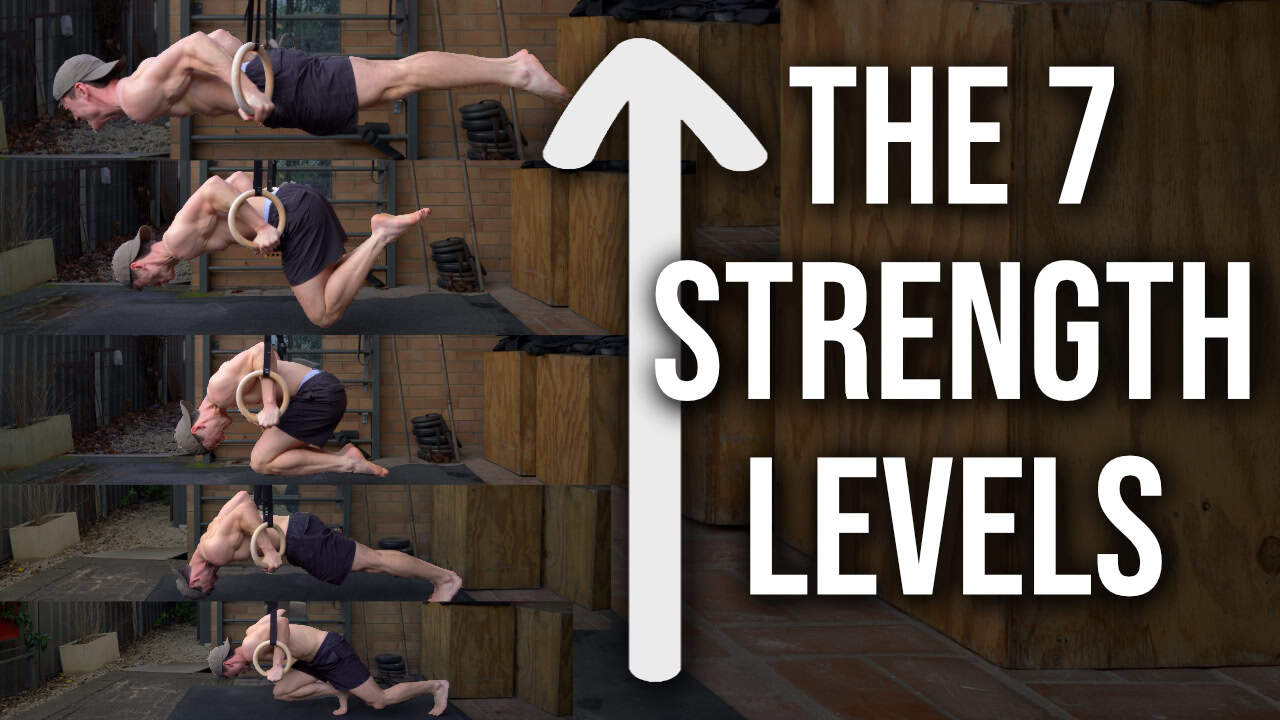
In this video we talk about how to turn fitness into an addictive process that feels more like a video game than working out. Here’s what we cover:
- Why short-term objective strength milestones are so important for ensuring long-term results, especially in the beginner and intermediate phases of training
- An easy levels system you can use to measure your current full-body strength in all 6 basic planes of motion
- Know what your next closest goal is for each movement pattern, and what to focus on to get there fastest
- Know when you can expect to achieve “free gains” movements like muscle ups and handstands
Video summary
This video provides a detailed overview of the seven levels of strength progression for six basic movement patterns: push-ups, rows, handstand push-ups, one-arm chin-ups, single-leg squats, and Nordic curls. It outlines the specific criteria for each level, from beginner to elite, and explains how to measure progress and identify the next goal to work towards. The summary covers the key points:
- Outlines the seven levels of progression, from beginner to elite, for each of the six movement patterns
- Describes the specific criteria and test exercises to determine the current level of strength for each movement
- Emphasises the importance of focusing on incremental progress and celebrating reaching each new level
- Recommends pushing with maximum intensity across the full range of motion to build strength as quickly as possible
- Suggests tracking progress and using the information in this video as a framework for navigating the strength development journey
Full transcript
Being a beginner is the easiest time to get fast results in anything, particularly strength training, but it doesn’t always feel that way. The core reason for my success with fitness and developing a training system that works so well for me despite taking less than 40 minutes a week is the unwavering focus that I have held four years on the same set of six strength goals regardless of specific techniques. Every inch toward them has been a clear level up in a video game of constant improvement towards an exciting tangible endpoint. And that’s allowed me the confidence and motivation to keep pushing on long-term. But when you’re early on staring down the barrel of a multi-year journey to get to your lifetime goals, any progress that you do make towards ’em at this stage can feel insignificant. And that’s why these early stages without the right framework in place are such a risky time because it’s when you are most likely to feel a lack of motivation quit and then jeopardise your chances of ever reaching your goals at all.
So in this video I want to give you a system for navigating all stages of your strength development, turning progress at every level from absolute beginner all the way up to elite, into an addictive process that feels more like a video game than working out while also giving you critical feedback to know that you are on the right path and a clear sense of direction as to how to get to the next level. I’m also going to clarify when you can expect to unlock certain strength goals like handstands and muscle up so you can map your progress towards these bonus achievements along the way as well. So what you want to do is figure out where you’re at now in terms of your strength on all six basic plans of motion. Know what your next closest goal is and what you need to focus on to get there fastest.
Just remember how you make this progress is completely up to you. We do it in 40 minutes a week, but that’s just one approach of many. As long as you’re progressing, you’re getting results and the faster you can work through these levels, the sooner you’re going to have the accompanying strength and muscle mass and lean body composition that they require. I’d suggest watching all of this through once figuring out where you’re at for each movement. Then you can always come back to this video as much as you do progress through these levels to figure out what’s next. So I’m going to go through the criteria for each level and what to focus on to get to the next one. This is not a tutorial on how to train. I’ll link some other videos and go watch to learn actual training technique. This is about measuring progression across your full body strength.
Now your strength might vary across movements. Some movement patterns might be much stronger than others. That’s okay. It’s very rare that you’ll be at the exact same level on all your strength movements and these measurements aren’t perfect. The point is that you’re progressing on all of them across time. So level one is our ground zero. This is a level that anyone can start at because it requires zero strength to be able to do it, and the goal at this point is just to learn to train full range of motion reps regardless of how weak you feel so that you can actually start progressing and getting up to the high levels. So for all six movements, you can have all your weight on the assisting muscles and none of it actually on the working muscles. So for our upper body movements plan pushups, we can get down to our knees, take all our weight off our hands, same for rows.
We can walk back all our weights on our feet, hands down, push up. We can stand there and work through it. Again, no weight on our hands, one arm chin up. We’re just guiding ourselves through weights on our feet, single leg squat weights on our other foot and our hands and our Nordic curl. We bend our hips and guide ourselves through the full thing with our arms. So anyone can start at this point from here. For all our bilateral movements where we’re using both sides of our body at once, we’re just going to measure progress through the highest level that we hit in our training for the unilateral movements, single leg squats, one arm chin ups, your training at this level is going to look very similar to the training you’re doing all the way up at level seven. Even when you reach end goal level strength, you’re always going to be struggling against max intensity and the progression itself’s going to look the same.
So what we do to measure progress here is do test reps and I talk about this in the specific tutorial videos for these movements, but before you start training, the way to gauge your progress and see where you’re up to every time you train is just by doing a quick test rep. So ground zero test rep for the one arm chin up is a two arm dead hang and for the single leg squat is just a body weight squat, two legs, and this is just our starting point base level of testing for these two movements. Level two is our beginner level and the goal here is just to start loading more weight onto the working muscles. So for our plan to push up, that looks like getting up on our feet and starting to add forward lean, increasing horizontal distance between shoulders and hands. Front labour are exactly the same, letting our body come under the rings and starting to push the rings away towards our feet, again, increasing that horizontal distance between shoulders and hands, hands up, push up.
We start loading weight under the hands as well by bringing our feet back and getting into a park position and for our unilateral tests, one arm chin up, we now reach free, single arm, dead hang and single leg squat. We do a negative single leg squat. Once you’re hitting these progressions or tests, you’re now at level two and can start working for level three for the Nordic curve. We’ll come back to this once we get to level four for now, just keep working on it. All these level two progressions, you can really milk for a lot of progress and these are going to be the staple base of your training. Even when you’re at much higher levels, you’re going to continue dropping down Whenever you’re tired or just in weaker parts of the range of motion, you’re going to come back and use these progressions to help you get the reps in that you want to get in.
So every bit of improvement you make at this progression making things harder is building skill that you’re going to use forever. Level three bridges, beginner and intermediate levels, and it’s this point where we start to get full body weight progressions going. So this is where we first started integrating tuck plant, push up and tuck front lever rows into our training hips don’t have to be level, but if you can stay tuck tight as a ball, knees to chest for any range of motion, you’ve hit level three handstand push up. We’re going to stack more weight on our hands by elevating our feet. And just to note for all these movements, you just have to hit these progressions for some range of motion of your first rep. They don’t have to be complete reps. If you’re doing an entire rep at a set progression, it’s usually an indicator that some of it’s way too easy, so that’s not what we want to see.
What we want to see is when you’re strongest at the start of your set on the strongest part of the range of motion, you’re using one of these progressions for a little bit. That’s all that’s required to hit the level one arm chin up and squats. You’re still just training them for range motion loading as much as you can onto the working arm or leg, but for your test before that training set for one arm chin up, it’s now a two arm chin up partial range of motion, so any part of the range of motion that you can pull through full body weight, that’s level three ticked off and for the single leg squat, we’re now getting a full range single leg squat positive, so no weight, no assistance, full range, single leg squat. Big thing at this level, level three, when you’re starting to float with these higher progressions for your upper bodies to just get comfortable hitting them and then dropping ’em back down as needed.
As I said, you’re only going to start using these progressions for parts of your reps. So this is where we start to really build the skill of switching up and down between progressions as needed to keep our training always at maximum intensity. Level four is intermediate and this is a very exciting place to get to with your training. We’re really starting to solidify intermediate positions with our progressions now and hitting much harder strength tests. So for the plange pushup and the front lever row, we’re getting our hips level with our shoulders again for some range of motion before they drop or before we have to pull ’em up. In the front lever hand stamp pushup, we’re getting our legs on the straps, so this shoulder stamp position at the bottom we can flick up into safety warning, spread your legs, say it once everyone makes this mistake or just be ready to stack it for the Nordic curl.
We can now get some range of motion unassisted, so some range of motion on the positive where we are not using our hands. You can bend your hips as much as you want, but anywhere before your knee joint gets to 90 degrees before your fem is perpendicular with the ground counts as level four. And again, just a reminder, all these positions are just partial range of motion. First rep at some point hit them, you’re good. The one arm chin up test is a full range of motion, one arm chin up, so dead hang all the way to where your wrists touch your chest and the single leg squat. We’re now going to start loading these unassisted squats. Level four is 10 kilos or about 20 pounds. Just another reminder, you’re still training single leg squats in one arm. Its full range of motion max intensity.
This is just your test at the start before you do your set. Level four is a seriously solid level of strength to get to and this is where you started to transition from these quick beginner early stages into much more significant development, slower, harder, but way more rewarding. You should be by this stage already feeling really strong and limber looking athletic. You’re not going to be able to do these if you’re not somewhat lean and it’s also at this point where you’d be expecting to unlock things like muscle ups with a bit of full grip practise. You should have no trouble getting these on the rings. Now a muscle up is just really continuation of strength. You’ve built from doing full range motion chin-ups. Transitioning is then strength you’re building with your front lever rows and then the dip is just strength you’ve built from your plan pushups.
So if you’re at level four on these three movements, you should be able to get muscle up At this stage we just really want to push to use these level four intermediate progressions throughout as much range of motion as we can as we’re training. Again, that will be easiest at the start first rep when we’re freshest and then we can still continue scaling back as much as needed. Dropping down to level three to one to keep training four range of motion reps for as long as we want to. As soon as you can manage some decent range of motion with these level four positions, you’re onto level five. So level five, we’re now into this intermediate advanced territory. So for the P push up, we now take this intermediate position of our hips level and start to extend out at the hip keeping our hips level.
Same with front lever where we get to our level four position and then we extend out keeping our hips level. As soon as that’s impossible, we can just tuck back into a ball and keep training as normal. For the handstand push up, we can take this shoulder stamp position we’ve built and now start to push up. And so as soon as we can get some range of motion using the straps for assistance and we’re now at level five, again all these three pass range of motion, anything you can get counts then make sure you scale back and continue training as you were before. Scaling back as you tyre for the Nordic curl, we now hit a full negative without using our hands, so touching down to our chest. You can still use hip bend to make this easier than the full thing. Once you do touch down with your chest, just make sure you finish full range motion rep using assistance, but as little as possible, our single side tests now get really tough.
We’re going to be hitting a partial range of motion negative for the one arm chin up again, whatever range you’re strongest on counts for this. And then for the single leg squat, it’s a full range unassisted, 20 kilo single leg squat or about 45 pounds at this point. Now getting partial range strap assisted handstand push up should have a really good base of strength for handstands. Again, with some practise in the position getting your alignment and practising kick ups, the shoulder strength you’ve developed to this point is really going to start to shine through in your ability to control the position. The reason why it’s really important to train four range of motion reps on your handstand push chops. Things are now really heavy. You are starting to get really strong and our goal is to really just lean more and more into these progressions, pushing towards the advanced positions of level six.
Level six is advanced stage and this is where things are really serious well on your way by this point to the end. Goals, plans, pushups and front levers. Were hitting advanced tuck, so 90 degree at the hip for some range of motion. You hand stamp push that you’re going to get some unassisted range, whether that be on the negative because you’ve pushed all the way up with strap assistance to the top or you’re just getting some unassisted positive range of motion. You’re now at level six here. Nordic curl is now going to be no hands for the positive, so you’re going to lift your chest off the ground without any help from your hands. Make sure you still work the first part of this when you’re training and then once you’ve lifted off, extend your hips as much as possible to keep it max effort, one arm chin.
You’re now hitting full range of motion negatives all the way from wrist touching chest to a dead hang under control and your single x squat. We’re going to hit another 10 kilo increment, 30 kilo squat, about 65 pounds. So by this stage, as I said, you’re getting very close to the full end goal movements. You have to have an excellent physique by this point, lean serious amounts of muscle mass and you should start to see that advanced level strength be available to you across full range of motion. You’d expect at this stage to be able to start pressing into handstands. So whether that be straddle presses as the easiest pi presses or full sword pressors, depending a bit too on your hip mobility, you’re going to have the raw strength to be able to handle these movements down. This is around the stage two where you’d expect to unlock back levers so you can start playing around with that again, depending on how strong your plan to push up strength is.
Your focus at this point is really starting to reach for the end goals and so every time you show up to train, you should be starting to test how close you can reach for those six big movements. Level seven, we’re now elite and this is the level where you’re now starting to push beyond the end goal movements during parts of your training to make sure you are maxing out 100% intensity for you across the full range of motion of your reps. So for the plange push up and front lever row, we’re now hitting a full lay position for some range of motion. So plan push up. This is easiest at the bottom, so you’re getting into a Ben arm P plange position for the front lever. It’s easiest at the bottom as well, which means you’re hitting a full front lever, which is a huge place to go to for the hand sample push up, we’re going to start to move side to side, loading more weight on one arm to make sure that our negatives especially are fully loaded, maximum intensity, one arm chin up, we’re going to hit positive one arm chin up for at least partial range of motion.
Our single X squats now 40 kilos or about 90 pounds and our Nordic curl, when it gets too easy, we’re going to pick up some weight to slow it down. So as I said, at this point we’re kind of reaching beyond end goals in order to make sure we’re maxing out. So this is where you can really start to practise the end goals when you do train and before you get stuck in really practise the skills themselves. So in terms of usable skills, you can start to practise straddle planers, your front lever, you’ll be practising at the study set anyway. Handstand, pushup, you can get free standing really easily now with some practise of the balance coordination without using a wall or a strap as assistance. One arm chin up is just about getting your strength test over enough range of motion, so that’s full thing.
Nordic curls just about using less and less hip bend as you take off from the ground and the single leg squat. You’re using serious weight in your test now, so you should find your leg strength in a fantastic position getting to this point. Your physiques guaranteed to be insane. This is the level I’m at. There’s no other secrets to my physique and your focus at this point is just making sure you do keep pushing to make things as heavy as possible and as I said, practising the skill of using your strength to demonstrate those movements if you want to be able to show them off. Again, you don’t need to go and do sessions for this, it’s still part of it, but you just put the focus at the start when you’re freshest into demonstrating the maximum strength that you’ve got and that’s it. They are the seven levels of strength for the six basic planes of motion that you can train from beginner to elite.
Your next step is to go through this for each of your basic movement patterns and figure out where is your strength currently for each one. Once you know where you’re at, you should then have one clear goal for each movement pattern that you’re focused on building towards. Next, all we want to do in our training is each one step closer to that next goal. Every time we train. That is all we need to do to see progress. You can always think about hitting the long-term goal when you train, but your immediate target is to just simply reach that next level. Making those incremental steps towards it are going to compound very quickly over time, and when you hit a new level, recognise it, celebrate, keep your current levels written down somewhere and track the new ones that you unlock over time. This is going to keep you training clear, it’s going to keep it fun, it’s going to show you that you actually are making progress towards your long-term goals.
How do you make sure this progress happens regardless of what specific progressions you’re up to using? Now, building that strength as fast as possible is all about pushing with the maximum intensity that you can across the full range of motion of whatever movement pattern that you’re training. Do this properly in 40 minutes a week is more than you need to get that done. If you’d like help getting this right, it’s literally what I do. You can learn how our whole system works for free first link and then description. Otherwise, if you want to keep cracking on this video should help. Thanks for watching Chucky questions below and I’ll chat to you soon.