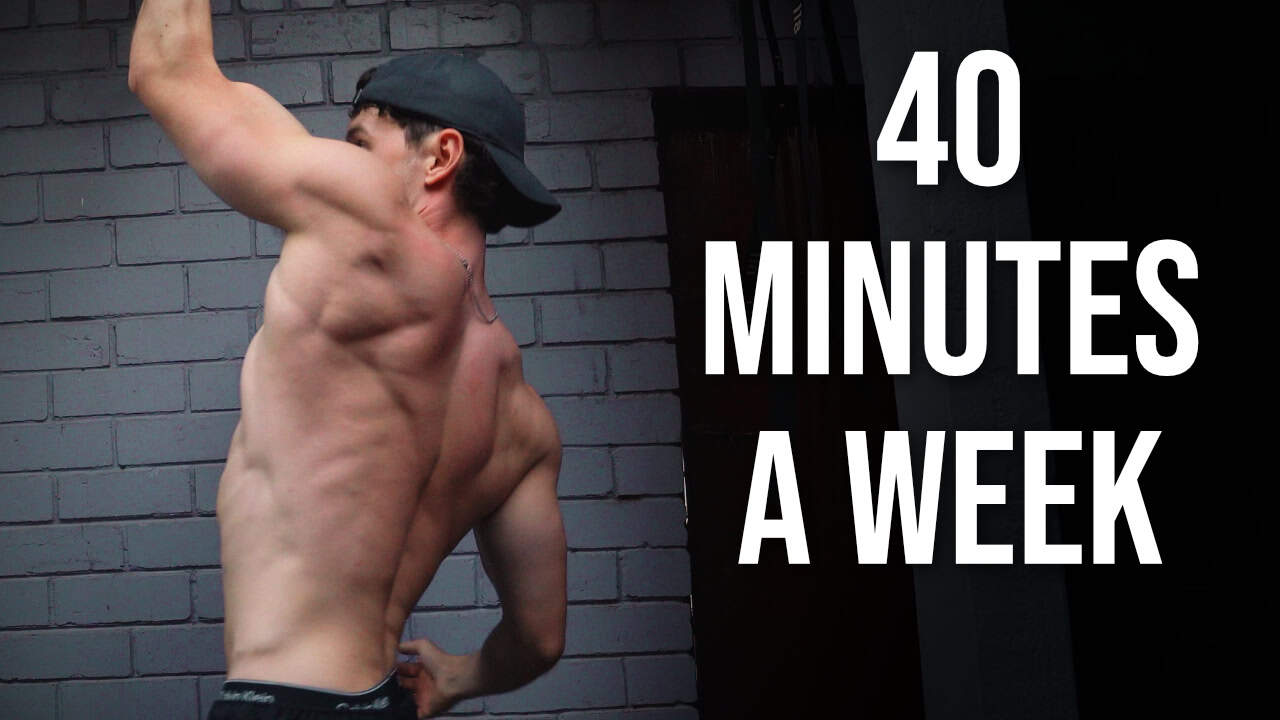
In this video we talk about a revolutionary approach to fitness that is saving people hours a week, accelerating their physique progress, and allowing them to become strong and mobile while avoiding injury. Here’s what we cover:
- The four key problems with traditional methods of strength training and where they stem from
- The ideal “dream” training method that would allow maximum progress with minimum time and injury risk
- How we have implemented such a method to allow people of all ages and strength levels to progress safely and effectively from home in under 40 minutes of training a week
- Complete demonstrations of all movements used in this method, from beginner to advanced levels
- The full weekly routine we use to optimise progress
Video summary
This video presents a highly efficient and time-saving method of strength training that can deliver impressive results in as little as 10-20 minutes per week. [00:00] The key principles are:
- Focusing on building overall body strength through six basic movement patterns (horizontal push/pull, vertical push/pull, squat, and Nordic curl), rather than relying on traditional exercises with fixed external loads. [08:03]
- Adjusting the difficulty of each movement by manipulating body positioning and leveraging body weight, rather than adding external weights. [07:53] This allows the trainee to work at the limit of their current strength throughout the entire range of motion.
- Performing continuous, all-out effort sets to failure, rather than accumulating “junk volume” with warm-up sets and partial reps. [03:36] This maximises the training stimulus while minimising time and risk of injury. [07:36]
- Completing the entire weekly training regimen in just 10-20 minutes of actual work time, by training each movement pattern once per week. [13:07]
This approach has allowed me to make rapid strength and physique improvements while drastically reducing my weekly training time compared to traditional methods. [00:00] It is a highly efficient, practical, and safe alternative for most people seeking to get strong and build an aesthetic, functional physique. [00:33]
Full transcript
About five years ago, I stumbled upon a method of strength training that allowed me to cut my weekly training down from five hours a week to less than 40 minutes, break through all my intermediate plateaus and hit my lifetime strength goals, transforming my physique in the process. And it bewilders me that in 2025, more people haven’t clued onto this process because not only do traditional methods of fitness take hours a week to do, they also make achieving reliable results very difficult, complicated, and laden with risk of overwork and injury, which puts up a huge barrier to a lot of people ever getting strong and mobile and lean. And when such a simple and time efficient alternative exists, why is that not where we’re starting? Because not only does this work insanely well up to advanced levels like where you see me at now 10 years into my training career, but it offers in my experience the safest and most fast track journey for people who are just starting out with strength training.
And I know this because I’ve seen it again and again in everyone I’ve taught this method to young, weak, old, undertrained male female. The further back people are with their strength and muscle, mass body composition, the faster they respond to a smart, efficient training system. So in this video, I want to show you very simply why the old system of fitness is broken, why it’s doing inefficient and impractical for most people, and show you very clearly the alternative that we’re using to get such great results so that you can start doing this to save yourself years of time and effort and frustration and actually build a body of life. First up, when we go to gym, go do exercise. What are we actually trying to achieve for the goals of muscle mass, bone density, lean body composition, six pack, however you want to look, and mobility for general life.
There’s one thing we can achieve with our training that delivers all these outcomes and that is strength. You can go and do cardio and all sorts of other types of activity aside from this, but to achieve a body that looks great and it’s going to stay functional as we age, we need to build as much strength as we possibly can. So in a sense, achieving all these things is really very simple, and the way we build that strength is through intensity. It’s by hitting the limit of our current ability by trying to lift heavier than we currently can. It’s only by trying to lift heavier that we tell our bodies that we’re not strong enough now and we need to build more strength so the next time we can lift heavier. The problem with traditional training with the gym, free weights, machines, normal body weight exercises is that all of these things have a fixed level of resistance.
We set 50 kilos on our barbell and we start bench pressing. The resistance is always 50 kilos until we stop and change the weights. Same goes for a machine you set at a certain level or pull-ups. It’s always your body weight. The problem with this is that as soon as you hit the limit of your strength, you fail, you then need to stop. What happens when you’re bench pressing and suddenly you can’t move the bar anymore? You reach a point where it takes all your strength to move it. You have to end the set unless your spotter is going to continually help you through the entire set from the start, you’re going to have to have a pretty dedicated spot if they’re going to do that. Then as soon as you start maxing out the limits of your strength, the set’s over you’re done and you need to stop, rest and wait for the next set.
And this means that maybe you accumulate a couple seconds on that bench press pushing as hard as you can at the most. This is if you take the set to failure and you have a spotter there to help you get the bar up couple of seconds, took you several minutes of warmup and prior reps to get there, and now you’re resting for a couple of minutes. And so over an entire one hour workout, at best, you might accumulate less than a minute of actual maximum effort, maximally effective training stimulus. The result is that you then need to spend hours and hours a week in the gym to accumulate enough of this max effort training to actually stimulate your body to go and grow and build muscle for the week. But that’s not all at the same time. When you’re doing all these warmup reps to get to that point of failure, you’re also accumulating all this junk volume, which is where you’re doing work that’s below your max.
So it’s not stimulating much strength gain if any, but it’s still having a taxing effect on your connective tissue, your tendons, your joints, and so it’s still accumulating damage that without enough recovery can lead to injury. And so then we can try and compensate all we like by doing extensive warmups and a bunch of stretching mobility routines, but none of these things are going to reverse the damage that we’re doing with our training. The only thing that really fixes these problems is rest and recovery and time. And so is this catch 22 where we need to do so much work to get sufficient amount of stimulus in and then that stimulus is having negative effects in terms of obviously time consumption, but also in terms of wear and tear in our body. Another issue is that because we’re only able to hit that max effort for a small part of the range of motion we might put out bench press up and we get halfway and then we get stuck and then our spotter helps us through and then it’s easy.
Again, that means that for most of that range of motion, we’re working well below our limits still even on the reps where we do hit failure. And so then we need a bunch of different exercises to cover strength across all parts of that range of motion, which means we then need to launch a list of different exercises to do throughout our hours a week that we’re spending in the gym. It’s very complicated and it’s very hard to target everything in a single training programme. And then another issue that throws a lot of people off is that to get to failure, you need to use big external weights that are outside of your control. And so as soon as you do successfully fail and reach a strength threshold, you’re then not in control of the weight that you’re using. And that can be a problem if you don’t have someone strong that is there to help you get out from under the bench press or whatever movement you’re doing.
So what’s the alternative? In theory, if we wanted to design the perfect strength training routine that was fast, efficient, and safe, rather than setting the difficulty of an exercise through external load, we would be in control of the load and we would just adjust it so that rather than building up to failure, we would start there. We would struggle from the start of our first rep. The bench press would be perfectly difficult for us to challenge our maximum, but then it would get easier just enough to allow us to push if we tried as hard as possible to do so, and it would be like that throughout the entire range of motion all the way to the top. Every inch of the bench press would be maximally challenging for us at that point in time, and that would change throughout the rep. That would change throughout the set as we got tired and it would progress over time.
Naturally, as our strength improved week to week, if we could somehow do this suddenly in say three minutes of continuous max effort failing, we could accumulate the same effective volume, the same stimulus to tell our bodies to grow that it would’ve taken us previously an hour in the gym to do, and we would be cutting out all that waste volume meaning even though we’re struggling constantly the whole time and it seems really intense, we’d actually be doing a lot less damage to our tendons, our connective tissue because it’s the same amount of that max effort work, but we’ve just cut out everything else and done it in one continuous set. So again, hypothetically, if we could do that in 10 to 20 minutes of working time per week, we could get the same effective volume as a five hour gym programme. It had put us at less risk of overwork and injury.
We would need way less movements because suddenly we’re training every single part of the range of motion as effectively as possible. So we’d need very few movements to cover our entire body’s muscle strength and mobility. And it’d be super safe because we’d always be in control of the difficulty at a moment’s notice. We could back it off to zero and we’d never be trying to handle loads that we’re not capable of handling only loads that were perfectly stimulating and challenging for us at any given point in time. And because of this, there’d be no need to warm up or do any other kind of work outside of this 10, 20 minutes. We’d be just stimulating growth and then prioritising rest and recovery, and we stay way ahead of injury, pains, soreness, et cetera. What we have just described is exactly the method that I talked about at the side of this video, and it’s exactly what we’ve been using with all our students for the last five years to get insane results.
So this is how it works, and the best part is anyone can learn to do this pretty quickly and simply with some simple home equipment, and it works for any strength level because the whole point is it scales to where you’re at now. So the premise is we take six basic movement patterns and the way that we load them such that you’re in control of that load at any point in time is by getting the difficulty from body positioning rather than external weight. And so take the first movement horizontal pushing. This is the equivalent movement of your bench press, but instead of getting the load from a barbell, we can actually just get it from leveraging our own body weight. And so on the lower end at zero, you can just be on your feet guarding yourself through a pushup. You can make this such that there is no weight whatsoever on your hands.
If we want to make it really hard, that’s easy. We just lean forward, bring our shoulders further forward in front of our hands. As we do this, because of the leverage of our body weight on our shoulder, it becomes harder and harder to push. Eventually, if we lean far forward enough, our feet come off the ground, we lean even further, we start to be able to extend our legs out and we lean far enough forward. We’re in this planed position. So if you go and try and do a pushup with your body straight out, feet off the ground, you’ll see how much load you can get just from leveraging your body weight. And so this gives us an end goal to work towards that is heavier than doing a hundred kilo bench press, and we didn’t need a barbell to achieve it. And so you can think of this forward lean, this distance between your hands and your shoulders as being the difficulty variable for this movement of horizontal pushing.
It’s like a knob. You can turn up or down as you do pushups to determine how heavy the movement is at any given point in time. And so here’s your spectrum all the way from feet assisted pushups to plant pushups, and once you’ve got the spectrum, it’s just about turning that knob as you do pushups to find a level that you can do and then dialling it up to the point where you find failure and you can stick there throughout the whole wrap. If we flip this to horizontal pulling, it’s exactly the same concept. We can grab our rings and start rowing like this if we want to make it harder, we just push the rings away. Again, increasing this horizontal distance between our shoulders and our hands. If we push far enough away, eventually our feet can come off the ground and we’re oiling like this, it would push them further and further away.
Again, we can extend out and eventually push them far enough away to the point where we’re in a front lever position like this. And again, you can go and try it and realise just how much force is required at your shoulder joint to be able to do this. It’s like again, rowing a hundred kilo plus barbell off the floor just from the positioning of your body. And so again, the knob here is just this horizontal distance between hands and shoulders, and the more we crank it up, the harder it gets, but we can always dial it back down enough to allow us to train. So that covers our horizontal pushing and pulling across the entire range of motion to build vertical pushing strength. We can then start to train variations of handstand pushups. So we can start here at zero where our feet are on the ground and we guard ourselves through full range of motion reps.
This is just like doing a dumbbell overhead press with the rings, but you’re upside down. If we then load some more weight onto our hands, it gets heavier. We step our feet up onto something that shifts our body over and puts even more weight on our hands. If we then put our feet up on the ring straps, that puts even more load on them. And eventually, if we just have our entire body weight on our hands, this is again end goal level like doing a very, very heavy loaded overhead press. So we have end goal handstand pushup. We have starting zero just guiding ourselves through on our feet. The difficulty not here is just how much weight’s on your hands and you can just adjust your body positioning to find that sweet spot as you train. Again, flipping this, we can train vertical pulling and it’s exactly the same, zero.
We guide ourselves through a one arm chin up with our feet, and at the other end of the spectrum, we can do a one arm chin up without any assistance. And so bearing this is just about how much assistance we give ourselves as we move through this movement pattern. Again, dialling it in to make it maximally challenging from the start of the rep to the end. And all of these movements as we are training. If we just train at max intensity, pushing or pulling as heavy and as hard as we possibly can, I against as much load as we can handle at every point in time, it doesn’t take long to max out what we can do the train till it’s no longer fine. You end up with two or three minutes of work maximising that signal for the week. For our lower body, it’s really easy.
We can train squats and so zero would just be doing a body weight squat, two legs like this. If we then start to put weight onto a single leg and load that up, we can get to a point where we’re building up to these heavy loaded single leg squats. And so adjusting the difficulty here, we can actually just load it up really heavy and then guide ourselves through with assistance using as little of that assistance as possible so that again, we’re doing max effort work throughout every stage of the squat, but still able to help ourselves through it as needed. And then the last move we can do is a Nordic curl. Again, easiest. We just guide ourselves with our hands like this through full 90 degree flexion at the knee, but if we want to make it harder, we work towards this where we’re straight and we’re not using any assistance.
And again, in between that we just vary how much we help ourselves using less and less help as we get stronger and build towards the full thing. And so that’s it. With six movements, we have just covered the body’s entire range of motion. If we train every part of those ranges of motion at max intensity, there’s nothing left to do. And because we’re only ever training at max intensity, we’re getting all the signal sent that we need to for the week. Literally all the signal that our body will respond to for the week in two or three minutes per movement, totaling 10 to 20 minutes of actual work time per week. And so the protocol that we use that works really well for this is to just train each of these movements once a week, split them up over the week in pairs like this.
Some of our students do it all on one day, and that works fine for them as well. If you do do that, it’s the most time consuming because obviously you’ve got to rest in between movements. But even if you take a good five minute rest between each of them, it’s less than 40 minutes and you’re getting your entire training for the week done. As I said, it’s constant max intensity. You stop when it’s no longer fun, and there’s reasons for that. Going to another videos, all you’ve got to do is basically learn to train that movement across full range of motion and load it appropriately so that it is maximally challenging for you, and in doing so, increase the maximum that you can handle over time. That’s all that matters for guaranteeing results. You can overcomplicate fitness and the variables involve as much as you want, but if you are maximum strength in each of those six movement patterns is increasing over time, then you’re building muscle, you’re obviously getting stronger.
Mobility and function is going to come from that, as well as improved body composition. You’re going to get leaner, you’re going to look better. It’s just a matter of time. Hope this helps you realise how achievable insane results are, and despite the fact that this takes so many hours less per week than normal training, you don’t sacrifice results. If I could get more from doing more, I would, and this is all I do. This is what’s helped me build my dream body. I teach this because I think it’s the best possible way to train for most of the people on this planet. If you want to learn more about how this whole system works, head to the free training first link in the description. Otherwise, I hope this video helps. Please let me know what you want to see next in the comments, and I’ll catch you in the next video.